
| name | Amanita luteivolvata |
| name status | nomen acceptum |
| author | O. K. Mill. |
| english name | "Yellow-Patched Limbed-Lepidella" |
| intro |
The following is based on the original description of Miller (1992). |
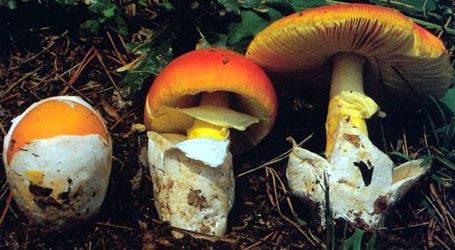
| cap | The cap of Amanita luteivolvata is 30 - 53 mm wide, convex to broadly convex, plane or slightly decurved margin in age, viscid, ivory white, glabrous, with a nonstriate and appendiculate margin [appears to noticeably extend beyond gills in original description's photograph]. The volva remnants are present as submembranous, patches of buff to yellow to orange-buff over the center. The flesh is firm and white. |
| gills | The gills are narrowly attached, subdistant, narrow to medium broad in age, white, with edge minutely fimbriate and white. The short gills are reported in one tier. |
| stem | The stem is 42 - 75 × 4 -12 mm, cylindric, stuffed, smooth, white, bearing white, fragile, superior, ragged, appressed remains of a ring just below the gills. The volva is present as very soft, thick, submembranous, buff to yellow to orange-buff ring of yellow tissue just below the rim of the marginate bulb. The bulb is subglobose, 9 -11 × 13 - 16 mm, with fine white threads of hyphae at the base. The flesh is firm. The flesh in the bulb is white and firm. The central cylinder often appears water-soaked. |
| odor/taste | The odor is "unpleasant, medicinal to stale, or like old hambones." |
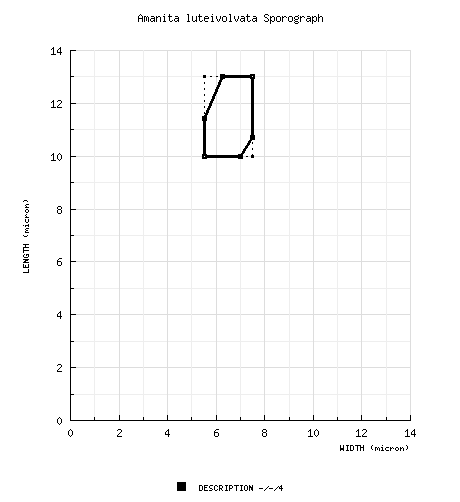
| spores | The spores measure (9-) 10 - 13 (-14) × (5-) 5.5 - 7.5 (8.6) µm and are ellipsoid to elongate to cylindric and amyloid. Clamps apparently absent at bases of basidia. |
| discussion |
Originally described from the state of Western Australia in association with Eucalyptus, Allocasuarina, and with imported Monterey pine (Pinus radiata) in one site. Miller suggests placement of this species in Amanita stirps Preissii and suggests that it is most closely related to Amanita sublutea (Cleland) E.-J. Gilbert. I think this placement is more strongly supported than Miller suggests, and since buff may be the color that results from exposure to sunlight of an originally bright-colored volva, a thorough morphological comparison of A. sublutea and A. luteivolvata would be very desirable.—R. E. Tulloss |
| brief editors | RET |
| name | Amanita luteivolvata | ||||||||||||||||||||
| author | O. K. Mill. 1992b [“1991”]. Mycologia 84: 685, figs. 9-11, 15. | ||||||||||||||||||||
| name status | nomen acceptum | ||||||||||||||||||||
| english name | "Yellow-Patched Limbed-Lepidella" | ||||||||||||||||||||
| MycoBank nos. | 360170 | ||||||||||||||||||||
| GenBank nos. |
Due to delays in data processing at GenBank, some accession numbers may lead to unreleased (pending) pages.
These pages will eventually be made live, so try again later. Search:
Showing 0 to 0 of 0 entries | ||||||||||||||||||||
| holotypes | PERTH; isotype, VPI | ||||||||||||||||||||
| intro |
The following text may make multiple use of each data field. The field may contain magenta text presenting data from a type study and/or revision of other original material cited in the protolog of the present taxon. Macroscopic descriptions in magenta are a combination of data from the protolog and additional observations made on the exiccata during revision of the cited original material. The same field may also contain black text, which is data from a revision of the present taxon (including non-type material and/or material not cited in the protolog). Paragraphs of black text will be labeled if further subdivision of this text is appropriate. Olive text indicates a specimen that has not been thoroughly examined (for example, for microscopic details) and marks other places in the text where data is missing or uncertain. The following material is derived from the protolog of the present species. from protolog: Basidiocarps: medium size. | ||||||||||||||||||||
| pileus | from protolog: 30 - 53 mm wide, ivory white, convex to broadly convex, plane or with margin slightly recurved in age, viscid, glabrous; context firm, white; margin nonstriate, with appendiculate remains of white partial veil visible when young; universal veil as buff to yellow (4A3) to orange-buff (5A4) patches over disc. | ||||||||||||||||||||
| lamellae | from protolog: nearly free to narrowly attached, subdistant, white, narrow to medium broad in age, with edge minutely fimbriate (use lens) and having narrow sterile white marginal zone; lamellulae irregular, short, in one tier. | ||||||||||||||||||||
| stipe | from protolog: 42 - 75 × 4 - 12 mm, white, cylindric, smooth; bulb 9 - 11 × 13 - 16 mm, marginate, sand-covered, with very fine white rhizomorphs at base; partial veil superior, white, membranous [per photograph—ed.], fragile, leaving irregular superior annular zone and deciduous appendiculate patches on pileus margin; context firm, white, with water-soaked dull-white central cylinder, in bulb white and solid; universal veil yellow to orange-buff, often present in zone just below rim of bulb. | ||||||||||||||||||||
| odor/taste | from protolog: Odor is unpleasant, medicinal to stale or like old ham bones. Taste not recorded. | ||||||||||||||||||||
| macrochemical tests |
none recorded. | ||||||||||||||||||||
| pileipellis | from protolog: up to 255 - 345 µm thick, an ixocutis of refractive, hyaline, thin-walled hyphae 2.5 - 5.0 µm wide. | ||||||||||||||||||||
| pileus context | from protolog: filamentous hyphae 3.4 - 23 µm wide, with segments sometimes vesiculose, thin-walled, hyaline in 3% KOH, light yellowish in Melzer’s reagent. [Acrophysalides not described.—ed.] | ||||||||||||||||||||
| lamella trama | from protolog: bilateral, divergent; filamentous hyphae 2.5 - 10.5 µm wide, with some segments slightly inflated, thin-walled, hyaline; vascular hyphae not recorded. | ||||||||||||||||||||
| subhymenium | from protolog: of "puzzle-like," short, irregular to "rectangular," thin-walled, hyaline cells. 3.4 - 11 µm wide; clamps absent. | ||||||||||||||||||||
| basidia | from protolog: 44 - 64 x 9.0 - 12.6 µm, thin-walled, hyaline, 4-sterigmate; clamp presence/absence not reported. | ||||||||||||||||||||
| universal veil | from protolog: filamentous hyphae 4.2 - 8.5 µm wide, thin-walled, hyaline, common; inflated cells 20 - 57 x (6-) 19 - 30 µm, ovoid to pyriform to clavate, common, thin-walled, terminal; clamp connections absent. | ||||||||||||||||||||
| stipe context | not described in protolog. | ||||||||||||||||||||
| partial veil | from protolog: filamentous hyphae 2.5 - 6.0 µm wide, thin-walled, hyaline, scattered; inflated cells globose to (occasionally) ovoid, dominating, 14 - 27 x 12 - 20 µm, thin-walled; clamps absent. | ||||||||||||||||||||
| lamella edge tissue | not recorded. | ||||||||||||||||||||
| basidiospores | from protolog: [-/-/4] (9.0-) 10.0 - 13.0 (-14.0) × (5.0-) 5.5 -7.5 (-8.6) μm, (Q = 1.43 - 2.08; Q' = 1.62), thin-walled, amyloid, ellipsoid to elongate to cylindric; apiculus not described; contents not described; white in deposit. | ||||||||||||||||||||
| ecology | from protolog: Usually scattered—in groups of two or three. Australia: "Under or near Eucalyptus calophylla R. Br. ex Lindley, E. marginata, E. jacksonii Maiden, E. diversicolor F. Muell., Allocasuarina fraseriana, with exotic Pinus radiata D. Don. present in one area." | ||||||||||||||||||||
| material examined |
from protolog: AUSTRALIA: WESTERN AUSTRALIA—Shire of Denmark - Giants St. Pk., 6.vi.1991 O. K. Miller 24779 (holotype, PERTH; isotype, VPI), 6.vi.1991 O. K. Miller 24781 (paratype, VPI). Shire of Gleneagle - Gleneagle Recreation Area, 15.vi.1991 O. K. Miller 24860 (paratype, VPI). City of Melville - Murdoch Campus Forest Reserve [32°4'27" S/ 115°50'14" E], | ||||||||||||||||||||
| discussion | from protolog: "... Collection OKM 24860 included a young fruiting body with a very thin, fragile, unbroken, partial veil that was stretched somewhat as the cap expanded but was just beginning to break near the pileus margin to leave a typical, often ragged annulus visible in mature specimens, as well as appendiculate remains on the margin of the pileus. The microscopically distinctive partial veil soon falls away in all likelihood because it is composed of a majority of globose cells with a very small number of filamentous hyphae. The common ectomycorrhizal hosts in widely separate habitats are E. calophylla and E. marginata. Although more hosts may be involved, it is doubtful if Pinus radiate is a potential host since it is in only one of the habitats and present as scattered trees removed at some distance from where A. luteivolvata was found. It is an amyloid spored member of the subgenus Lepidella. The submembranous appressed volval patches, ivory-white pileus, and ellipsoid spores are characters of the section Lepidella. The cylindric to nearly clavate volval cells with a large component of filamentous hyphae, the marginate bulb, and nonochraceous lamellae are characters of the subsection Limbatulae according to Bas (1969). The lack of clamp connections and spores longer than 8 µm would place the A. luteivolvata in the stirps Preissii. In stirps Preissii, A. luteivolvata would be close to A. sublutea (Cleland) E.-J. Gilbert from South Australia. The latter species has a buff, viscid pileus and no annulus (Bas, 1969) while A. luteivolvata has a viscid, ivory white pileus with a yellow to buff universal veil and a ragged annular zone. The description of fresh material was based on OKM 24779, OKM 24860, and OKM 25099." | ||||||||||||||||||||
| citations |
The editors express their thanks to Dr. Elaine Davison for her assistance with Western Australia geographical and other data relating to Miller's original materials of this taxon. —R. E. Tulloss | ||||||||||||||||||||
| editors | RET | ||||||||||||||||||||
Information to support the viewer in reading the content of "technical" tabs can be found here.
 Spore data sets and their composite
Each spore data set is intended to comprise a set of measurements from a single specimen made by a single observer; and explanations prepared for this site talk about specimen-observer pairs associated with each data set. Combining more data into a single data set is non-optimal because it obscures observer differences (which may be valuable for instructional purposes, for example) and may obscure instances in which a single collection inadvertently contains a mixture of taxa.

Text and User-Generated Sporographs are published under the Creative Commons License.

In the case of a taxon page, image credits are on the 'image' tab.