| name |
Amanita longipes |
| author |
Bas ex Tulloss & Dav. T. Jenkins. 1985. Mycotaxon 22(2): 439, fig. 1. |
| name status |
nomen acceptum |
| english name |
"Dog-Legged Lepidella" |
| synonyms |
= Amanita longipes Bas nom. prov. 1969. Persoonia 5: 459, figs. 203-205.
The editors of this site owe a great debt to Dr. Cornelis Bas
whose famous cigar box files of Amanita nomenclatural information
gathered over three or more decades were made available to RET for computerization
and make up the lion's share of the nomenclatural information presented on this site.
|
| MycoBank nos. |
105036 |
| GenBank nos. |
Due to delays in data processing at GenBank, some accession numbers may lead to unreleased (pending) pages.
These pages will eventually be made live, so try again later.
|
| holotypes |
NY; isotype in herb. D. T. Jenkins, Univ. of Alabama, Birmingham |
| revisions |
Tulloss, here. |
| intro |
The following text may make multiple use of each data field.
The field may contain magenta text presenting data from a type study
and/or revision of other original material cited in the protolog of the present taxon.
Macroscopic descriptions in magenta are a combination of data from the protolog and
additional observations made on the exiccata during revision of the cited original
material.
The same field may also contain black text, which is data from a revision of the present
taxon (including non-type material and/or material not cited in the protolog).
Paragraphs of black text will be labeled if further subdivision of
this text is appropriate.
Olive text indicates a specimen that has not been
thoroughly examined (for example, for microscopic details) and marks other places in the text
where data is missing or uncertain.
The following material is derived from (Bas 1969), the protolog of the present species, and original research by R. E. Tulloss. |
| pileus |
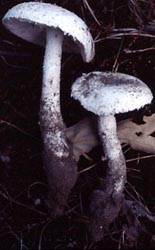
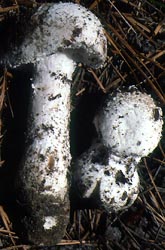
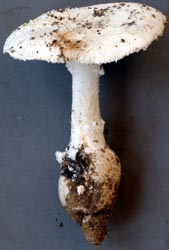
24 - 102 mm wide, hemispheric at first becoming broadly convex to plano-convex, occasionally slightly depressed in center; white, pallid grayish-brown or grayish buff over disk in age, surface dull and tacky at first and becoming shiny; pileipellis peeling; context white, one specimen slightly browning where damaged, larva tunnels not discolored, 3 - 10 mm thick at center; margin nonstriate, incurved at first, then decurved, appendiculate; universal veil dense, finely pulverulent-flocculose, sometimes largely disappearing in age, especially over disk, white or at times grayish or brownish over disk where it infrequently comprises irregular, floccose warts sometimes darkening on tips. |
| lamellae |
narrowly adnate to adnate, sometimes with a decurrent line, close, whitish, becoming grayish-cream on drying, with white, floccose remnants of partial veil on edges, narrow, 4.5 - 11 mm broad, sometimes anastomosing; lamellulae truncate to rounded truncate to attenuate to attenuate in steps, plentiful, of diverse lengths, unevenly distributed. |
| stipe |
25 - 142 × 5 - 20 mm, white, tapering upwards slightly with flaring apex, floccose especially in upper portion, material easily removed, with no bruising of flesh noted except in one specimen (7-30-82-C) in which handling seemed to leave a faintly pinkish bruise; bulb subradicate or radicate, rarely narrowly oblong or subclavate, 22 - 72 × 8.5 - 27 mm, sometimes with brick red or rusty stains or spots, frequently flattened or doglegged; context white, occasionally graying in damaged areas, no discoloration in larvae tunnels or slightly brownish, easily breaking up into fibers, solid or with firmly stuffed central cylinder, up to 7 mm wide; partial veil fibrous-floccose and rapidly evanescent; universal veil absent from bulb and stipe base or difficult to distinguish. |
| odor/taste |
Odor indistinct or, rarely, faintly odorous (as of disinfectant or cleansing powder, not unpleasant). Taste not recorded. |
macrochemical
tests |
Spot test for laccase (syringaldazine) - negative throughout basidiome. Spot test for tyrosinase (paracresol) - positive in innermost part of stipe context first (3 min.); then in pileus context along attachment of lamellae and at interface with stipe context (8 min.); finally positive throughout or positive on cut edge of pileipellis over disc, on edges of lamellae, on large area of lamella surface, and in regions slightly expanded over those previously noted. Phenol - positive (only stipe context tested). FeSO4, NH4OH, KOH, formalin - all negative. H2SO4 (conc.) - negative in bulb, pale pink in stipe context (developing slowly then fading), brown ring on pileipellis (developing quickly), rapidly orangish pink then pink then brown then pink in lamellae and pileus context; all color eventually disappearing. Test vouchers: ??. |
| pileipellis |
two layers about 130 µm thick, suprapellis an ixocutis, gelatinizing, subpellis of nongelatinizing, interwoven filamentous undifferentiated hyphae 1.4 - 4.2 µm wide; vascular hyphae plentiful, branching, up to 9.1 µm wide. |
| pileus context |
filamentous undifferentiated hyphae 3.5 - 4.2 µm wide; inflated cells abundant, terminal, broadly ellipsoid, up to 77 × 43 µm, to slender bacilliform, up to 180 × 30 µm; no clamps observed. |
| lamella trama |
bilateral; wcs = ?? µm; wct = ?? µm; filamentous undifferentiated hyphae up to 5 µm wide; inflated cells slender, up to 170 × 28 µm; vascular hyphae plentiful. |
| subhymenium |
inflated ramose to subcellular; wst-near = ?? µm; wst-far = ?? µm; with basidia arising from both inflated cells and uninflated hyphal segments. |
| basidia |
45 - 60 (-70) × 9.5 - 14 µm, 4-spored, thin-walled; clamps not observed. |
| universal veil |
On pileus: filamentous, undifferentiated hyphae 1.5 - 7.0 µm wide, relatively infrequent, infrequently branching, with yellowish subrefractive walls; inflated cells dominating, globose to subglobose (up to 78 × 71 µm) to broadly ellipsoid to ellipsoid to elongate to clavate (up to 94 × 31 µm) to subfusiform to fusiform to subpyriform, in easily dissociated chains of 4 or more, without apparent order, with walls thin or up to 0.8 µm thick, hyaline to yellowish to slightly sordid yellowish to brownish yellow in 3% KOH; vascular hyphae not observed. |
| stipe context |
longitudinally acrophysalidic; filamentous undifferentiated hyphae ?? µm wide, ??; acrophysalides narrowly clavate, up to 285 × 32 µm; vascular hyphae ?? µm wide, moderately abundant to abundant; no clamps observed. |
| basidiospores |
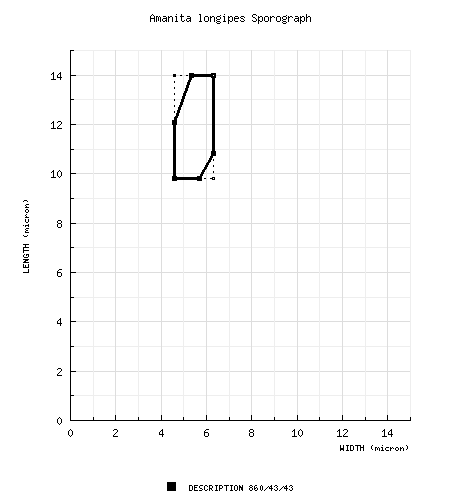
composite data from all material revised by RET: [860/43/43] (7.2-) 9.8 - 14.0 (-20.3) × (3.9-) 4.6 - 6.3 (-9.8) µm, (L = (10.2-) 10.4 - 12.7 (-13.6) µm; L’ = 11.8 µm; W = (4.5-) 4.8 - 5.9 (-6.3) µm;
W’ = 5.4 µm; Q = (1.42-) 1.72 - 2.63 (-3.33); Q = (1.82-) 1.92 - 2.48 (-2.51); Q’ = 2.19), hyaline, smooth, thin-walled, amyloid, elongate to cylindric, rarely ellipsoid, infrequently bacilliform, occasionally constricted, may be expanded at one end; apiculus sublateral, ??; contents guttulate; white in deposit.
[Add Guravich 1355] |
| ecology |
Solitary to gregarious to subcespitose. New Jersey: in rich loam in mixed deciduous forest including Q. bicolor, Q. velutina, Q. palustris, Q. prinus, Q. rubra, Carya, Fagus grandifolia, Liriodendron tulipifera, Liquidambar styraciflua, Acer, Betula spp., etc. with understory of Smilax, Vaccinum, diverse ferns, etc. New Jersey and New York: In loose, sandy soil under Quercus spp., including Q. ilicifolia Wangenh. and Q. marilandica Muenchh., and Pinus spp., predominantly P. rigida. Alabama: In mixed woods including P. taeda and Quercus spp. |
| material examined |
Bas (1969):
U.S.A.: NEW YORK—Sussex
Co. (Long Isl.) - Port Jefferson, viii.1906 C. H.
Peck s.n. (NYS).
U.S.A.:
ALABAMA—Unkn. Co. -
ca. border of Shelby & Jefferson Cos., unkn.
loc., 21.viii.84 C. Bas & D. T. Jenkins 2538
(paratype, in herb. David T. Jenkins).
MARYLAND—Baltimore City,
23.vii.1990 Paul Noell s.n. [Tulloss 7-23-90-PEN2]
(RET 147-1).
MASSACHUSETTS—Dukes Co. - Vineyard Haven,
late.vii.198? Buck McAdoo pg.60#2
(RET 080-8).
MISSISSIPPI—Jackson Co. - Gulf Island
Nat. Seashore, Ocean Springs, 13.vii.1981 N. S.
Weber s.n. [Dan Guravich 1355] (MICH n.v.).
NEW JERSEY—Burlington Co. - Brendan
Byrne St. For., 15.viii.1982
M. A. King & R. E. Tulloss 8-15-82-A (paratype,
in herb. D. T. Jenkins, Univ. Alabama Birmingham;
paratype, RET 341-1), 11.ix.1983 M. A. King &
R. E. Tulloss 9-11-83-A (paratype, RET 470-7),
15.viii.1982 NJMA members s.n. [Tulloss 8-15-82-B]
(paratype, RET 341-5), 7.ix.1986 Eugene Yetter s.n. [Tulloss
9-7-86-C] (RET 669-2), s.n. [Tulloss 9-7-86-B]
(RET 670-6), participant Mycol. Assoc. Washington
foray s.n. [RET 9-7-86-G] (RET 670-7);
Brendan Byrne St. For., Pakim Pond, 8.ix.1996 NJMA
foray participant s.n. [Tulloss 9-8-96-A]
(RET 249-3); ca. Chatsworth, Franklin Parker
Preserve, ?2009 Nina Burghardt et al. s.n.
(RET 581-7); ca. Chatsworth,
Franklin Parker Preserve, "airport gate area"
[39°48'48" N/ 74°32'52" W, 27 m], 19.viii.2011 Nina
Burghardt s.n. (RET 486-8); ca. Chatsworth, Franklin
Parker Preserve, tr. to pond, NW of "airport gate,"
28.viii.2010 Nina Burghardt, Lily & R. E.
Tulloss [Tulloss 8-28-19-A] (RET 450-9). Cape
May Co. - ca. Woodbine, Belleplain St. For.,
6.ix.1986 M. A. King & R. E. Tulloss 9-6-86-F
(RET 670-2). Hunterdon Co. - W of Clinton,
27.viii.1990 Al Northrup s.n. [Tulloss 8-27-90-AN1]
(RET 026-4). Middlesex Co. - Jamesburg Twp.,
Jamesburg Twp. Pk., ca. Helmetta [40°23’07” N/
74°25’48” W], 12.viii.1981 R.
E. Tulloss 8-12-81-F (paratype, RET 173-7), -G
(paratype, RET 173-5), 30.vii.1982 R. E. Tulloss
7-30-82-C (paratype, RET 218-1), 18.viii.1983 R. E.
Tulloss 8-18-83-E (paratype, RET 105-3), -G
(paratype, RET 105-4), -H (paratype,
RET 105-2), 21.viii.1993 R. E. Tulloss
8-21-93-E (RET 096-8), 3.ix.1983 R. E. & D. C.
Tulloss 9-3-83-F (paratype, RET 470-3), 2.viii.1983
R. E. & M. H. Tulloss 8-2-83-E (paratype, RET
105-5), -F (paratype, RET 226-10), 18.ix.1982 R.
E. & M. H. & D. C. Tulloss 9-18-82-E
(paratype, RET 226-1), 25.vii.1985 R. E.
& M. H. & D. C. Tulloss 7-25-85-E
(RET 202-5), 7.viii.1983 M. A.
King & R. E. & D. C. Tulloss 8-7-83-A
(paratype, RET 226-9), -B (paratype, SIU),
1.viii.1982 A. Norarevian & D. Patterson s.n.
[Tulloss 8-1-82-AN1] (paratype, RET 217-8), s.n.
[Tulloss 8-1-82-AN2] (paratype, RET 217-1).
Monmouth Co. - Upper
Freehold, ca. Imlaystown, Clayton Co. Pk., Bridges
Tr. [40°09’26” N/ 74°30’10” W, 75 m], 19.viii.2012
M. A. & R. E. Tulloss 8-19-12-A (RET 508-3);
Holmdel, Holmdel Park, 24.viii.1986 A. Norarevian
& E. R. Yetter s.n. [Tulloss 8-24-86-A]
(RET 465-4); Millstone Twp., Assunpink
Wildlife Mgmt. Area, former Suszko prop., 1.ix.2001
R. E. Tulloss & Cuzzolino family [Tulloss
9-1-01-A] (RET 360-1); Roosevelt, hill area of SE
part of Block 7, Lot 10.1, 22.ix.1999 R. E. Tulloss
9-22-99-R (RET 303-1); Upper Freehold Twp.,
Assunpink Wildlife Mgmt. Area, 16.ix.1998 R. E.
Tulloss 9-16-98-A (RET 287-3). Ocean Co. -
Lakehurst, 11.ix.1982 R. E.
Tulloss 9-11-82-S (paratype, RET 340-4);
Waretown, Hogenbirk prop., 1.ix.1993 C. Hogenbirk
s.n. (RET 103-1), 22-24.ix.1993 C. Hogenbirk s.n.
(RET 106-5); N of Whiting, along Rte 539,
20.vii.1986 E. R. Yetter s.n. [Tulloss 7-20-86-EY2]
(RET 223-5).
NEW YORK—Suffolk
Co. (Long Isl.) - Flanders, 12.viii.1982 A.
Norarevian s.n. [Tulloss 8-12-82-AN1] (paratype,
RET 341-3), s.n. [Tulloss 8-12-82-AN2] (paratype,
in herb. David T. Jenkins), s.n. [Tulloss
8-12-82-AN3] (holotype, NY; isotype, in herb. David
T. Jenkins), s.n. [Tulloss 8-12-82-AN4] (paratype,
RET 341-4), s.n. [Tulloss 8-12-82-AN6 (paratype,
RET 341-7); Riverhead, 12.viii.1982 A. Norarevian
s.n. [Tulloss 8-12-82-AN5] (paratype,
RET 341-2).
SOUTH CAROLINA—Oconee Co. - Seneca
[34°46'09" N/ 82°57'55" W, 263 m], 14.vii.1987
Mary A. King s.n. [Tulloss 7-14-87-MAK1]
(RET 001-7).
WEST VIRGINIA—Unkn. Co. - unkn. loc.,
31?.vii.1985 NAMA85 participant s.n. [Tulloss
7-31-85-A] (RET 204-6) [This collection
appeared on a table at the NAMA 1985 foray on the
first day (could have been
extraregional).].
[Additional material at SFSU
from NC.] |
| discussion |
... more ...
Since the validation of the present name (Tulloss and Jenkins ), it has been found that the spores Bas originally measured from an old specimen of Peck's were aberrant in comparison with a large sample of spores from recently collected material. To reduce confusion in the sporograph of the present species, we have decided to list Bas' original spore measurements here in the discussion:
Bas (1969): [20/1/1] 10.5 - 13.5 (-14.0) × 5.5 - 7.5 (-8.0) μ,m, (Q = 1.6 - 2.0; Q = 1.80), colorless to yellowish, hyaline, thin-walled, amyloid, elongate, rarely subcylindric, often slightly constricted at mid-length; apiculus not described; contents somewhat refractive; color in deposit not recorded. |
| citations |
—R. E. Tulloss |
| editors |
RET |
|


 Spore data sets and their composite