

| name | Amanita kalamundae |
| name status | nomen acceptum |
| author | O. K. Mill. |
| english name | "Kalamunda Amanita" |
| images | |
| intro |
The following is based on Miller (1992). |
| cap |
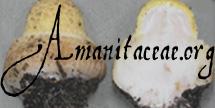
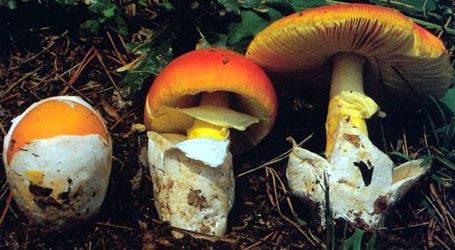
The cap of Amanita kalamundi is (18-) 31 - 57 mm wide, broadly convex to nearly planar in age, dry, brown, with a nonstriate margin. The volval remnants are present as scattered, irregular, filmy patches of orange volval material reduced to orange fibrils at the cap margin. The flesh is firm and white. |
| gills |
The gills are adnate, close to subdistant, white at first, cream in age. Short gills are said to be in a single tier. |
| stem |
The stem is 65 - 90 × 6 - 9 mm, cylindric, nearly lacking in decoration, and buff with orange over the basal bulb or entirely orange below the ring and then with the orange surface minutely granular. The ring is superior, weakly membranous, skirt-like, orange, sometimes disappearing at maturity, sometimes leaving minute fibrils along the cap margin. The flesh is white (except in the bulb where it may be yellow-tinted) or yellow throughout. |
| odor/taste |
The odor is not distinctive. |
| spores |
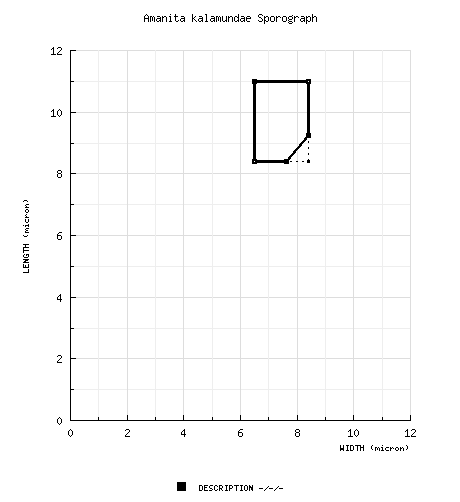
The spores measure 8.4 - 11 (-12) × (5-) 6.5 - 8.4 µm and are broadly ellipsoid to ellipsoid to elongate and amyloid. Clamps are absent at bases of basidia. |
| discussion |
Originally described from the state of Western Australia in association with Eucalyptus and Agonis. I agree with Miller that this species' placement in section Validae is tentative. His description seems to imply that the margin of the cap is lightly appendiculate. This and the weakness of the annulus would be unusual characters for a species of section Validae. However, given our current understanding of Amanita, there is no other obvious placement for it.—R. E. Tulloss |
| brief editors | RET |
| name | Amanita kalamundae | ||||||||||||||||||||
| author | ("kalamundi") O. K. Mill. 1992a ["1991"]. Canad. J. Bot. 69: 2697, figs. 24-26. | ||||||||||||||||||||
| name status | nomen acceptum | ||||||||||||||||||||
| english name | "Kalamunda Amanita" | ||||||||||||||||||||
| MycoBank nos. | 560219 | ||||||||||||||||||||
| GenBank nos. |
Due to delays in data processing at GenBank, some accession numbers may lead to unreleased (pending) pages.
These pages will eventually be made live, so try again later. Search:
Showing 0 to 0 of 0 entries | ||||||||||||||||||||
| holotypes | PERTH; isotype, VPI | ||||||||||||||||||||
| intro |
The following text may make multiple use of each data field. The field may contain magenta text presenting data from a type study and/or revision of other original material cited in the protolog of the present taxon. Macroscopic descriptions in magenta are a combination of data from the protolog and additional observations made on the exiccata during revision of the cited original material. The same field may also contain black text, which is data from a revision of the present taxon (including non-type material and/or material not cited in the protolog). Paragraphs of black text will be labeled if further subdivision of this text is appropriate. Olive text indicates a specimen that has not been thoroughly examined (for example, for microscopic details) and marks other places in the text where data is missing or uncertain. The following material is drawn entirely from the protolog of the present species. from protolog: Basidiomes medium-sized. | ||||||||||||||||||||
| pileus | from protolog: (18-) 31 - 57 mm wide, tannish brown (5D4-5), broadly convex to nearly plane in age, dry; context firm, white; margin nonstriate, often with scattered orange fibrils; universal veil as scattered, irregular, filmy, flat patches especially over disc, orange (5A3). | ||||||||||||||||||||
| lamellae | from protolog: adnate, close to subdistant, white to cream in age; lamellulae of uniform length, "unchanged in age." [Note: We are not sure how to understand "unchanged in age" (apparently applied to the lamellulae) when the lamellae as a whole are said to become cream in age.—ed.] | ||||||||||||||||||||
| stipe | from protolog: . | ||||||||||||||||||||
| odor/taste | from protolog: Odor not distinctive. Taste not recorded. | ||||||||||||||||||||
| macrochemical tests |
none described. | ||||||||||||||||||||
| pileipellis | from protolog: up to 200 - 250 µm thick; mixocutis; filamentous hyphae 3 - 6 µm wide, hyaline, frequently branched. [Note: It is unusual for there to be no pigment seen in the pileipellis of a species with a pileus that is distinctly pigmented to the naked eye. Absence of mention of layering is also unusual. A revision of the original material is desirable.—ed.] | ||||||||||||||||||||
| pileus context | from protolog: filamentous hyphae (3.5 -) 7 - 16 (-30) µm wide, interwoven, "sometimes swollen." [Note: Apparently failed to notice the acrophysalides that are instrumental in causing the pileus to expand.—ed.] | ||||||||||||||||||||
| lamella trama | from protolog: "weakly divergent"; filamentous hyphae 4.2 - 8.5 (-11) µm wide. | ||||||||||||||||||||
| subhymenium | from protolog: inflated cells oval to irregular, several layers deep. [Note: Probably cellular.—ed.] | ||||||||||||||||||||
| basidia | from protolog: 41 - 55 × 9.5 - 13.5 µm, 4-sterigmate; clamps not observed. | ||||||||||||||||||||
| universal veil | from protolog: elements hyaline; filamentous hyphae 3 - 4.5 µm wide; inflated cells ovoid to "swollen," 18 - 45 × 14 - 22 µm. [Note: When a universal veil is strongly pigmented, at least some inflated cells are usually found to have distinct, often intracellular, pigmentation.—ed.] | ||||||||||||||||||||
| stipe context | not described. | ||||||||||||||||||||
| partial veil | not described. | ||||||||||||||||||||
| lamella edge tissue | from protolog: not observed. [Note: This tissue misdescribed by Miller as "cheilocystidia."—ed.] | ||||||||||||||||||||
| basidiospores | from protolog: [-/-/-] 8.4 - 11.0 (-12.0) × (5.0-) 6.5 - 8.4 μm, (Q = 1.10 - 1.79; Q' = 1.45), thin-walled, "darkly" amyloid, subglobose to broadly ellipsoid to ellipsoid to elongate; apiculus "small"; contents not recorded; color in deposit not recorded. | ||||||||||||||||||||
| ecology | from protolog: Gregarious. In deep litter under Eucalyptus patens Benth. and Agonis eriofolia. | ||||||||||||||||||||
| material examined |
from protolog: AUSTRALIA: WESTERN AUSTRALIA—Shire of Kalamunda - unkn. loc., | ||||||||||||||||||||
| citations |
The editors express their thanks to Dr. Elaine Davison for her assistance with Western Australia geographical and other data relating to Miller's original materials of this taxon. —R. E. Tulloss | ||||||||||||||||||||
| editors | RET | ||||||||||||||||||||
Information to support the viewer in reading the content of "technical" tabs can be found here.
| name | Amanita kalamundae |
| bottom links |
[ Section Validae page. ]
[ Amanita Studies home. ]
[ Keys & Checklists ] |
| name | Amanita kalamundae |
| bottom links |
[ Section Validae page. ]
[ Amanita Studies home. ]
[ Keys & Checklists ] |
 Spore data sets and their composite
Each spore data set is intended to comprise a set of measurements from a single specimen made by a single observer; and explanations prepared for this site talk about specimen-observer pairs associated with each data set. Combining more data into a single data set is non-optimal because it obscures observer differences (which may be valuable for instructional purposes, for example) and may obscure instances in which a single collection inadvertently contains a mixture of taxa.

Text and User-Generated Sporographs are published under the Creative Commons License.

In the case of a taxon page, image credits are on the 'image' tab.