
| name | Amanita inodora |
| name status | nomen acceptum |
| author | (Murrill) Bas |
| english name | "Odorless Limbed-Lepidella" |
| synonyms | |
| intro |
This description is based largely on that of Bas (1969). |
| cap |
The cap of Amanita inodora is about 30 - 60 mm wide, convex to plano-convex, white, dry, appendiculate, with a nonsulcate margin. The cap is covered with very thin, inconspicuous, adnate, submembranous-felted to subpulverulent, small to rather large patches, or a more or less continuous, thin crust. |
| gills |
The gills are crowded, narrowly adnate, adnexed or free, and white. The short gills are obliquely truncate. |
| stem |
The stem is short, about 35 - 55 × 10 - 16 mm, solid, white, exannulate, and without distinct remnants of volva (in the material seen by Bas). The stipe has a pronounced marginate bulb that is obovoid to napiform (about 20 - 30 × 15 - 25 mm). There is also a fluffy annular zone near the apex or near the middle, but no membranous annulus. |
| odor/taste |
The fruiting body is odorless. |
| spores |
The spores measure (11-) 11.5 - 13.5 (-15.5) × 3.5 - 4.5 (-5) µm and are amyloid. Clamps are not found at bases of basidia. |
| discussion |
Amanita inodora was originally described from Florida, U.S.A. in association with oak and in mixed woods. Coker collected the species in South Carolina. Bas placed this species in his stirps Roanokensis (see A. roanokensis Coker. |
| brief editors | RET |
| name | Amanita inodora | ||||||||||||||||||||
| author | (Murrill) Bas. 1969. Persoonia 5: 547, figs. 355-360. | ||||||||||||||||||||
| name status | nomen acceptum | ||||||||||||||||||||
| english name | "Odorless Limbed-Lepidella" | ||||||||||||||||||||
| synonyms |
≡Venenarius roanokensis f. inodorus Murrill. 1946. Lloydia 9(4): 324.
≡Amanita roanokensis f. inodora (Murrill) Murrill. 1946. Lloydia 9(4): 330. The editors of this site owe a great debt to Dr. Cornelis Bas whose famous cigar box files of Amanita nomenclatural information gathered over three or more decades were made available to RET for computerization and make up the lion's share of the nomenclatural information presented on this site. | ||||||||||||||||||||
| MycoBank nos. | 308560, 351861, 345955 | ||||||||||||||||||||
| GenBank nos. |
Due to delays in data processing at GenBank, some accession numbers may lead to unreleased (pending) pages.
These pages will eventually be made live, so try again later. Search:
Showing 0 to 0 of 0 entries | ||||||||||||||||||||
| holotypes | FLAS | ||||||||||||||||||||
| type studies | Jenkins. 1979. Mycotaxon 10: 189. | ||||||||||||||||||||
| intro |
The following text may make multiple use of each data field. The field may contain magenta text presenting data from a type study and/or revision of other original material cited in the protolog of the present taxon. Macroscopic descriptions in magenta are a combination of data from the protolog and additional observations made on the exiccata during revision of the cited original material. The same field may also contain black text, which is data from a revision of the present taxon (including non-type material and/or material not cited in the protolog). Paragraphs of black text will be labeled if further subdivision of this text is appropriate. Olive text indicates a specimen that has not been thoroughly examined (for example, for microscopic details) and marks other places in the text where data is missing or uncertain. The following text is derived from the revision of Bas (1969) and other sources as cited in the text. Bas (1969): Basidiomes small to medium, rather thickset. | ||||||||||||||||||||
| pileus | Bas (1969): 30± - 60± mm wide, white, convex to planoconvex, dry; context white, firm; margin appendiculate, non-striate; universal veil as a more or less continuous crust or as small to rather large patches up to 8 mm wide, very thin, inconspicuous, adnate, submembranous-felted to subpulverulent. | ||||||||||||||||||||
| lamellae | Bas (1969): narrowly adnate to adnexed to free, crowded, white, up to 9 mm broad; lamellulae obliquely truncate. | ||||||||||||||||||||
| stipe | Bas (1969): 35± - 55± × 10± - 16± mm, white, granular above, flocculose below; bulb 20± - 30± × 15± - 15± mm, conspicuous, obovoid to napiform, marginate; context solid, white, firm; partial veil lacking or as fluffy, apical to median, annular zone (apical to median); universal veil lacking or indistinct. | ||||||||||||||||||||
| odor/taste | Bas (1969): Odorless. Taste faint. | ||||||||||||||||||||
| pileipellis | Bas (1969): two-layered; suprapellis gelatinized; filamentous hyphae 1.5 - 5 μm wide, interwoven. | ||||||||||||||||||||
| pileus context | not described. | ||||||||||||||||||||
| lamella trama | Bas (1969): bilateral. | ||||||||||||||||||||
| subhymenium | Bas (1969): ramose to inflated ramose. | ||||||||||||||||||||
| basidia | Bas (1969): 40 - 50 × 8 - 11 μm, 4-sterigmate; clamps not observed. | ||||||||||||||||||||
| universal veil | Bas (1969): On pileus exterior layer: submembranous with very abundant hyphae. On pileus interior: filamentous hyphae rather abundant to abundant, 2 - 10 μm wide; inflated cells globose to pyriform to broadly clavate to clavate to fusiform, up to 100 × 70 μm and 180 × 45 μm, terminal or in chains of 2. On stipe base: absent. | ||||||||||||||||||||
| stipe context | Bas (1969): longitudinally acrophysalidic; vascular hyphae abundant. | ||||||||||||||||||||
| partial veil | not described. | ||||||||||||||||||||
| lamella edge tissue |
Bas (1969): filamentous hyphae entangled; inflated cells sphaeropedunculate to elongate up to 50 × 35 μm and 80 × 15 μm. [Note: Sterile—ed.] | ||||||||||||||||||||
| basidiospores |
Bas (1969): [40/3/2] (11.0-) 11.5 - 13.5 (-15.5) × 3.5 - 4.5 (-5.0) μm, (Q= 2.70 - 3.80; Q = 2.90 - 3.10), smooth, thin-walled, amyloid; apiculus not described; contents granular, refractive; "pure white" in deposit. from type study of Jenkins (1979): [-/-/1] 12.5 - 13.3 (-14.1) × 3.9 - 4.7 μm, (Q = 2.66 - 3.41; Q' = 2.94), hyaline, thin-walled, amyloid, cylindric to bacilliform, often adaxially flattened; apiculus sublateral, short, truncate-conic; contents guttulate; color in deposit not recorded. | ||||||||||||||||||||
| ecology | Bas (1969): Subgregarious. Terrestrial. Under Quercus or in mixed forest. | ||||||||||||||||||||
| material examined |
Bas (1969): U.S.A.:
FLORIDA—Alachua Co. - Gainesville, 29.viii.1944 W. A. Murrill F 20091 (holotype, FLAS).
NORTH CAROLINA—Horry Co. - Myrtle Beach, 22.vii.1946 W. C. Coker 13718 (NCU). from type study of Jenkins (1979): U. S. A.: FLORIDA— Alachua Co. - Gainesville, | ||||||||||||||||||||
| discussion |
Bas (1969): "Because of the shape of the bulb and the nature of the volva the types of A. roanokensis and its forma inodora are so much different in appearance that it is difficult to believe they represent forms of a single species. "When it turned out that the patches of the volva on the cap have a distinct, membranous outer layer in roanokensis and not in that of forma inodora, it even seemed as though they were not closely related. However, in the specimens of Coker 13718, a collection which is described by Coker as odorless and which at first sight strongly resembles the type of A. inodora, the thin patches on the cap appeared to have a thin, submembranous, outer layer, just as in A. roanokensis. Therefore, in the type of A. inodora the outer, membranous layer of the patches of the volva has disappeared. In fact, there are some patches on the the cap of the type specimen of A. roanokensis to which the same has happened. "Nevertheless, the rather small size, the distinctly marginate bulb, the relatively incoherent remnants of the volva on the cap, the larger inflated cells in these remnants, the lack of any trace of a volval limb on the margin of the bulb, and the somewhat smaller spores led me to decide to raise Murrill's 'forma inodora' to specific rank. "Since Murrill described the true A. roanokensis as a new species (A. watsoniana) and placed his A. roanokensis together with the forma inodora in a group of species with friable volva (Murrill, 1948: 100) it would seem that A. roanokensis sensu Murrill is probably a form of A. inodora with a smell!" | ||||||||||||||||||||
| citations | —R. E. Tulloss | ||||||||||||||||||||
| editors | RET | ||||||||||||||||||||
Information to support the viewer in reading the content of "technical" tabs can be found here.
| name | Amanita inodora |
| bottom links |
[ Section Lepidella page. ]
[ Amanita Studies home. ]
[ Keys & Checklists ] |
| name | Amanita inodora |
| bottom links |
[ Section Lepidella page. ]
[ Amanita Studies home. ]
[ Keys & Checklists ] |
 Spore data sets and their composite
Each spore data set is intended to comprise a set of measurements from a single specimen made by a single observer; and explanations prepared for this site talk about specimen-observer pairs associated with each data set. Combining more data into a single data set is non-optimal because it obscures observer differences (which may be valuable for instructional purposes, for example) and may obscure instances in which a single collection inadvertently contains a mixture of taxa.
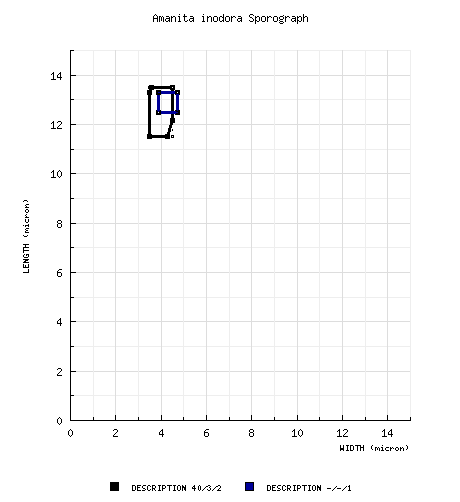

Text and User-Generated Sporographs are published under the Creative Commons License.

In the case of a taxon page, image credits are on the 'image' tab.