

| name | Amanita infusca |
| name status | nomen acceptum |
| author | E.-J. Gilbert ex Singer |
| english name | "Dark Slender Caesar" |
| intro | The following description is based on the original description of Amanita infusca (≡A. umbrina Beeli), (Beeli 1935), and (Gilbert 1940 & 1941). |
| cap | The cap of Amanita infusca is 70 - 120 mm wide, subcylindric at first, expanded-convex, fleshy, glabrous, with a long striate margin. The center of the cap is slightly depressed. The cap is blackish brown with a coal-black center. The volva is absent. |
| gills | The gills are free, pale, very pale pinkish-white, 10 mm broad, and pointed at the end near the stem. |
| stem | Its stem is 170 - 200 × 8 - 11 mm, streaked with dark colored fibrils, eventually hollow, and tapering upward. The ring is placed above the middle of the stem and is skirt-like, membranous, and umber-brown. The volva is membranous, thick, whitish, and saccate. The stem's flesh is white. |
| odor/taste | The odor and taste of A. infusca are acrid. |
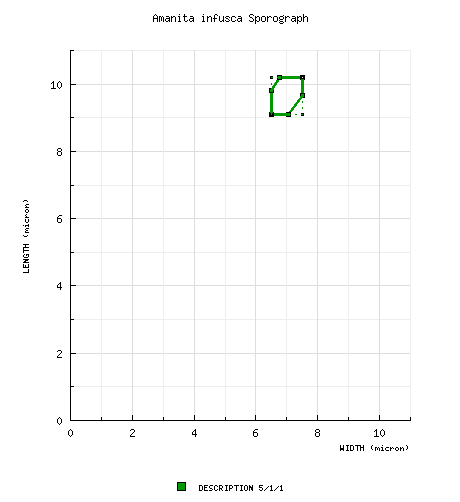
| spores | The spores of A. umbrina measure 9.1- 10.2 × 6.5 - 7.5 µm and are ellipsoid and inamyloid. The bases of basidia probably bear clamps. |
| discussion |
The present species was originally described from the
Republic of Congo in association with
Gilbertiodendron. Madame Goossens depicts the fibrils of the stem as significantly browner than the very dark cap and ring. In her painting, the volval sac is quick thick at the base and the thinner upper part is broadly opened and collapsing like a deflating basketball. She also shows that the underside of the annulus, at least at first, is pallid with flecks that are concolorous with the colored fibrils on the stem—more reddish brown than fuliginous or dark brown. Amanita infusca sensu Pegler and Shah-Sm. (1997) is a somewhat similar mushroom from Zambia, but, given the state of knowledge of A. infusca, the Zambian material may be an undescribed species. The cap, rather than being coal black in the center, is sometimes yellowish-brown; the stem is often shorter than the cap's diameter; the annulus is described as pale to reddish-brown; the saccate volva has a reddish-brown margin; the odor is very faint; and the spores are larger, so far as can be told, although similarly shaped.—R. E. Tulloss |
| brief editors | RET |
| name | Amanita infusca | ||||||||||||||||||||
| author | E.-J. Gilbert ex Singer. 1951 ["1949"]. Lilloa 22: 385, t. 10. | ||||||||||||||||||||
| name status | nomen acceptum | ||||||||||||||||||||
| english name | "Dark Slender Caesar" | ||||||||||||||||||||
| synonyms |
≡Amanita infusca E.-J. Gilbert nom. prov.
1941.
Amanitaceae. Iconogr. Mycol. (Milan) 27,
suppl. (2): 231, t. 10.
≡Amanita umbrina Beeli. 1931. Bull.
Soc. Roy. Bot. Belgique 63: 104, pl. 7
(fig. 4). non Amanita umbrina
Pers. 1797.
Tentam. Disp. Meth. Fung.: 67. Amanita umbrina Secr. nom. inval.
1833.
Mycogr. Suisse 1: 18, no. 17. [Name of
designated rank from suppressed work.
ICBN §34.1, App. VI] The editors of this site owe a great debt to Dr. Cornelis Bas whose famous cigar box files of Amanita nomenclatural information gathered over three or more decades were made available to RET for computerization and make up the lion's share of the nomenclatural information presented on this site. | ||||||||||||||||||||
| MycoBank nos. | 517863, 517864 | ||||||||||||||||||||
| GenBank nos. |
Due to delays in data processing at GenBank, some accession numbers may lead to unreleased (pending) pages.
These pages will eventually be made live, so try again later. Search:
Showing 0 to 0 of 0 entries | ||||||||||||||||||||
| holotypes | BR (implicit) | ||||||||||||||||||||
| revisions | Beeli. 1935. Fl. iconogr. champ. Congo 1: 15, pl. 1 (fig. 7). | ||||||||||||||||||||
| intro |
The following text may make multiple use of each data field. The field may contain magenta text presenting data from a type study and/or revision of other original material cited in the protolog of the present taxon. Macroscopic descriptions in magenta are a combination of data from the protolog and additional observations made on the exiccata during revision of the cited original material. The same field may also contain black text, which is data from a revision of the present taxon (including non-type material and/or material not cited in the protolog). Paragraphs of black text will be labeled if further subdivision of this text is appropriate. Olive text indicates a specimen that has not been thoroughly examined (for example, for microscopic details) and marks other places in the text where data is missing or uncertain. The following information is derived from the protolog of the present species and from (Gilbert 1940 & 1941). RET interpreted associated illustrations to increase the detail of the descriptions. | ||||||||||||||||||||
| pileus | protolog: 70 - 120 mm wide, fuligineous, fuiligineous-black over disc, a little less dark toward margin, initally ovoid then campanulate, eventually plano-convex and centrally depressed. not umbonate, glabrous; context white, firm, unchanging [per figure], thickest above stipe, thinning evenly toward margin for two-thirds to three-quarters of radius, then membranous to margin [per figure]; margin long striate (0.35-0.55R), nonappendiculate; universal veil absent. | ||||||||||||||||||||
| lamellae |
protolog: free, density not
recorded, white to pale pinkish, 10±
mm broad, broadest at ca two-thirds length from
stipe [per figure], attenuate toward stem, rounded
at margin
[per figure]; lamellulae excavate truncate
[per figure]. [Note: Without comment, Beeli (1935) replaced "whitish" ("lamellis...albidis") in the protolog with "light pink" ("Lamelles...légèrment rosées"). This change is in agreement with the 1935 reproduction of the Goossens watercolor of this species in which the lamellae are distinctly pink in the cross-section of a mature specimen. Gilbert (1941) followed Beeli's 1935 description. It should be noted that Goossens represented the lamellae of an immature specimen as white.—ed.] | ||||||||||||||||||||
| stipe | protolog: 170 - 120 × 8 - 11 mm, with pallid ground color underlying moderately dense layer of dark red-brown fibers (redder than pileus in Goossens' watercolor), narrowing upward; context white, firm, becoming hollow; partial veil superior, membranous, persistent, fuliginous, infundibuliform at first, then pendent. spotted below; universal veil saccate, membranous, thick, white on exterior, attached to sides of stipe well above stipe base in Goossens' watercolor, with long free limb. | ||||||||||||||||||||
| odor/taste | protolog: acrid. | ||||||||||||||||||||
| macrochemical tests |
none recorded. | ||||||||||||||||||||
| basidiospores |
protolog: [-/-/-] 9 - 10 × 6
μm, (approx. Q = 1.50 - 1.67), hyaline, smooth,
inamyloid, ellipsoid; color in deposit
unknown. [Note: A sporograph cannot be
generated from this data.—ed.] Gilbert (1940): [5/1/1] 9.1- 10.2 × 6.5 - 7.5 μm, (L = 9.6 μm; W = 6.9 μm; Q = 1.29 - 1.51; Q = 1.40), hyaline, smooth, inamyloid, ellipsoid; apiculus sublateral; contents not descibed; color in deposit unknown. [Note: Spore measurements are taken from the five drawings of (Gilbert 1940: tab. VII (fig. 6)) that are in apparent lateral view.—ed.] | ||||||||||||||||||||
| ecology | protolog: Rare. In tropical forest with Gilbertiodendron dewevrei. | ||||||||||||||||||||
| material examined |
from protolog: CONGO,
DEMOCRATIC REPUBLIC OF:
EQUATEUR—Territoire Lisala -
Binga [2°23'41" N/ 20°25'25" E, 361 m],
from Beeli (1935): CONGO, DEMOCRATIC REPUBLIC OF: EQUATEUR—Territoire Lisala - Binga [2°23'41" N/ 20°25'25" E, 361 m], from Gilbert (1940 & 1941): CONGO, DEMOCRATIC REPUBLIC OF: EQUATEUR—Territoire Lisala - Binga [2°23'41" N/ 20°25'25" E, 361 m], | ||||||||||||||||||||
| discussion |
This species is known only from the type collection
and the watercolor of the fresh material of that
collection by its collector. See also Amanita infusca sensu Pegler and Shah-Sm. | ||||||||||||||||||||
| citations | —R. E. Tulloss | ||||||||||||||||||||
| editors | RET | ||||||||||||||||||||
Information to support the viewer in reading the content of "technical" tabs can be found here.
 Spore data sets and their composite
Each spore data set is intended to comprise a set of measurements from a single specimen made by a single observer; and explanations prepared for this site talk about specimen-observer pairs associated with each data set. Combining more data into a single data set is non-optimal because it obscures observer differences (which may be valuable for instructional purposes, for example) and may obscure instances in which a single collection inadvertently contains a mixture of taxa.

Text and User-Generated Sporographs are published under the Creative Commons License.

In the case of a taxon page, image credits are on the 'image' tab.