

| name | Amanita imazekii |
| name status | nomen acceptum |
| author | T. Oda, C. Tanaka & Tsuda |
| english name | "Imazeki ?Slender Caesar" |
| images |
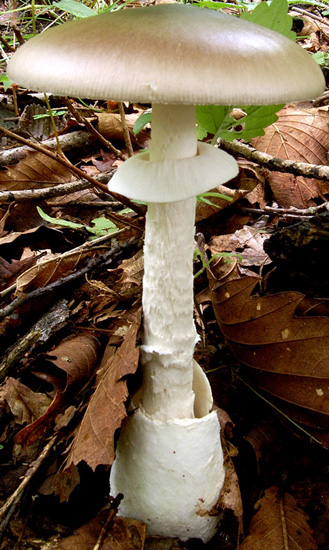 1. Amanita imazekii, Tomakomai, Sapporo, Hokkaido Pref. [Hokkaido Isl.], Japan 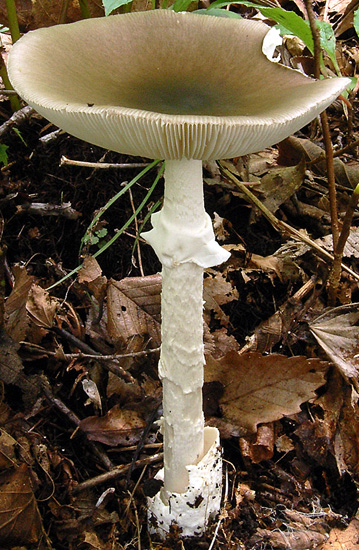 2. Amanita imazekii, Tomakomai, Sapporo, Hokkaido Pref. [Hokkaido Isl.], Japan |
| intro | The following description is based on the original description by Oda, Tanaka, and Tsuda (2001). |
| cap | The cap of A. imazekii is 65 - 140 mm wide, brown to grayish brown at the center, often paler towards the margin, at first hemispherical, then convex to planar, with the margin uplifted in age and a short-striate margin (about 10 - 25% of the radius). The flesh is white and 6 - 12 mm thick over the stem. |
| gills | The gills are free to remote, attenuate, 6 - 10 mm broad, white to pale creamy, crowded, with a pruinose to slightly floccose edge. The short gills are moderately frequent and truncate to subtruncate. |
| stem | The stem is 140 - 255 × 8 - 34 mm, narrowing upwards (dramatically so in illustration), white to pale cream, frosted or slightly powdery, sometimes slightly fibrillose or slightly scaly, and stuffed becoming hollow. The ring is attached in the upper part or near the middle of the stem, white, membranous, persistent, striate on the upper surface (according to the illustration). The saccate volva is white to pale creamy on the exterior, attached to the stem at the lower one-third to two-thirds; the free limb is thick in the upper part. The volval sac is 25 - 45 mm wide and encompasses one-third to one-half of the stem. |
| spores | The spores measure (8.0-) 8.8 - 10.8 (-12.0) × (7.6-) 8.4 - 10.4 (-10.8) µm and are globose to subglobose and inamyloid. Clamps are present at bases of basidia. |
| discussion |
This species is originally described from and is only know from central and eastern parts of the Japanese archipelago where it occurs with a large number of potential symbionts including firs (Abies), pines (Pinus), oaks (Quercus), and larches (Larix). It occurs alone or in small groups. According to the illustration, mature basidia arise from inflated cells in one or two layers. However, the text of the original description emphasizes the uninflated or partially uninflated and frequently branching nature of the subhymenium. Hence placement of this species in a stirps is not completely clear although both stirps Hemibapha and stirps Calyptroderma are possible. A revision of the type should clarify the matter. This species holds a rather isolated position in this site's world key to section Caesareae.—R. E. Tulloss and L. Possiel |
| brief editors | RET |

 Spore data sets and their composite