
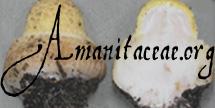
| name | Amanita hondurensis |
| name status | nomen provisorum |
| author | Tulloss & G. M. Muell. |
| english name | "Honduran Pink Lepidella" |
| intro | The following is based on original research of R. E. Tulloss and C. L. Obvrebo. |
| cap | The cap of A. hondurensis is 98 - 100 mm wide, pinkish buff, and convex. The cap's margin is nonstriate and appendiculate. The white or pinkish buff volva on the cap appears in patches that are intimately bound to the cap flesh without an intervening cap skin. |
| gills | The cream colored, relatively thick gills are free to narrowly attached and fairly far apart. They are up to 15 mm broad with a ragged edge. Short gills were not described. |
| stem | The off-white stem is 120 - 160 x 15 - 20 mm, smooth on top, and rough and scab-covered on the bottom. The stem decoration is light orange-brown. The elongated bulb is 40 - 50 mm wide. There is a very thick, membranous, white ring on the upper part of the stem. The volval remnants are present on the stem as lines of light orange flat scales. |
| odor/taste | The odor is of “chlorine”, and the taste was not recorded. |
| spores | The spores of A. hondurensis measure (7.8-) 8.2 - 10.0 (-10.5) × (5.5-) 6.0 - 7.0 (-8.0) µm, and are broadly ellipsoid to ellipsoid to (occasionally) elongate. Basidia lack clamp connections at their bases. |
| discussion |
A single pair of this species was found in Honduras under Oak (Quercus). The structure of the volval remnants place the species in Amanita subsection Vittadiniae Bas. The absence of clamps at the bases of basidia and the length of the spores suggest stirps Thiersii, but these species have globose to subglobose spores with thick walls; also the volval remnants are cottony in these taxa. On the other hand, the only other species in the subsection that lacks clamps and was treated by Bas is A. hesleri Bas, which was the sole taxon placed by him in stirps Hesleri. The latter has a dark colored volva and has some microscopic similarities to the present species. It is curious that the present taxon, A. hesleri, and A. zangii are three of the few taxa in subsection Vittadiniae that may be mycorrhizal. The first and last were collected in association with Oak (Quercus); and A. hesleri is known from mixed deciduous forest, often including Oak, in the southeastern U.S.A. Moreover Wolfe et al. (2012) demonstrated that A. hesleri has lost some of the genes necessary to digest cellulose—apparently an important food source for the free-living taxa of subsection Vittadiniae.—R. E. Tulloss and N. Goldman |
| brief editors | RET |
| name | Amanita hondurensis | ||||||||||||||||||||
| author | Tulloss & G. M. Muell. nom. prov. | ||||||||||||||||||||
| name status | nomen provisorum | ||||||||||||||||||||
| english name | "Honduran Pink Lepidella" | ||||||||||||||||||||
| GenBank nos. |
Due to delays in data processing at GenBank, some accession numbers may lead to unreleased (pending) pages.
These pages will eventually be made live, so try again later. Search:
Showing 0 to 0 of 0 entries | ||||||||||||||||||||
| intro |
Olive text indicates a specimen that has not been
thoroughly examined (for example, for microscopic details) and marks other places in the text
where data is missing or uncertain. The text below is based on original research of R. E. Tulloss and C. L. Ovrebo. | ||||||||||||||||||||
| pileus | 98 - 100 mm wide, pinkish buff, convex, glabrous; context ??; margin nonstriate, appendiculate; universal veil in tightly appressed patches, white to concolorous with pileus. | ||||||||||||||||||||
| lamellae | free to narrowly attached, moderately distant, cream color in mass?, relatively thick, up to 15 mm broad, with serrate?? edge; lamellulae ??. | ||||||||||||||||||||
| stipe | 120 - 160 × 15 - 20 mm [length including bulb], off-white, nearly glabrous above, scabrous below, decoration buff to light orange brown (5A5); bulb ?? × 40 - 50 mm, elongate; context ??; partial veil superior, very thick, membranous, white; universal veil as lines of appressed scales, buff to light orange brown (5A5). | ||||||||||||||||||||
| odor/taste | Odor of "chlorine." Taste not recorded. | ||||||||||||||||||||
| macrochemical tests |
none recorded. | ||||||||||||||||||||
| pileipellis | poorly differentiated, slightly browner than adjoining tissues, merging with pileus context below and universal veil above, over a region ca. 105 µm thick; filamentous, undifferentiated hyphae 2.1 - 10.2 µm wide, ??; vascular hyphae not observed??. | ||||||||||||||||||||
| pileus context | filamentous, undifferentiated hyphae ?? µm wide, ??; acrophysalides ??; vascular hyphae 4.2 - 14.0 µm wide, scattered, locally tangled. | ||||||||||||||||||||
| basidia | 43 - 63 × 8.5 - 18.2 µm, 4-sterigmate, with sterigmata typically 5.0 × 1.8 µm; clamps rare or absent. | ||||||||||||||||||||
| universal veil | On pileus, exterior surface: filamentous, undifferentiated hyphae 1.8 - 10.5 µm wide, branching in fascicles and singly, interwoven in rather dense lattice, dominating; ??. On pileus, interior: filamentous, undifferentiated hyphae ?? µm wide, ??, plentiful; inflated cells in chains, having roughly periclinal orientation, broadly subfusiform to subfusiform to narrowly clavate to clavate (e.g, 101 × 38 µm), dominating; vascular hyphae ??; clamps not observed. On stipe base: ??. | ||||||||||||||||||||
| basidiospores | [40/2/1] (7.8-) 8.2 - 10.0 (-10.5) × (5.5-) 6.0 - 7.0 (-8.0) µm, (L = 9.0 µm; L’ = 9.0 µm; W = 6.5 - 6.7 µm; W’ = 6.6 µm; Q = (1.21-) 1.25 - 1.54 (-1.62); Q = 1.34 - 1.39; Q’ = 1.37), hyaline, colorless, thin-walled, smooth, amyloid, broadly ellipsoid to ellipsoid, occasionally elongate, adaxially flattened, sometimes expanded at one end; apiculus sublateral, proportionately rather small, cylindric; contents granular to mono- or multiguttulate; color in deposit unknown. | ||||||||||||||||||||
| ecology | Paired. Honduras: At 1800 m elev. Under Quercus. | ||||||||||||||||||||
| material examined | HONDURAS: FRANCISCO MORAZAN—Tegucigalpa - Parq. Nac. La Tigre, Sendero Bosque Nublado, 4.vii.1991 G. M. Mueller, B. A. Strack, R. & M. Singer & Roberto Andino [Mueller 4120] (F 1098665). | ||||||||||||||||||||
| discussion |
The structure of the universal veil clearly places the present species in Amanita subsection Vittadiniae Bas (1969). The lack of clamps and the length of the spores suggests stirps Thiersii, but these species have globose to subglobose spores with thickened walls; also, the universal veil is floccose in these taxa. On the other hand, the only other species in the subsection that lacks clamps and was treated by Bas is A. hesleri Bas, which was the sole taxon placed by him in stirps Hesleri. The latter has a dark colored volva, cellular to subcellular subhymenium and a well-developed "hymenopodium" (subhymenial base?). Since 1969, two taxon have been described that appears to belong in stirps Hesleri: It is curious that the present taxon, A. hesleri, and A. zangii are three of the few taxa in subsection Vittadiniae that may be mycorrhizal. The first and last were collected in association with Quercus; and A. hesleri is known from mixed deciduous forest, often including Quercus, in the southeastern U.S.A. Moreover Wolfe et al. (2012) demonstrated that A. hesleri has lost some of the genes necessary to digest cellulose—apparently an important food source for the free-living taxa of subsection Vittadiniae. | ||||||||||||||||||||
| citations | —R. E. Tulloss | ||||||||||||||||||||
| editors | RET | ||||||||||||||||||||
Information to support the viewer in reading the content of "technical" tabs can be found here.
| name | Amanita hondurensis |
| bottom links | [ Keys & Checklists ] |
| name | Amanita hondurensis |
| bottom links | [ Keys & Checklists ] |
 Spore data sets and their composite
Each spore data set is intended to comprise a set of measurements from a single specimen made by a single observer; and explanations prepared for this site talk about specimen-observer pairs associated with each data set. Combining more data into a single data set is non-optimal because it obscures observer differences (which may be valuable for instructional purposes, for example) and may obscure instances in which a single collection inadvertently contains a mixture of taxa.
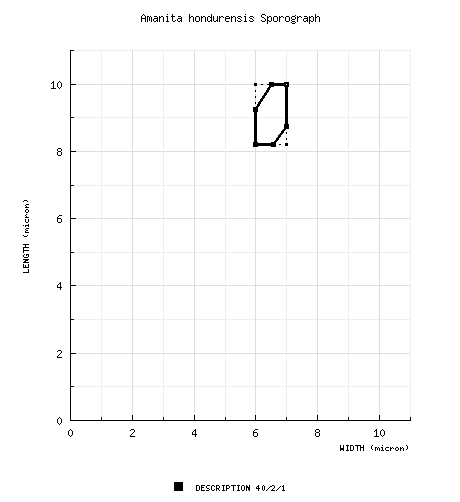

Text and User-Generated Sporographs are published under the Creative Commons License.

In the case of a taxon page, image credits are on the 'image' tab.