| name |
Amanita homolalittenii |
| author |
Tulloss et al. nom. prov. |
| name status |
nomen provisorum |
| etymology |
genitive of a Latinized compound name; hence, the amanita
of Homola and Litten. In honor of two discoverers
of original material—Drs. Richard Homola and
Walter Litten. |
| GenBank nos. |
Due to delays in data processing at GenBank, some accession numbers may lead to unreleased (pending) pages.
These pages will eventually be made live, so try again later.
|
| intro |
Olive text indicates a specimen that has not been
thoroughly examined (for example, for microscopic details) and marks other places in the text
where data is missing or uncertain.
The material below is based on the field notes of
Dr. Litten and original research by R. E.
Tulloss and C. Rodríguez Caycedo. |
| pileus |
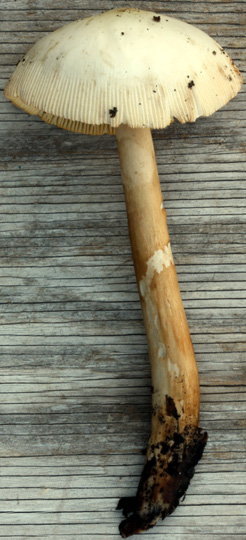
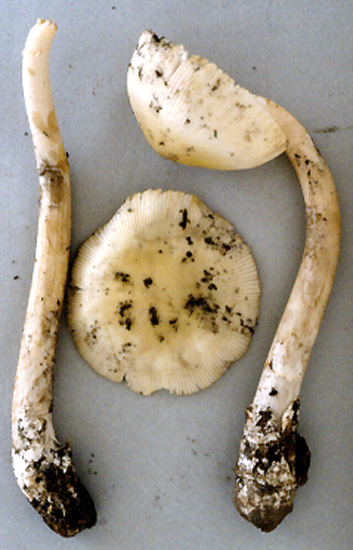
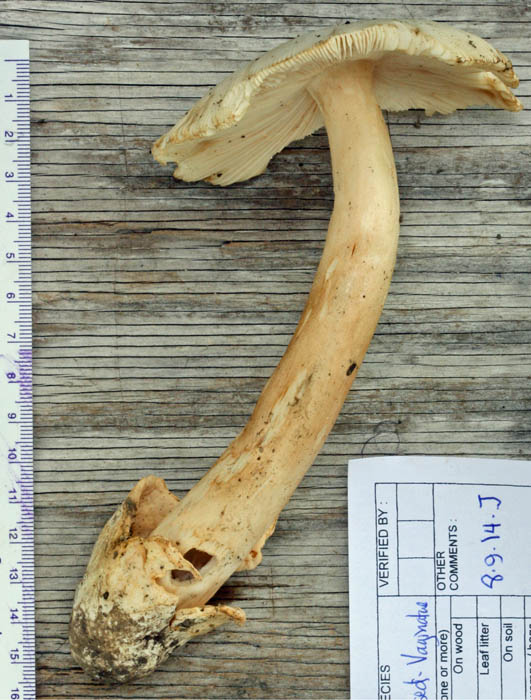
52 - 88 mm wide, light cream (e.g., 2A2), cream or
very pale pinkish- or
orangish-white, or off-white, sometimes white at
margin, becoming sordid yellowish cream or pallid
grayish brown in age, broadly campanulate with
deflexed margin, becoming planoconvex to nearly
planar, tacky, glabrous,
matte; context white, whiter than lamellae,
unchanging when cut or bruised, 4.5 - 6.5 mm thick at
stipe, thinning evenly for one half to two thirds of
radius, then membranous to margin; margin
striate (0.2R - 0.6R), nonappendiculate; universal
veil absent. |
| lamellae |
free to narrowly adnate with a decurrent tooth
(10× lens)
or a line on the stipe apex (10× lens), subcrowded
to crowded, cream or pale pinkish- or orangish-cream
in mass,
??, ?with brown stains at
mid-radius in side view , drying a
lovely pale orange (as does, on occasion, the
underside and striate region of the pileus), 6.5 -
?? mm broad,
?sometimes almost all with
reverse forking for about 0.5 mm near
stipe, sometimes with edges laciniate;
lamellulae truncate, of varying length,
unevenly distributed. |
| stipe |
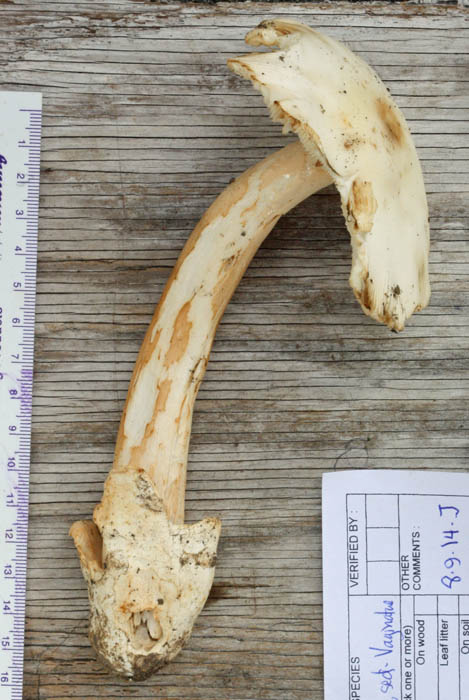
140 - 220 × 12-18 mm, entirely whitish or cream,
often with orange pulverulence in upper half,
sometimes dingy gray above
saccate volva, browning on edge of wounds and
from handling, sometimes with plentiful
yellowish fibrils in upper half and yellowish
fibrillose flakes in lower half; context white to off-white and
somewhat water logged, unchanging when cut or
bruised (with larva tunnels concolorous),
hollow or partially stuffed
with white cottony material, with central cylinder
3.5 - 6.5 mm wide; exannulate; universal
veil as saccate volva, white, occasionally with
some brown stains on exterior surface, membranous,
leathery, free from stipe for considerably more than
half distance from stipe base to highest point on
limb, about 1± mm thick at
midpoint between highest point of limb and point of
attachment to stipe, with highest point on limb
49 - 51 mm from base of stipe, decaying
with stipe base in wet
terrain ("separating from stipe when
collected" [Litten], "appearing to liquify on
handling" [Litten]); limbus
internus as a very small ridge just above point
of attachment to stipe. |
| odor/taste |
Odorless. Taste not recorded. |
macrochemical
tests |
none recorded. |
| anatomical figures |
|
| basidiospores |
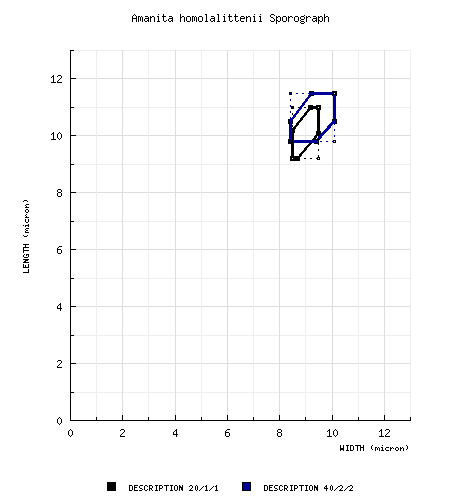
[20/1/1] 9.2 - 11.0 × (8.2-) 8.5 - 9.5 µm,
(L = 10.1 µm; W = 9.0 µm; Q = (1.02-)
1.06 - 1.20 (-1.22); Q = 1.12), smooth,
thin-walled, ??,
inamyloid,
globose to subglobose to broadly ellipsoid, rarely
ellipsoid, adaxially flattened; apiculus
sublateral, proportionately
small, cylindric; contents
??; white in
deposit.
[40/2/2] (9.4-) 9.8 - 11.5 × (7.7-) 8.4 - 10.1
(-10.5) μm (L = 10.3 - 10.8 μm; L' =
10.6 μm; W = 9.2 μm; W' = 9.2 μm; Q =
(1.03-) 1.04 - 1.25 (-1.31); Q = 1.12 - 1.17;
Q' = 1.15). |
| ecology |
Solitary to subgregarious. Maine: In wet loam or
in conifer
duff in an open road through mixed woods. New York:
At ca. 560 m elev. In moss over very dark, wet loam,
in open, old growth forest with Acer, Fagus
grandifolia, Betula, and Tsuga canadensis or in open,
regrown, mixed woods including Acer, Betula, F.
grandifolia, Picea, T. canadensis, Pinus resinosa, and
P. strobus. |
| material examined |
U.S.A.: MAINE—Cumberland
Co. - Standish, off Rte. 114, 27.vii.1998 Samuel S.
Ristich s.n. (RET 288-3, nrITS & nrLSU
seq'd.).
Hancock Co.
- Town of Lamoine, Marboro, Cemetery Rd., 11.vii.1976
Walter Litten L-715 (RET 002-2).
Kennebec Co. - Hallowell, Jamies Pond Wildlife Mgmt. Area,
9.viii.2014 Clement Ockay s.n. [Tulloss 8-9-14-J]
(RET 628-7, nrITS & nrLSU seq'd.).
Penobscot Co. - Orono, Univ. of Maine, 10.viii.1991
participant NEMF1991 s.n. [Tulloss 8-10-91-B]
(RET 031-3, nrITS seq'd.); Greenfield, Passadumkeag
Mtn., 11.viii.1991 participant NEMF1991 s.n.
[Tulloss 8-11-91-F] (RET 029-8, nrITS seq'd.).
MARYLAND— Harford County - Little Gunpowder Falls Trail [39.476 N/76.4083 W, 69 m] 8.xiii.2019 Ryan Pridgeon s.n. [mushroomobserver.org #326528] (RET 859-2).
8.xiii.2018. [mushroomobserver.org #326515] (RET 859-8).
MASSACHUSETTS—Unkn. Co. - unkn. loc.
(NEMF 2001, foray 5), 17.viii.2001
Terry Stoleson s.n. [Tulloss 8-17-01-E]
(RET 361-4, partial nrITS & nrLSU seq'd.);
Unkn Co., (NEMF 2001, foray 10),
18.viii.2001 Connie Borodenko s.n. [Tulloss
8-18-01-F] (RET 362-4, nrITS seq'd.).
MISSISSIPPI—Unkn. Co. - Hermanville,
10.viii.2019 Logan Weidenfeld s.n. [mushroomobserver
#377397]
(RET 910-10, nrLSU seq'd.).
NEW YORK—Franklin Co. - Harrietstown,
Ampersand Mtn., 13.viii.2011 Jacques Brochard s.n.
[Tulloss 8-13-11-A] (RET 479-8, nrLSU seq'd.);
Lake Placid, Bear Cub
Lane, Henry's Woods
[44°15'48" N/ 73°58'57" W, 558 m],
12.viii.2011 Renée LeBeuf s.n. [Tulloss 8-12-11-J]
(RET 480-8), Owen Tulloss s.n. [Tulloss 8-12-11-K]
(RET 480-3). |
| discussion |
Amanita homolae is a very distinctive species with
its cream-colored cap tinted with pink or orange and a
stipe often decorated with pale orange
pulverulence.
Genetic studies indicate that the number of white- to
cream-capped species with a relatively persistent,
saccate universal veil in Amanita section
Vaginatae in northeastern North America are far
more numerous than has been previously suspected.
Due to recent efforts of members of the Quebec and
Montreal mycological societies, the laboratory of Dr.
Jean-Marc Moncalvo, and the authors of this page, the
following white or pallid taxa (in additions to the
present species) have been genetically segregated:
A. albiceps,
??.
At present, an additional
4?? probable taxa
(including A.
sp-NFL02) have been identified based on
RET's herbarium collections which had been
tentatively identified under one of the names
listed above.
Genetic work is being scheduled to compare this taxon with
A. sp-NFL02.
The present species has an nrLSU sequence that is
identical to that of the morphologcically distinct
A. sp-MO04.
They differ slightly (but consistently to date) in
their nrITS sequences—at ca. char. 30 in ITS2,
A multi-G repeat is four characters long in A.
sp-MO04 and 2 characters long in
A. homolae. Other loci must be
explored. |
| citations |
—R. E. Tulloss and L. V. Kudzma |
| editors |
RET |
|



 Spore data sets and their composite