
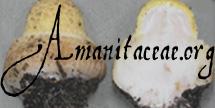

| name | Amanita herrerae |
| name status | nomen acceptum |
| author | Aroche |
| cap | The cap of Amanita herrerae is 25 - 60 mm wide, hemispherical to convex, and has a slight umbo in the center. It is white to marble-alabaster; and, in the center, it may be grayish-brown to grayish with brownish-yellow tones. Sometimes, the entire cap of A. herrerae may have colors that range from faint blonde tints to brownish-gray to occasionally yellow-ochre, or grayish yellow. The cap may be slightly sticky-hygrophanous to slimy or silky. It may appear to be covered with fine fibers, but lacks colored radial fibrils. It bears minute yellow particles or, in rare cases, has been known to ooze drops of colorless to yellow fluid. The edge of the cap is curved inward or curved downward, is slightly appendiculate, and is not striate. The cap flesh is white and unchanging. Volval remnants can be absent or present. The skin of the cap peels easily. |
| gills | The gills of Amanita herrerae are narrowly adnate to free or subdistant. They are cream to whitish with edges that are undecorated or are decorated with minute bits of white, removable material. The lamellulae have not been described. |
| stem | The stem measures 80 - 100 × 5 - 12 mm. It is cream or the same color as the cap; it becomes yellow to the touch, then light brown. The stem narrows upward. It can be covered with a frost-like dust or fine fibers or scaly bran-like particles or be smooth and without any hairs or particles. The bulb is nearly globose to ovoid, and occasionally flattened on top inside the volal limbs. The stem's flesh is white and unchanging on exposure except for sometimes being slightly grayish-brown in the bulb. The stem is hollow with cottony stuffing The subapical, skirt-like ring has a soft, pliable texture; it is persistent, fragile, skirt-like, and light cream, with an upper surface that is covered with a frost-like dust or is radially striate, and with a lower surface that is smooth, irregularly covered with tufts of small hairs that rub off. The stem turns yellow to the touch and releases a barely perceptible liquid. The stem bears a limbate volva with the free limbs being having a height of about half the bulb's length. The volva can have two to four limbs. The outside of the volva is powdery, white, and (at times) has brownish-gray or alabaster tints on the margin. |
| odor/taste |
The Odor is agreeable—like paraffin mixed with chlorine. The taste was not recorded. As a precaution, this species should be considered deadly POISONOUS. |
| spores | The spores of Amanita herrerae are (8.8-) 9.0 - 11.0 (-11.5) × 6.5 - 8.9 (-9.0) μm, amyloid, and broadly ellipsoid to ellipsoid. Clamps are probably absent from the bases of basidia. |
| discussion |
Amanita herrerae has been found only in the state of Hildalgo, Mexico at 1550 m elevation, in a cloud forest region at the edge of pastureland with Oak trees. The present species was placed in section Amidella by its author; however, it seems to be better placed in sect. Phalloideae at the moment. In addition, the yellowing of the fruiting body suggests that at least some of the original material on which the taxon was based were suffering from the "yellowing syndrome" (see discussion on the taxon page of A. subsolitaria. |
| brief editors | RET |
| name | Amanita herrerae | ||||||||||||||||||||
| author | Aroche. 1986. Rev. Mex. Micol. 2: 335. figs. 1-9. | ||||||||||||||||||||
| name status | nomen acceptum | ||||||||||||||||||||
| MycoBank nos. | 131152 | ||||||||||||||||||||
| GenBank nos. |
Due to delays in data processing at GenBank, some accession numbers may lead to unreleased (pending) pages.
These pages will eventually be made live, so try again later. Search:
Showing 0 to 0 of 0 entries | ||||||||||||||||||||
| holotypes | ENCB; isotype, MEXU 2439 | ||||||||||||||||||||
| type studies | Tulloss, here | ||||||||||||||||||||
| intro |
The following text may make multiple use of each data field. The field may contain magenta text presenting data from a type study and/or revision of other original material cited in the protolog of the present taxon. Macroscopic descriptions in magenta are a combination of data from the protolog and additional observations made on the exiccata during revision of the cited original material. The same field may also contain black text, which is data from a revision of the present taxon (including non-type material and/or material not cited in the protolog). Paragraphs of black text will be labeled if further subdivision of this text is appropriate. Olive text indicates a specimen that has not been thoroughly examined (for example, for microscopic details) and marks other places in the text where data is missing or uncertain. The following material not directly from the protolog of the present taxon and not cited as the work of another researcher is based on original research by R. E. Tulloss. | ||||||||||||||||||||
| pileus | From the protolog: 25 - 60 mm wide, convex to hemispherical to slightly expanded, subumbonate, white (5A1) to marble-alabaster (5B2) with grayish-brown disk (5C2) to grayish (5D5) with brownish-yellow tones (5C7), sometimes from disk to margin having faint blonde (5D4) to brownish-gray (6C2) to occasionally yellow-ochre (5C7) to grayish yellow (4B6) tints, subviscid-hygrophanous to lubricous, silky, fibrillose, without colored radial fibrils, sometimes with minute yellow particles or (rarely) with drops of colorless to yellow exudate; context white and unchanging; margin incurved to decurved, slightly appendiculate, nonstriate; universal veil absent or present; pileipellis easily peeling. | ||||||||||||||||||||
| lamellae | from the protolog: narrowly adnate to free, subdistant, cream to whitish with edge minutely flocculose to undecorated; lamellulae not described. | ||||||||||||||||||||
| stipe | from the protolog: 80 - 100 × 5 - 12 mm, narrowing upward, cream to concolorous with pileus, becoming yellow to the touch then light brown, pruinose-fibrillose to furfuracious or glabrous; bulb subglobose to ovoid, occasionally submarginate; context white and unchanging on exposure except slightly grayish-brown in the bulb, hollow with cottony stuffing; partial veil submembranous, persistent, fragile, subapical, pendent, light cream, with upper surface pruinose-striate and lower smooth, with irregular, floccose, turning yellow to the touch, releasing barely perceptible liquid; universal veil as saccate volva two thirds of which adnate to bulb, usually with two, but also with three or four limbs, externally pruinose, white with brownish-gray (5C2) or alabaster (5B2) tints at times on the margin. | ||||||||||||||||||||
| odor/taste | from the protolog: Odor agreeable—like paraffin mixed with chlorine. Taste not recorded. | ||||||||||||||||||||
| macrochemical tests |
?? | ||||||||||||||||||||
| pileipellis | ?? | ||||||||||||||||||||
| pileus context | ?? | ||||||||||||||||||||
| lamella trama | ?? | ||||||||||||||||||||
| subhymenium | ?? | ||||||||||||||||||||
| basidia | ?? | ||||||||||||||||||||
| universal veil | ?? | ||||||||||||||||||||
| stipe context | ?? | ||||||||||||||||||||
| partial veil | ?? | ||||||||||||||||||||
| lamella edge tissue | not described | ||||||||||||||||||||
| basidiospores |
from protolog: [-/-/-] (7.3-) 9.0 - 10.3 (-11.7) × (6.0-) 7.3 (-9.0) µm, (Q = 1.23 - 1.41; Q = 1.33), hyaline, thin-walled, amyloid, broadly ellipsoid to ellipsoid; apiculus sublateral, 1.0 - 1.5 µm long, cylindric; contents guttulate; probably white in deposit. from type study (RET): [17/1/1] (8.8-) 9.0 - 11.0 (-11.5) × 6.5 - 8.9 (-9.0) μm, (L = 10.0 μm; W = 7.4 μm; Q = (1.22-) 1.26 - 1.53 (-1.54); Q = 1.36), ??, smooth, ??, amyloid, broadly ellipsoid to ellipsoid, often adaxially flattened; apiculus sublateral, ??; contents ??; ?? in deposit. | ||||||||||||||||||||
| ecology | Hidalgo: Solitary to subgregarious. At 1550 m elev. In cloud forest region, at the edge of pastureland with Quercus. | ||||||||||||||||||||
| material examined | MÉXICO: HIDALGO—Tlanchinol, km 161 on Pachuca-Tampico Rd. [20°58’57” N/ 98°40’05” W, 1620 m], 24.ix.1990 R. M. Aroche 916 (holotype, ENCB n.v.; isotype, MEXU 2439), s.d. R. M. Aroche 739 (paratype, ENCB), 741 (paratype, ENCB), 751 (paratype, ENCB), 717 (paratype, FCME), 770 (paratype, FCME), 719 (paratype, XAL), 771 (paratype, XAL), 777 (paratype, XAL). | ||||||||||||||||||||
| discussion | The protolog implies that the yellowing reaction of the basidiome is reason for classifying the species in Amanita section Amidella. This is not the case. The protolog suggests that one or more of the collections that are cited as original material suffered from the "yellowing syndrome." (See the discussion of the latter on the taxon page for A. subsolitaria.) | ||||||||||||||||||||
| citations | —R. E. Tulloss | ||||||||||||||||||||
| editors | RET | ||||||||||||||||||||
Information to support the viewer in reading the content of "technical" tabs can be found here.
| name | Amanita herrerae |
| bottom links | [ Keys & Checklists ] |
| name | Amanita herrerae |
| bottom links | [ Keys & Checklists ] |
 Spore data sets and their composite
Each spore data set is intended to comprise a set of measurements from a single specimen made by a single observer; and explanations prepared for this site talk about specimen-observer pairs associated with each data set. Combining more data into a single data set is non-optimal because it obscures observer differences (which may be valuable for instructional purposes, for example) and may obscure instances in which a single collection inadvertently contains a mixture of taxa.
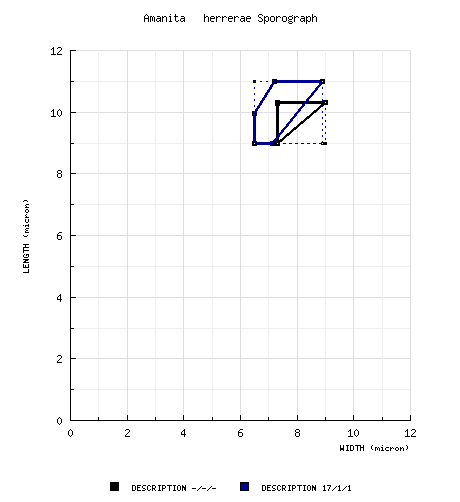

Text and User-Generated Sporographs are published under the Creative Commons License.

In the case of a taxon page, image credits are on the 'image' tab.