
| name | Amanita fuscostriata |
| name status | nomen acceptum |
| author | Pegler |
| english name | "Dark Eyed Ringless Amanita" |
| intro |
The following is based on the original description by Pegler (1983). |
| cap | The cap of A. fuscostriata is 40 mm wide, chestnut brown to fuscous, soon applanate with a depression in the center, smooth, with a densely striate margin [Striations appear to occupy one-third of the radius according to the illustration]. No volval remains are present. The flesh is very thin, white, and unchanging. |
| gills | The gills are free, subcrowded, white, 3 - 4 mm wide, with a distinctly uneven edge. The short gills are of at least two lengths. |
| stem | The stem is 80 × 40 mm, cylindric, hollow, white with scattered appressed fibrils. No ring is present. The volva is saccate, forms a narrow sheath at the stem base, membranous, and white. The flesh is very thin, white, and unchanging. |
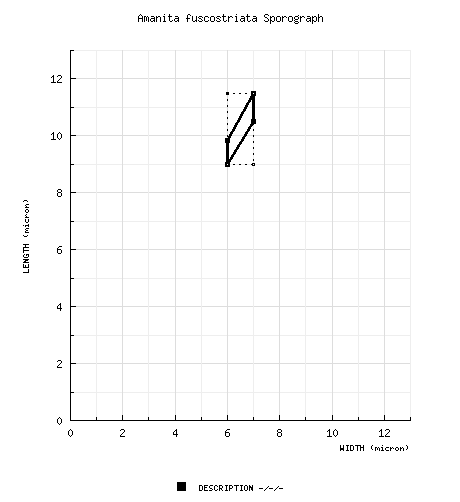
| spores | The spores measure 9 - 11.5 × 6 - 7 µm and are ellipsoid to elongate and inamyloid. Clamps are absent at bases of basidia. |
| discussion |
This species was originally described from the island of Martinique in the Lesser Antilles. The collection was made in a secondary mesophytic forest. The present species is rather isolated as far as the section Vaginatae is now known. Among the factors which, in combination, contribute to this isolation are relatively narrow spores and a cellular (similar to plant tissue) subhymenium, in addition to a ringless stem and a membranous volval sac, a strongly pigmented cap. All other things being equal, spore shape alone segregates this species from the most similar taxa—these taxa have spores so broad that the overlap of the ranges of spore length with the spore length of the present species is nearly nil. RET having examined some undescribed taxa of section Vaginatae from Africa with dark caps and narrow spores suggests that if any close relatives of A. fuscostriata are to be found, they would be found in central Africa or in forests of leguminous trees in northern South America.—R. E. Tulloss and L. Possiel |
| brief editors | RET |
| name | Amanita fuscostriata | ||||||||||||||||||||
| author | Pegler. 1983. Kew Bull., Addit. Ser. 9: 288, 292, fig. 5(2A-D). | ||||||||||||||||||||
| name status | nomen acceptum | ||||||||||||||||||||
| english name | "Dark Eyed Ringless Amanita" | ||||||||||||||||||||
| MycoBank nos. | 108667 | ||||||||||||||||||||
| GenBank nos. |
Due to delays in data processing at GenBank, some accession numbers may lead to unreleased (pending) pages.
These pages will eventually be made live, so try again later. Search:
Showing 0 to 0 of 0 entries | ||||||||||||||||||||
| holotypes | K | ||||||||||||||||||||
| basidiospores | from protolog: [-/-/-] 9.0 - 11.5 × 6.0 - 7.0 μm, (L' = 10.3 ± 0.5 μm; W' = 6.7 ± 0.3 μm; (est.) Q = 1.50 - 1.64; Q' = 1.53), hyaline, inamyloid, ellipsoid to elongate; apiculus not described; contents as large refractive guttule; color in deposit not described. [Note: The range of spore shape that can be extracted from the data is unrealistically narrow. with Q' = 1.56, as reported, both ellipsoid and elongate spores should have been encountered commonly. A type study will be useful.] | ||||||||||||||||||||
| ecology | from protolog: In secondary mesophytic forest. | ||||||||||||||||||||
| material examined | from protolog: MARTINIQUE: Rivière Capot, 26.ix.1975 J. P. Fiard 591 (holotype, K). | ||||||||||||||||||||
| citations | —R. E. Tulloss | ||||||||||||||||||||
| editors | RET | ||||||||||||||||||||
Information to support the viewer in reading the content of "technical" tabs can be found here.
| name | Amanita fuscostriata |
| bottom links | [ Keys & Checklists ] |
| name | Amanita fuscostriata |
| bottom links | [ Keys & Checklists ] |
 Spore data sets and their composite
Each spore data set is intended to comprise a set of measurements from a single specimen made by a single observer; and explanations prepared for this site talk about specimen-observer pairs associated with each data set. Combining more data into a single data set is non-optimal because it obscures observer differences (which may be valuable for instructional purposes, for example) and may obscure instances in which a single collection inadvertently contains a mixture of taxa.

Text and User-Generated Sporographs are published under the Creative Commons License.

In the case of a taxon page, image credits are on the 'image' tab.