

| name | Amanita fuscoflava |
| name status | nomen acceptum |
| author | Zhu L. Yang, Yang-Yang Cui & Qing Cai |
| english name | "Black-Eyed Susan Slender Caesar" |
| intro | This text is derived from the original description of Amanita fuscoflava. The fruiting bodies of Amanita fuscoflava are medium-sized to large. |
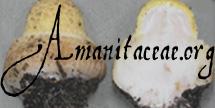
| cap | The cap is 70 – 120 mm wide, plano-convex to planar, raised over the stem (umbonate), dark brown in the center, gradually changing towards the margin to yellow to honey yellow. The cap’s margin is radially grooved for about 50-70% of the cap's radius and does not have material hanging from the edge. The flesh is white to cream. |
| gills | The gills are free, crowded, and yellowish with cream to yellowish edges. The short gills are truncate and plentiful. |
| stem | The stem is 80 – 150 × 10 – 15 mm, nearly cylindric or narrowing upwards; its surface is yellow and covered with yellow to yellowish fibers in a snakeskin pattern. The stem lacks a basal bulb. The volva is saccate, 20 – 40 × 20 – 30 mm, and membranous and has white inner and outer surfaces. The ring is yellow. |
| odor/taste | The odor and taste were not recorded for the present species. |
| spores | The spores measure 8.5 – 10.5 × 6.0 – 7.0 µm and are ellipsoid and inamyloid. Clamps are common at bases of basidia. |
| discussion | Amanita fuscoflava corresponds to Amanita sp. 5 in Yang (2015). So far as we know, it's cap coloration is distinct in southern China. It occurs in tropical to subtropical forests dominated by the Beech family (Fagaceae), and currently known to occur only in southern China.—Yang-Yang Cui and Rachel Warner |
| brief editors | RET |
| name | Amanita fuscoflava | ||||||||||||||||||||||||||||||||||||
| author | Zhu L. Yang, Yang-Yang Cui & Qing Cai in Cui et al. 2018. Fungal Diversity 91(1): 50, figs. 3(h), 9. | ||||||||||||||||||||||||||||||||||||
| name status | nomen acceptum | ||||||||||||||||||||||||||||||||||||
| english name | "Black-Eyed Susan Slender Caesar" | ||||||||||||||||||||||||||||||||||||
| MycoBank nos. | 824970 | ||||||||||||||||||||||||||||||||||||
| GenBank nos. |
Due to delays in data processing at GenBank, some accession numbers may lead to unreleased (pending) pages.
These pages will eventually be made live, so try again later. Search:
Showing 1 to 5 of 5 entries | ||||||||||||||||||||||||||||||||||||
| holotypes | HKAS 59800 | ||||||||||||||||||||||||||||||||||||
| intro |
The following text may make multiple use of each data field. The field may contain magenta text presenting data from a type study and/or revision of other original material cited in the protolog of the present taxon. Macroscopic descriptions in magenta are a combination of data from the protolog and additional observations made on the exiccata during revision of the cited original material. The same field may also contain black text, which is data from a revision of the present taxon (including non-type material and/or material not cited in the protolog). Paragraphs of black text will be labeled if further subdivision of this text is appropriate. Olive text indicates a specimen that has not been thoroughly examined (for example, for microscopic details) and marks other places in the text where data is missing or uncertain. The following material is derived directly from the protolog of the present taxon and associated documen- tation such as sequences deposited in GenBank. | ||||||||||||||||||||||||||||||||||||
| editors | RET | ||||||||||||||||||||||||||||||||||||
Information to support the viewer in reading the content of "technical" tabs can be found here.

Text and User-Generated Sporographs are published under the Creative Commons License.

In the case of a taxon page, image credits are on the 'image' tab.