| name |
Amanita fulva—unsequenced_specimens_corral |
| english name |
"American Orange-Brown Ringless Amanita" |
| etymology |
elision of "America" and "fulva"; hence, American fulva. |
| GenBank nos. |
Due to delays in data processing at GenBank, some accession numbers may lead to unreleased (pending) pages.
These pages will eventually be made live, so try again later.
|
| intro |
Olive text indicates a specimen that has not been
thoroughly examined (for example, for microscopic details) and marks other places in the text
where data is missing or uncertain.
The following is based upon
original research by R. E. Tulloss. |
| pileus |
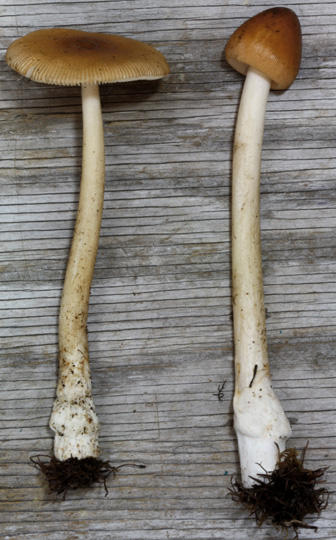
45 - 60 mm wide, fulvous to grayish orange (6B3-4) to
brownish orange (6C4) to orange brown (5B6, 6C6),
slightly darker (dark fulvous—e.g., 7E-D7) over disk,
unchanging when bruised or cut (or edges of
pileipellis slightly brown in old wounds),
campanulate at first, becoming convex and then
planoconvex with broad umbo, subshiny to dull,
subviscid or tacky when moist; context white to
pale cream, sometimes with fulvous tint in upper part
or just near pileipellis, infrequently with a few
rusty spots, unchanging when bruised or cut, sometimes
rather brittle, 4.5 mm thick at stipe, thinning
evenly for about two-thirds to three-quarters of
radius, then a membrane to margin; margin
subtuberculate to sparsely tuberculate-striate (0.35 - 0.5R), sometimes becoming rimose to fissurate, nonappendiculate; universal veil almost always absent. |
| lamellae |
free to occasionally narrowly adnate, without decurrent line on stipe or with faint very short line (lens), subcrowded to crowded, white to pale cream to cream to very pale orangish or yellowish cream in mass and white to off-white to pale cream to cream in side view, unchanging when cut or bruised, 4.5 - 7 mm broad, with edge minutely fimbriate; lamellulae truncate to subtruncate to truncate with attenuate tooth at pileus context, plentiful, of diverse lengths, unevenly distributed, occasionally connected to stipe rather than to margin. |
| stipe |
90 - 124 × 7 - 8 mm, white to cream to pale yellowish (4A3-4) to very pale fulvous, occasionally darkening slightly from handling (especially with surface fibrils becoming fulvous or darker), narrowing upward, barely or not flaring at apex, pruinose or finely fibrillose above, faintly longitudinally striatulate (lens) and satiny (lens) to fibrillose or smooth below; context white to off-white to slightly orangish white, sometimes with rusty spots in very base of stipe, hollow with lining or occasional cross walls of white cottony fibrils, with larva tunnels concolorous, with central cylinder 4 - 4.5 mm wide; exannulate; universal veil as saccate volva, membranous, soft, rather firm, white, developing ochraceous or rusty or grayish orange (6B6) tinges (at first in the upper part of the limb and spreading downward), occasionally becoming entirely grayish orange, edges of limbs occasionally brown, 32 - 38 mm from stipe base to highest point of limb, 17 - 20 mm wide, with limb 1- - 2 mm thick at midpoint of free portion; limbus internus ??. |
| odor/taste |
Odor faintly fungoid or indistinct or absent. Taste not recorded. |
macrochemical
tests |
L-tyrosine spot test for tyrosinase - ?. Paracresol spot test for tyrosinase - ?. Syringaldazine spot test for laccase - ?. |
| subhymenium |
wst-near = 15 - 20 (-35) µm; wst-far = 40 - 55 µm; 4± cells deep, comprised of inflated and partially inflated cells in branching structure, soon with major axis roughly perpendicular to central stratum, with most basidia arising from inflated cells, occasionally with an elongate cell reaching from central stratum to base of basidium. |
| basidia |
44 - 65 × 12.0 - 16.0 µm, ?-sterigmate, with sterigmata up to ? × ? µm; clamps not observed. |
| basidiospores |
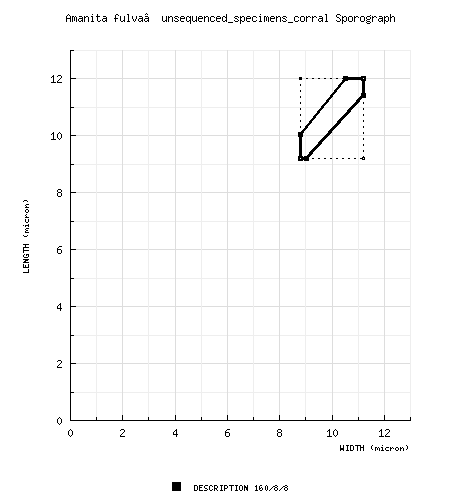
[160/8/8] (8.0-) 9.2 - 12.0 (-14.0) × (6.8-) 8.8 - 11.2 (-12.5) µm, (L = (10.0-) 10.5 - 11.2 µm; L’ = 10.6 µm; W = (9.2-) 9.8 - 10.2 µm; W’ = 9.9 µm; Q = (1.0-) 1.02 - 1.14 (-1.22); Q = 1.06 - 1.09 (-1.10); Q’ = 1.08), hyaline, colorless, thin-walled, smooth, inamyloid, globose to subglobose, occasionally broadly ellipsoid, at least somewhat adaxially flattened; apiculus sublateral, at times rather prominent, cylindric to truncate-conic; contents monoguttulate; white in deposit. |
| ecology |
Very common throughout eastern United States and southeastern Canada, found in many forest types. New Jersey: ?. New York: In open woods of Abies and Picea, near Sphagnum bog. West Virginia: in forest of Pinus, Tsuga canadensis, and Acer pennsylvanicum or in forest dominated by Betula lutea f., T. canadensis, Quercus rubra, and Tilia sp. or in boggy to very wet, dark loam with T. canadensis, B. lutea, Fagus grandifolia, and Picea or at 1220 m elev. in forest of old growth Picea and B. lutea or in deep moss under Picea rubens.
Occasionally found in very rotten wood of old stumps. Tolerance for wet conditions is further indicated by BPI 14713 having been collected in a cranberry bog. |
| material examined |
U.S.A.:
CONNECTICUT—Middlesex Co. - E. Haddam, Devil's
Hopyard St. Pk. [41.4756° N/ 72.3403° W, 72 m],
3.ix.2011 Sandy Sheine s.n. [Tulloss 9-3-11-P]
(RET 490-4), 4.ix.2011 Rhoda Roper s.n. [Tulloss
9-4-11-B] (RET 492-1).
MAINE—Penobscot Co. - Bangor, Prentiss
Woods, 12.viii.1991 participant NEMF91 s.n.
[Tulloss 8-12-91-D] (RET 030-6).
NEW JERSEY—
Monmouth Co. - Shark River Co. Pk.
[40.205° N/ 74.0956° W, 16 m], 13.ix.1998 NJMA foray participant s.n. [R. E. Tulloss 9-13-98-D] (RET 287-9). Morris Co. - Hackettstown Reservoir, 25.vii.1984 G. Kibby, J. Richards, R. Peabody & R. E. Tulloss 7-25-84-J (RET 053-1). Ocean Co. - Waretown [39°47’12” N/ 74°11’50” W], 15.x.1993 Cornelius Hogenbirk 13 (RET 118-5). Sussex Co. - Stokes St. For., 7.vii.1985 David C. Tulloss & R. E. Tulloss 7-7-85-C (RET 053-6), D. C., M. A. & R. E. Tulloss 7-7-85-D (RET 054-7); Stokes St. For., Kittle Field Recreation Area [41°12’23” N/ 74°46’30” W], 28.ix.1997 Laura G. Weishaupt & R. E. Tulloss 9-28-97-B (RET 271-1).
NEW YORK—Franklin Co. -
Floodwood Mtn. Rd. [44.3476° N/ 74.4424° W, 501 m],
21.viii.1987 Ray La Sala s.n. [Tulloss 8-21-87-J]
(RET 017-2); E of Floodwood Mtn. Rd., 22.viii.1987
J. & S. Arnold, G. Flanz & R. E. Tulloss
8-22-87-G (RET ??),
22.viii.1987 R. E. Tulloss 8-22-87-H (RET 017-3),
-I (RET ??);
Jenkins Mtn. Rd., 22.viii.1987 NEMF foray
participant s.n. [Tulloss 8-22-87-D] (RET 019-3);
Paul Smith's [44°26'02" N/
74°15'06" W, 500 m], 20.viii.1987 NEMF foray
participant s.n. [Tulloss 8-20-87-A] (RET 017-6),
[Tulloss 8-20-87-B] (RET 018-7), 21.viii.1987 D. C.
& R. E. Tulloss 8-21-87-D (RET 017-1),
21.viii.1987 R. E. Tulloss 8-21-87-C (RET 017-4),
21.viii.1987 Randy Weidner s.n. [Tulloss 8-21-87-E]
(RET 017-5). Madison Co. - unkn. loc.,
11.ix.2010 Eric Smith s.n. [www.mushroomobserver.org
#52543]
(RET 482-5). Unkn. Co. - Adirondack Pk.,
21.viii.1987 NEMF foray participant s.n. [Tulloss
8-21-87-O] (RET 018-4).
NORTH CAROLINA—Macon Co. - SW of
Highlands, Glen Falls, 21.vii.2008 Jay Justice s.n.
(RET 444-10).
PENNSYLVANIA—Pike Co. - Dingman's Ferry,
Pocono Environmental Education Ctr. [41°10'17" N/
74°54'52" W, 235 m], 20.vi.1981 Mary A. King &
R. E. Tulloss 6-20-81-E (RET 176-3), 21.vi.1981
M. A. King & R. E. Tulloss 6-21-81-R
(RET 168-4), 21.vi.1986 M. A. King, R. E. Tulloss,
et al. 6-21-86-E (RET 245-8); Lehman Twp., Egypt
Mills [41°07'33" N/ 74°57'29" W, 130-195 m],
26.vi.1985 R. E. Tulloss 6-23-85-B
(RET 055-7). Union Co. - R. B. Winter St.
Pk., 13.viii.1984 D. C., Mark H., & R. E.
Tulloss 8-13-84-D (RET 008-3).
TENNESSEE—Blount Co. - GSMNP, Cades Cove,
picnic area, 27.ix.2006D. J. Lodge & R. E.
Tulloss 9-27-06-G (RET 401-6). Cumberland
Co. - Cumberland Mtn. St. Pk., W side of loop tr.,
19.vii.2008 J. Justice s.n. (RET 435-6).
Sevier Co. - ca. Gatlinburg, GSMNP, Fork Ridge
trailhead [35°35'24” N/ 83°28'09” W], 13.vii.2004
mycoblitz participant s.n. [Tulloss 7-13-04-D]
(RET 378-5); Grotto Falls trailhead [35°40'52” N/
83°27'45” W], 12.vii.2004 Matt Kierle s.n. [Tulloss
7-12-04-X] (RET 376-4); ca. Gatlinburg, GSMNP,
Indian Gap [35°36'34” N/ 83°26'19” W], R. E.
Halling s.n. [Tulloss 7-13-04-L] (RET 377-1).
VERMONT—Bennington Co. - ca. Bennington,
28.viii.1981 R. E. Tulloss 8-28-81-A (RET 166-7);
ca. Bennington, Bennington Fish Culture Stn.
[42°51'10" N/ 73°10'12" W, 288 m], 24.viii.1980
M. A. King & R. E. Tulloss 8-24-80-B (RET
392-7).
VIRGINIA—Unkn. Co. - Shenandoah Nat. Pk.,
s.d. "RRGS" 25 (LFCC; RET 143-9).
WEST VIRGINIA—Greenbrier Co. - woods
above rest stop along U.S. Rt. 60 ca. 1.6 km W of
Charmco, 9.viii.1990 M. A. Vincent 4388 (MU
F38504). Pocahontas Co. - Monongahela Nat.
For., ca. Highland Scenic Hwy., 31.vii.1982 G.
Bills 421 (BPI 900737); Monongahela Nat. For.,
26.vii.1977 K. H. & Kathleen McKnight s.n. (BPI
14713). Randolph Co. - Gaudnier Scenic Area,
26.ix.1992 S. L. Stephenson, R. P. Bhatt & A.
Kumar A4 (FWVA; in herb. R. P. Bhatt).
Tucker Co. - Abe Run Tr., Canaan Valley St. Pk.,
6.viii.1992 Mary A. King, E. H. Tulloss, J. C.
Tulloss, S. E. K. Tulloss & R. E. Tulloss
8-6-92-A (RET 120-1),
6.viii.1992 R. E. Tulloss 8-6-92-B (RET 120-2). |
| discussion |
t.b.d.
The following figure provides sporograph comparisons
between the present possible taxon and two formally
named taxa:
A.
fuligineodisca and
A.
fulva.
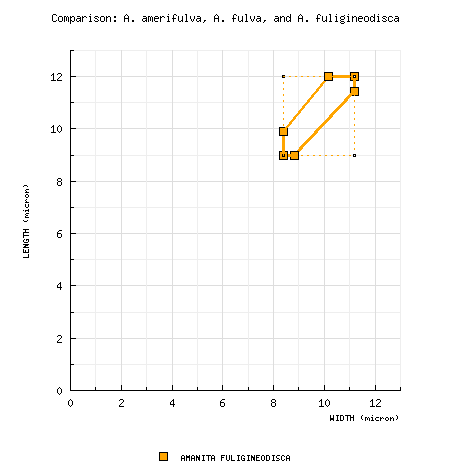
Other sporograph comparisons of interest occur on
the techtabs for A.
sp-N44 and A.
sp-N46. |
| citations |
—R. E. Tulloss |
| editors |
RET |
|


 Spore data sets and their composite