
| name | Amanita franchetii var. lactella |
| name status | nomen acceptum |
| author | (E.-J. Gilbert & Kühner) Bon & Contu in Contu |
| english name | "Milk White Franchet's Amanita" |
| images | |
| intro |
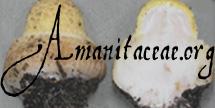
[Note: Differing from f. franchetii by having a milk white cap rather than one which ranges from citron yellow to whitish. In the most recent restatement of information concerning f. lactella, Neville and Poumarat do not make a case for segregating taxonomically pure white specimens from specimens that are almost white. It is worth noting that we have found no value in segregation of palely pigmented and albino specimens of a number of taxa (for example, A. brunnescens G. F. Atk., A. caesarea (Scop. : Fr.) Pers., and A. phalloides (Fr. : Fr.) Link, etc.). In other cases, RET has found some pallid and white infraspecific taxa to be distinct at the ranks of variety or species (for example, A. rubescens var. alba Coker). A careful evaluation of the status of f. lactella would be valuable—especially since a neotype has been designated.] The following is derived from the description of Bertault based on north African material associated with Quercus suber which is provided in full by Neville and Poumarat (2004). |
| cap |
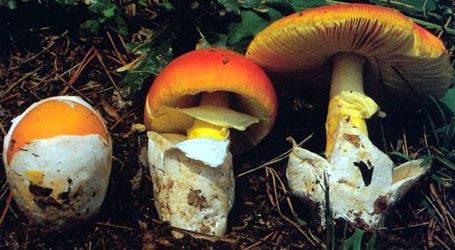
The cap of Amanita franchetii f. lactella is 70 - 90 mm wide, pure white, becoming a little brownish in the center in age, globose or hemispheric at first, then convex, sometimes with a little umbo, finally planar or subdepressed, matte, subviscid when moist, with a smooth, nonappendiculate and nonstriate margin, except in age. The volva is present as membranous, densely arranged, pyramidal warts in the center of the cap, bright golden yellow, easily removable, cleanly detached from browning areas; the warts are sparser, flatter, and paler towards the edge. The flesh is white. |
| gills |
The gills are crowded, free to distant from the stem, white, narrowing in both directions, up to 8 mm broad, with a finely floccose edge. The short gills are truncate. |
| stem |
The stem is 90 - 100 × 10 - 20 mm, solid, subcylindric, flaring at the top, white, slightly squamulose below the ring, stained brownish at the bottom of the stem, with a slightly spindle-shaped bulb. The ring is membranous, placed high on the stem, skirt-like, finely striate above, with an irregularly splitting and rather thickened edge, and tinted bright yellow or light brown on the edge. The volva is present as vague circles of yellow or in mature material as an irregular a bistre line around the top of the bulb, but the latter is not always present. The flesh is white, turning brownish in the bulb when cut. |
| odor/taste |
The odor is indistinct and the taste is sweet. |
| spores |
The spores measure 7.5 - 8.5 (-9) × 4.8 - 5 µm and are ellipsoid to elongate and amyloid. Clamps are absent at bases of basidia. Bertault's measurements describe spores proportionately narrower than those of f. franchetii. In contrast, Neville and Poumarat cite measurements on 20 spores from French material which they considered otherwise in poor condition, and those measurements are 7.5 - 9 (-9.5) × 6 - 7 and are broadly ellipsoid to ellipsoid and amyloid. |
| discussion |
This taxon occurs in Spain, France, Italy, and Morocco in association with oak (Quercus suber, Q. robur) and Carpinus betulus.—R. E. Tulloss and L. Possiel |
| brief editors | RET |
| name | Amanita franchetii var. lactella | ||||||||||||||||||||
| author | (E.-J. Gilbert & Kühner) Bon & Contu in Contu. 1986a. Doc. Mycol. 17(65): 62. | ||||||||||||||||||||
| name status | nomen acceptum | ||||||||||||||||||||
| english name | "Milk White Franchet's Amanita" | ||||||||||||||||||||
| synonyms |
≡Amanita franchetii f. lactella (E.-J. Gilbert & Kühner) Neville & Poumarat. 2004. Fungi Europaei 9: 749.
≡Amanita aspera f. lactella E.-J. Gilbert in E.-J. Gilbert & Kühner. 1928. Bull. Trimestriel Soc. Mycol. France 44: 151. [Misapplicaton.]
≡Amanita aspera f. lactella ["lactea"] E.-J. Gilbert in E.-J. Gilbert & Kühner sensu Parrot. 1960. Amanites S.-O. France: 100. [Misapplication.]
≡Amanita aspera f. lactella E.-J. Gilbert ex Bertault. 1980. Bull. Trimestriel Soc. Mycol. France 96: 276. [Superfluous?? The original publication appears valid, if extremely brief...unless it is not based on Persoon's name??.] The editors of this site owe a great debt to Dr. Cornelis Bas whose famous cigar box files of Amanita nomenclatural information gathered over three or more decades were made available to RET for computerization and make up the lion's share of the nomenclatural information presented on this site. | ||||||||||||||||||||
| etymology | lacteus, "milk white" + -ellus, diminutive ending; hence, perhaps, "little milk white thing" | ||||||||||||||||||||
| MycoBank nos. | 321169, 118223, 129667 | ||||||||||||||||||||
| GenBank nos. |
Due to delays in data processing at GenBank, some accession numbers may lead to unreleased (pending) pages.
These pages will eventually be made live, so try again later. Search:
Showing 0 to 0 of 0 entries | ||||||||||||||||||||
| holotypes | in herb. Contu (CAG) as "holotype" (sic) | ||||||||||||||||||||
| neotypifications | Contu. 1986a. op. cit.: 62. | ||||||||||||||||||||
| intro | |||||||||||||||||||||
| citations | —R. E. Tulloss | ||||||||||||||||||||
| editors | RET | ||||||||||||||||||||
Information to support the viewer in reading the content of "technical" tabs can be found here.
| name | Amanita franchetii var. lactella |
| bottom links | [ Keys & Checklists ] |
| name | Amanita franchetii var. lactella |
| bottom links | [ Keys & Checklists ] |

Text and User-Generated Sporographs are published under the Creative Commons License.

In the case of a taxon page, image credits are on the 'image' tab.