| name |
Amanita foetidissima |
| author |
D. A. Reid. & Eicker. 1991. Mycol. Res. 95: 83, figs. 7-12, 42, 45-47. |
| name status |
nomen acceptum |
| english name |
"Stinker Lepidella" |
| MycoBank nos. |
129732 |
| GenBank nos. |
Due to delays in data processing at GenBank, some accession numbers may lead to unreleased (pending) pages.
These pages will eventually be made live, so try again later.
|
| holotypes |
location not unambiguously designated
PRUM?? or K?? |
| intro |
The following text may make multiple use of each data field.
The field may contain magenta text presenting data from a type study
and/or revision of other original material cited in the protolog of the present taxon.
Macroscopic descriptions in magenta are a combination of data from the protolog and
additional observations made on the exiccata during revision of the cited original
material.
The same field may also contain black text, which is data from a revision of the present
taxon (including non-type material and/or material not cited in the protolog).
Paragraphs of black text will be labeled if further subdivision of
this text is appropriate.
Olive text indicates a specimen that has not been
thoroughly examined (for example, for microscopic details) and marks other places in the text
where data is missing or uncertain.
The following material not directly from the
protolog is based upon original research by
R. E. Tulloss.
protolog: Basidiomes large to
very large. |
| pileus |
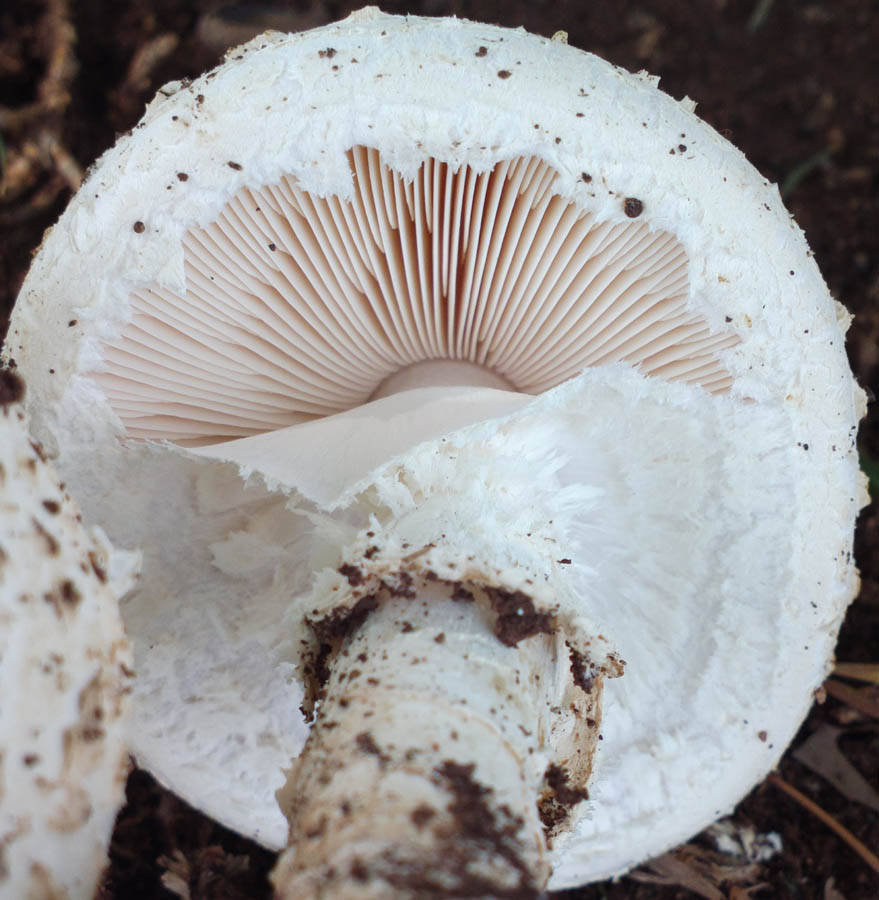
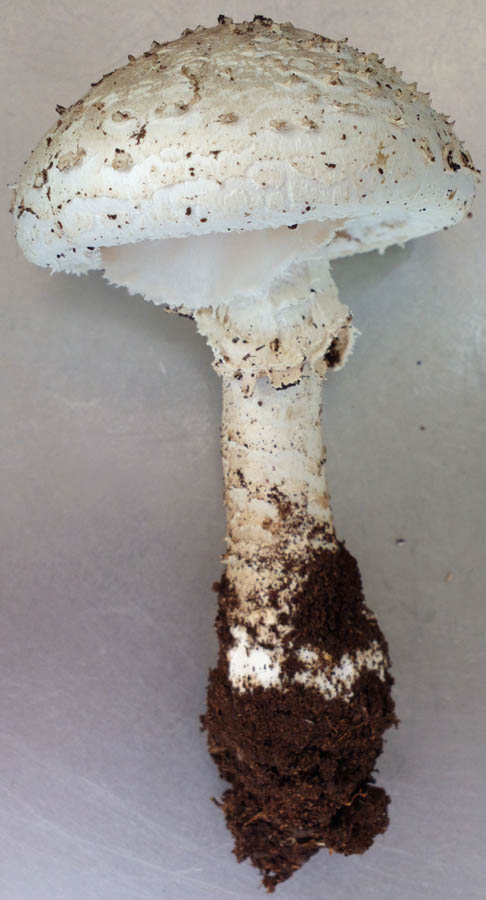
protolog: 70 - 140 mm wide (said
to grow much larger), pale creamy buff to buff,
occasionally more brightly colored with yellowish
ocher tints, initially conico-conivex, then
convex or convex-campanulate, finally planar;
context white, exuding copious slightly
watery juice in young specimens; margin
"strongly exceeding" end of lamellae;
universal veil as thick
soft floccose warts, concolorous or slightly
darker, becoming cob-webby fibrils toward margin,
often sticking to fingers when collected, with
age sometimes as flat polygons, in wet weather
sometimes quite smooth, sometimes as upturned scales
on deeply fissured surface in dry weather,
bruising orangey brown. |
| lamellae |
protolog: attachment not
described, compactness of arrangement not described;
pale to dirty cream, 10 - 20 mm broad;
lamellulae not described. |
| gleba |
double click in markup mode to edit. |
| stipe |
protolog: 70 - 160 ×
10 -20 mm, white, narrowest near mid-stipe, sometimes
exuding brown droplets from apical region in wet
weather; bulb
25 - 30 mm wide, flattened below (per figure);
context solid, white (see pileus regarding
exudate); partial veil membranous, but
fragile and fugacious, concolorous [probably with
universal veil?—ed.], with yellowish
buff floccose scales on underside;
universal veil covering stipe below the
partial veil, as dense, squarrose, buffy brown
squamules, collapsing on stipe with age, bruising
orange-brown to reddish brown. |
| odor/taste |
protolog: Odor
nauseous or very strongly unpleasant. |
macrochemical
tests |
none recorded. |
| pileipellis |
not described in protolog. |
| pileus context |
not described in protolog. |
| lamella trama |
not described in protolog. |
| subhymenium |
not described in protolog.
RET: dominantly pseudoparenchymatic (cellular);
filamentous undifferentiated hyphae branching
occasionally present. |
| basidia |
protolog: 50 - 52 ×
9.0 - 9.5 μm, 4-sterigmate; clamps
present.
RET: 52±: × 10.5±:
μm, 4-sterigmate, with sterigmata up to
?? μm,
arising from inflated cells or uninflated hyphal
segments; clamps present. |
| universal veil |
protolog: On pileus:
inflated cells in chains, thin-walled, barrel-formed
to fusiform, 70 - 170 × 15 - 32 μm, with
terminal elements fusoid; clamps present.
On stipe: not described.
RET: On pileus: with elements periclinally
aligned, with yellow-walled elements not found;
filamentous undifferentiated hyphae 2.5 - 8.9
μm, scattered, some in narrow fascicles; inflated
cells dominating, 58 - 114 × 19.0 - 43 μm,
thin-walled, in terminal chains, narrowly to
boardly fusiform or clavate or ovoid or ellipsoid
or narrowly ellipsoid to broadly clavate; clamps
present on septa between uninflated hyphal
segements and between inflated cells. |
| stipe context |
not described in protolog.
|
| partial veil |
not described in protolog. |
| lamella edge tissue |
not described in protolog. |
| basidiospores |
protolog: [-/-/-] 7.0 - 9.0
× 6.2 - 8.0 μm, hyaline, thin-walled,
amyloid, subglobose to ellipsoid (per figure);
white in deposit.
[-/-/-] 9.0 - 10.0 × 6.0 - 6.2 μm,
ellipsoid to elongate (per figure).
[-/-/-] 8.2 - 9.5 × 7.0 - 8.0 μm,
subglobose to broadly ellipsoid (per figure).
[Note: Reid had a habit of describing spores from
different collections separately. He even
described groups of spores from a single collection
separately if he judged them to be of different
shapes. He did not use Q in
describing the spores. He persisted in this
practice for more than two decades after Bas (1969)
had provided a different approach for spore
description. Reid's approach is
incompatible with the generation of
sporographs unless one can make some intelligent
guesses at the shapes of the spores measured in
lateral view. Unfortunately, very few of the
spores illustrated in the present case are shown
in lateral view.—ed.]
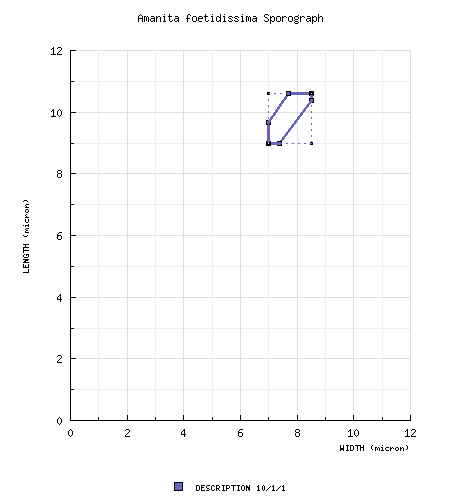
RET: [10/1/1] (8.3-) 9.0 -
10.6 (-11.5) × 7.0 - 8.5 (-9.0) μm,
(L = 10.0 μm; L' = 10.0 μm;
W = 7.7 μm; W' = 7.7 μm;
Q = 1.22 - 1.38 (-1.57); Q = 1.29 ;
Q' = 1.29),
hyaline, colorless, smooth, thin-walled, amyloid,
broadly ellipsoid to ellipsoid, adaxially
flattened; apiculus
sublateral, cylindric, proportionately small;
contents monoguttulate with additional small
granules; white in deposit. |
| ecology |
protolog: At 1365 m elev.
Solitary or gregarious
or growing in fairy rings. In grassland, playing
fields, lawns, or waste grassy areas.
At 1430 m elev. In lawn
under imported street tree (Quercus palustris)
(eastern North American). |
| material examined |
protolog: SOUTH
AFRICA: GAUTENG—City of
Tshwane - Pretoria,
Lynnwood Glen, 15.ii.1989 unkn. coll. s.n.
(holotype, K); Pretoria, Univ. of Pretoria campus,
L. C. de Villiers sports grounds [25°45'10" S/
28º14'46" E, 1365 m], 15.ii.1989 unkn. coll. s.n.
(paratype, PRUM; paratype, RET 353-9,
fragment.).
RET: SOUTH
AFRICA: GAUTENG—City of
Tshwane - Pretoria, Centurion [25.8520° S/
28.1896° E, 1430 m], 21.i.2016 Glen van Niekerk s.n.
[mushroomobserver
#228424] (RET 728-3, nrITS and nrLSU seq'd.);
Univ. of Pretoria campus,
L. C. de Villiers sports
grounds [25°45'10" S/ 28º14'46" E, 1365 m],
15.ii.1989 unkn. coll. s.n. (paratype, (PRUM;
paratype, RET 353-9, fragment). |
| discussion |
protolog summary: The
authors distinguish A.
foetidissima from A. roseolescens
by basidiome color and bruising reaction as well
as what they believe to be
larger spore size of A. foetidissima.
However, they present a counter argument leaving
the issue of spore size difference somewhat in
question. [Note: Their unusual method of reporting
spore size range makes the data difficult to use,
as they
recognize.—ed.]
The authors report that they could not find anyone
familiar with the areas in which the two species
were collected who knew of any recent sighting or
collection of
A. roseolescens.
Amanita
praeclara is distinguished from the
present species based on its color and bruising
reactions and its lack of clamp connections in
the universal veil. [Note: this places it
outside of stirps
Nauseosa.—ed.]
Amanita
nauseosa
and A.
manicata are also mentioned as similar
taxa. |
| citations |
—R. E. Tulloss |
| editors |
RET |
|


 Spore data sets and their composite