
| name | Amanita flaviphylla |
| name status | nomen acceptum |
| author | O. K. Mill. |
| english name | "Yellow-To-The-Core Lepidella" |
| images |
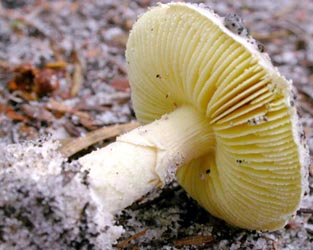  1. Amanita flaviphylla, Western Australia, Australia. 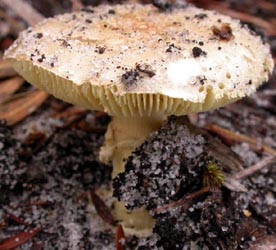 2. Amanita flaviphylla, Western Australia, Australia. |
| intro |
The following is largely based on the original description of Miller (1992). |
| cap |
The cap of Amanita flaviphylla is 28 - 52 mm wide, broadly convex to plano-depressed, viscid, yellow, with a nonstriate margin that does not extend past the ends of the gills. The cap is sand-covered with thin, filmy volval remnants over the center; these remnants often disappear. The flesh is yellow. |
| gills |
The gills are adnate with a fine line, close, yellow, and moderately broad. Short gills are plentiful and of diverse lengths. |
| stem |
The stem is 30 - 55 × 4 - 11 mm, cylindric, dry, undecorated, nearly hollow, buff to pale yellow or yellowish white. The basal bulb is 10 - 18 × 13 - 24 mm, compressed ovate, concolorous with the stem, and marginate to obscurely marginate. The ring is attached to the top of the stem, skirt-like, lightly striate on the upper surface, becoming appressed to the stem, and light orange to concolorous with the stem. The volva is scant or absent. The flesh is yellow, with the color most saturated near the stem's central hollow cylinder. |
| odor/taste |
The odor is not distinctive. |
| spores |
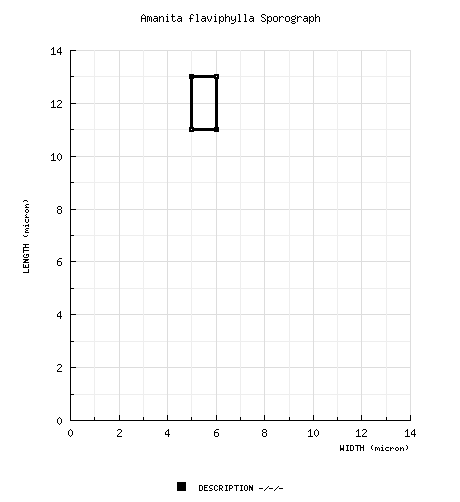
The spores measure 11 - 13 × 5 - 6 µm and are elongate to cylindric and strongly amyloid. Clamps are present at bases of basidia, frequency unknown. The spore deposit is described as "buff." [Note: Miller seems to use this term to mean something like pale primrose yellow. A spore print should be attempted without allowing the gill edges to touch the paper on which the print falls—just to be sure that yellow cells from the gill edges are not the cause of the yellow tint apparently seen in by Miller.] |
| discussion |
Originally described from the state of Western Australia, in association with Eucalyptus, Melaleuca, and Hakea growing in very sandy soil. It is known from at least three locations in southern Western Australia. The photograph with the original description seems to show scattered warts on the one cap of which the top is visible which is inconsistent with the written description of the volva. The yellow and orange pigments and their distribution is extremely reminiscent of the effect seen in Amanita specimens with the yellowing syndrome, see A. subsolitaria (Murrill) Murrill. The yellow pigments present in the Syme photo (above) are not at all typical of the yellowing syndrome. Note also that there is no orange pigment visible in the Syme photograph. The presence of clamps, the noncellular subhymenium, and the cap margin which appears sparsely appendiculate in the Miller photograph cited above (and is clearly appendiculate in the Syme photo), all support Miller's placement of this species in section Lepidella. Precise placement within section Lepidella is not possible at this time.—R. E. Tulloss |
| brief editors | RET |

 Spore data sets and their composite