| name |
Amanita flavescens |
| author |
(E.-J. Gilbert & S. Lund.) Contu. 1988. Pagine Bot. 12: 12. |
| name status |
nomen acceptum |
| english name |
"False Saffron Ringless Amanita" |
| synonyms |
≡ Amanitopsis vaginata var. flavescens E.-J. Gilbert & S. Lund. nom. inval. 1940. Iconogr. Mycol. (Milan) 27, suppl.: 75, tab. 5 (fig. 2). [Lacking Latin diagnosis. ICBN §36.1]
≡ Amanita vaginata var. flavescens E.-J. Gilbert & S. Lund. in E.-J. Gilbert. 1941. Iconogr. Mycol. (Milan) 27, suppl. (2): 217.
=Amanita adnata sensu S. Lund. & Nannf. 1936. Fungi Exsic. Suecici Upsaliensis: 308. [Misapplication.]
≡ Amanita flavescens (E.-J. Gilbert & S. Lund.) Kuthan in Kuthan & Kotlaba. 1988. Sborn. Nár. Muz. v Praze, Řada B, Přír. Vědy 44(3-4): 215. [Superfluous combination.]
≡ Amanita contui Bon & Courtec. in Bon nom illeg. 1989. Doc. Mycol. 19(76): 74. [Superfluous name; avowed replacement for a previously validly published name of the same rank. ICBN §52.1]
non Venenarius flavescens Murrill. nom. nud. 1951. Univ. Florida Agric. Exp. Sta. Tech. Bull. 478: 24.
The editors of this site owe a great debt to Dr. Cornelis Bas
whose famous cigar box files of Amanita nomenclatural information
gathered over three or more decades were made available to RET for computerization
and make up the lion's share of the nomenclatural information presented on this site.
|
| etymology |
flavus "yellow" + -escens "becoming"; hence, "becoming yellow" |
| MycoBank nos. |
444537 |
| GenBank nos. |
Due to delays in data processing at GenBank, some accession numbers may lead to unreleased (pending) pages.
These pages will eventually be made live, so try again later.
|
| holotypes |
PC; isotypes widely distributed |
| type studies |
Tulloss, here |
| revisions |
Tulloss, here |
| selected illustrations |
Tulloss and Gulden. 1999. Blekksoppen 27(79): 5. |
| intro |
The following text may make multiple use of each data field.
The field may contain magenta text presenting data from a type study
and/or revision of other original material cited in the protolog of the present taxon.
Macroscopic descriptions in magenta are a combination of data from the protolog and
additional observations made on the exiccata during revision of the cited original
material.
The same field may also contain black text, which is data from a revision of the present
taxon (including non-type material and/or material not cited in the protolog).
Paragraphs of black text will be labeled if further subdivision of
this text is appropriate.
Olive text indicates a specimen that has not been
thoroughly examined (for example, for microscopic details) and marks other places in the text
where data is missing or uncertain.
The following material not directly from the protolog of the present taxon is based upon
original research by R. E. Tulloss. |
| pileus |
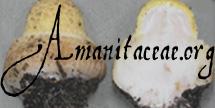
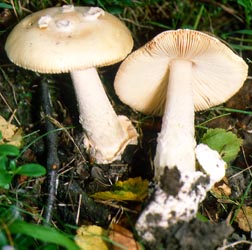
40 - 50 mm wide, Buff Yellow (2.5Y 8.0/7.0); context thin; margin striate [quite short in exsiccata—(0.1R - 0.15R)], nonappendiculate; universal veil absent. |
| lamellae |
narrowly adnate by line, not very crowded, with edge of varying form; lamellulae truncate to rounded truncate, common, of diverse lengths, unevenly distributed. |
| stipe |
75 - 100 mm long, white, subcylindric or slightly narrowing upward; context not described; exannulate; universal veil as saccate volva, membranous, white, adhering to stipe base only (up to one quarter of limb height in exsiccata), having two to four lobes sometimes of very different heights, with interior surface in exsiccata roughly concolorous with pileus as opposed to buff to buffy cream or sordid cream exterior surface, with limb reaching up to nearly half of stipe length. |
| odor/taste |
not recorded.
not recorded. |
macrochemical
tests |
none recorded.
none recorded. |
| pileipellis |
with suprapellis of partially gelatinized to gelatinized hyphae colorless and 35 - 60 µm thick, with subpellis of ungelatinized elements orangish yellow and 125 - 175 µm thick; overall 170 - 235 µm thick, exuding yellow pigment in 20% NH4OH; filamentous, undifferentiated hyphae 2.4 - 6.4 µm wide, branching, interwoven, with some having yellowish subrefractive walls; vascular hyphae 3.2 - 19.2 µm wide, branching, sinuous, occasionally tangling locally, scattered to locally common.
RET additions: Suprapellis may be minimal. Vascular hyphae sometimes narrower near pileus margin (e.g., 2.4 - 6.0 μm wide), slightly sordid brownish yellow to orange-brown to sordid yellow. |
| pileus context |
largely collapsed; filamentous, undifferentiated hyphae 2.4 - 8.0 µm wide, branching, plentiful, interwoven in open lattice, usually fasciculate, occasionally with yellowish subrefractive walls; acrophysalides clavate, thin-walled, up to 89 × 24 µm and probably larger; vascular hyphae not observed. |
| lamella trama |
bilateral; wcs = 30 - 40 µm; subhymenial base comprising divergent intercalary cells [ovoid to clavate, up to 35 × 16.8 µm, thin-walled, scattered, some overlapping subhymenium (but not giving rise to basidia), some not arising from central stratum] and plentiful, frequently branching, filamentous, undifferentiated hyphae (often with branches parallel to central stratum), with angle of divergence very variable from shallow to nearly perpendicular to central stratum; central stratum including partially inflated intercalary segments (e.g., fusiform, 87 × 14.0 µm); filamentous, undifferentiated hyphae 2.0 - 9.0 µm wide, branching; terminal, divergent inflated cells not observed; vascular hyphae 3.2 - 6.4 µm wide, sinuous, common |
| subhymenium |
wst-near = 40 - 50 µm; wst-far = 65 - 80 µm; sometimes pseudoparenchymatous locally, often including hyphal segments running parallel to central stratum, with basidia arising from sides and ends of uninflated hyphal segments and occasionally from inflated cells. |
| basidia |
40 - 69 × 10.5 - 15.8 µm, dominantly 4-sterigmate (even in apparently immature basidiome), rarely 1-sterigmate, with sterigmata up to 8.9 × 2.3+ µm; clamps not observed. |
| universal veil |
On pileus: absent. On stipe base, exterior surface: filamentous, undifferentiated hyphae 1.9 - 14.4 µm wide, most under 6.0 µm wide, branching, dominantly in fascicles, but also singly, many with sublongitudinal orientation, densely packed, ungelatinized to partially gelatinized, sometimes with yellowish walls; vascular hyphae not observed. On stipe base, interior: filamentous, undifferentiated hyphae 1.6 - 8.0 µm wide, branching, dominating, dominantly in fascicles, occasionally singly, interwoven in open lattice, occasionally with yellowish walls, sometimes constricted at septa, with tip cells occasionally slightly expanded; inflated cells clavate to broadly clavate to ovoid, not plentiful, scattered, up to 50 × 37 µm, with walls sometimes slightly thickened; vascular hyphae up to 17.6 µm wide, scarce. On stipe base, inner surface: partially gelatinized, comprising entirely yellowish filamentous, undifferentiated hyphae.
RET additions: Inflated cells of interior layer may be larger than reported for the type (e.g., 63 × 17.5 μm and 65 × 65 μm) with walls thickened up to 0.8 μm. The inner surface layer of the saccate volva may be scant or present only in limited areas and appear stretched with hyphae not strongly vertically aligned (like strings of filled string bag). |
| stipe context |
longitudinally acrophysalidic; filamentous, undifferentiated hyphae 2.7 - 10.6 µm wide, branching, plentiful, often with yellowish walls; acrophysalides plentiful, up to 154 × 45 µm, often broad and rounded at base, thin-walled; vascular hyphae 3.5 - 8.0 µm wide, infrequent. |
| partial veil |
absent in sect. Vaginatae.
absent in sect. Vaginatae. |
| lamella edge tissue |
region dominated by filamentous, undifferentiated hyphae (even in rather immature basidiocarp); inflated cells somewhat sparsely distributed, clavate to pyriform to subglobose, usually not forming distinct layers, in rare regions of more plentiful cells up to 5 layers present.
RET additions: sterile; in younger material with inflated cells in 5 - 6 layers, readily collapsing, detersile, subpyriform to subclavate (e.g., 27 - 45 × 19.0 - 25 μm), with filamentous hyphae tending to become dominant. |
| anatomical figures |
|
| basidiospores |
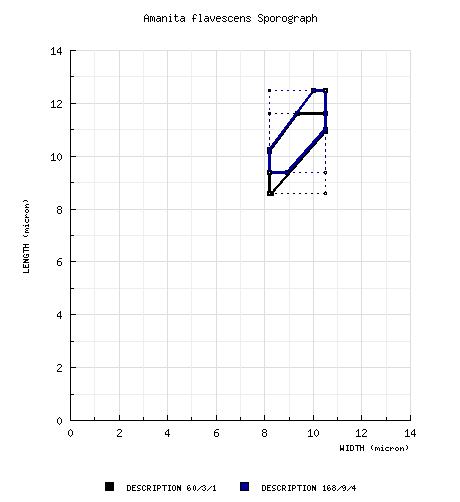
[60/3/1] (8.4-) 8.6 - 11.6 (-13.6) × (7.4-) 8.2 - 10.5 (-12.6) µm, (L = 9.6 - 10.7 µm; L’ = 10.2 µm; W = 8.6 - 9.6 µm; W’ = 9.1 µm; Q = (1.02-) 1.04 - 1.24 (-1.35); Q = 1.12 - 1.14; Q’ = 1.13), hyaline, colorless, smooth, thin-walled, inamyloid, globose to subglobose to broadly ellipsoid to (infrequently) ellipsoid, adaxially flattened; apiculus sublateral, cylindric to truncate-conic; contents granular to mono- or multiguttulate; color in deposit not known.
composite for all material revised by RET: [168/9/4] (8.4-) 9.4 - 12.5 (-17.6) × (7.4-) 8.2 - 10.5 (-14.1) µm, (L = 9.6 - 11.5 µm;
L’ = 10.7 µm; W = 8.6 - 9.9 µm; W’ = 9.3 µm; Q = (1.02-) 1.05 - 1.25 (-1.58); Q = 1.11 - 1.20; Q’ = 1.14), hyaline, colorless, smooth, thin-walled, inamyloid, globose to subglobose to broadly ellipsoid to (infrequently) ellipsoid, adaxially flattened; apiculus sublateral, cylindric to truncate-conic; contents granular to mono- or multiguttulate; color in deposit not known. |
| ecology |
Sweden: In lawn under Betula in plantation of frondose trees.
Norway: At 350 - 750 m elev. In ravine landscape with remnants of natural Alnus forest or in calcarious soil of mixed forest in small scale agricultural landscape or in Picea forest or "in alpine zone." |
| material examined |
NORWAY: AKERSHUS—Ås -
Åsmosan, 2.viii.1984 Gro Gulden 16/84 (O).
BUSKERUD—Kongsberg -
Lindåskroken [UTMWGS84 NM 35,01-02],
21.viii.1999 P. Marstad, H. Myhre, T. Torjesen s.n.
[Tulloss 8-21-99-E] (O; RET 310-7); Efteløt
prestegård [UTMWGS84 NM 455,012-013]
20.viii.1999 L. Winter, S. Aasrum, M. Nuñez s.n.
[Tulloss 8-20-99-C] (O; RET 308-10, nrITS seq'd.).
NORDLAND—Saltdal, near Belvatnet [2128 I
WQ 4430, 750 m], 28.viii.1988 Jens Stordal 25605
(O).
OPPLAND—Nord-Aurdal
[32 V NN 020 460, 870 m], 26.vii.1981 Jens Stordal
21143 (O).
SWEDEN:
Upsala, Slottsbacken, ca. Gunnar Wennerberg Monument,
22.vii-3.viii.1936 S. Lundell & K. G. Ridelius
[Fung. Exsicc. Suecici No 308 as "Amanitopsis
adnata (W. G. Smith apud Saunders &
Smith) Sacc."] (holotype, PC). |
| discussion |
t.b.d. |
| citations |
—R. E. Tulloss |
| editors |
RET |
|


 Spore data sets and their composite