

| name | Amanita fibrillosa |
| name status | insufficiently known |
| author | Beeli |
| intro | The following information is almost entirely based on the original description of Beeli. Gilbert (1940) provides one spore drawing and an hypothesis concerning the present species' possible being based on an old specimen of A. strobilaceovolvata (see discussion, below). |
| cap | The viscid, bell-shaped or broadly bell-shaped cap of A. fibrillosa is about 70 mm wide, brown-sepia, and darker over the marginal striations and over a central umbo. The soft flesh becomes slightly pinkish upon exposure to air. The cap's margin is striate. It bears rather easily crumbling warts in the shape of pyramids. |
| gills | The free gills are white with a brown edge and about 6 mm broad. Beeli states that the gills number 9 per cm [possibly as measured along the cap's circumference]; and the short gills, 3 per cm. |
| stem | The solid, ringless stipe is 120 - 130 × 6 - 8 mm, whitish, cylindric, and covered with grayish fibrils. The flesh becomes slightly pinkih on exposure to air. The volva is saccate, membranous, and ochraceous and has its surface divided into slightly bulbous regions. |
| odor/taste | The odor of this species is said to be agreeable; and the taste, sweet with a sharp aftertaste. |
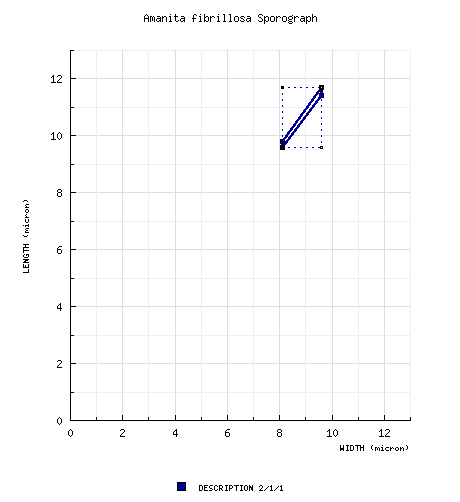
| spores | Two authors [Beeli (1935) and Gilbert (1940)] have reported on the spores of this species. Their data is incompatible. The data drived from Gilbert' spore drawings has been shown to be more reliable in other cases; hence, the spores are about 9.6 - 11.7 × 8.1 - 9.6 μm, broadly ellipsoid, and inamyloid. |
| discussion |
This species was originally described from the Democratic Republic of Congo. It was described as occurring singly in dry forest. Gilbert proposed that the present species is based on an old specimen of A. strobilaceovolvata that had lost is ring and (presumably) become decolored. This seems unlikely. It would be unusual for a post-mature specimen of an Amanita to have larger spores than are found in a younger specimen of the same species. |
| brief editors | RET |
| name | Amanita fibrillosa | ||||||||||||||||||||
| author | ["fibrilosa" (sic)] Beeli. 1935. Fl. Iconogr. Champ. Congo 1: 22, tab. 4 (fig. 1). [Note: Correct spelling of the epithet appears in the caption to the figure.—ed.] | ||||||||||||||||||||
| name status | insufficiently known | ||||||||||||||||||||
| etymology | fibrillosus "covered with fine (thread-like) fibers" | ||||||||||||||||||||
| MycoBank nos. | 517866 | ||||||||||||||||||||
| GenBank nos. |
Due to delays in data processing at GenBank, some accession numbers may lead to unreleased (pending) pages.
These pages will eventually be made live, so try again later. Search:
Showing 0 to 0 of 0 entries | ||||||||||||||||||||
| holotypes | BR (implicit) | ||||||||||||||||||||
| intro |
The following text may make multiple use of each data field. The field may contain magenta text presenting data from a type study and/or revision of other original material cited in the protolog of the present taxon. Macroscopic descriptions in magenta are a combination of data from the protolog and additional observations made on the exiccata during revision of the cited original material. The same field may also contain black text, which is data from a revision of the present taxon (including non-type material and/or material not cited in the protolog). Paragraphs of black text will be labeled if further subdivision of this text is appropriate. Olive text indicates a specimen that has not been thoroughly examined (for example, for microscopic details) and marks other places in the text where data is missing or uncertain. The following material is derived from the protolog of the present taxon and (Gilbert 1940 & 1941). | ||||||||||||||||||||
| pileus | from protolog: 70 mm wide, brown-sepia darker over striations and umbo, expanded-campanulate, umbonate, slightly viscous; context soft fleshy, fibrillose, becoming slightly pink on exposure to air; margin striate (ca. 0.2-0.3R per figure); universal veil as several warts, pyramidal, flocculent. | ||||||||||||||||||||
| lamellae | from protolog: free, 9 per cm, white, with brown edge, 6 mm broad, acute at both ends, thin; lamellulae 3 per cm. | ||||||||||||||||||||
| stipe | from protolog: 120 - 130 × 6 - 8 mm, whitish, cylindric, covered with grayish fibrils; context solid, soft, fibrillose, becoming slightly pink on exposure to air; exannulate; universal veil as saccate volva, membranous, ochraceous, with surface divided into slightly bulbous regions. | ||||||||||||||||||||
| odor/taste | from protolog: Odor agreeable. Taste of walnuts with a sharp aftertaste. | ||||||||||||||||||||
| macrochemical tests |
none recorded. | ||||||||||||||||||||
| pileipellis | from protolog: filamentous hyphae thin, "parallel," ?"oblong"; excretive (?vascular) hyphae present. | ||||||||||||||||||||
| pileus context | not described. | ||||||||||||||||||||
| lamella trama | from protolog: bilateral. | ||||||||||||||||||||
| subhymenium | not described. | ||||||||||||||||||||
| basidia | not described. | ||||||||||||||||||||
| universal veil | not described. | ||||||||||||||||||||
| stipe context | not described. | ||||||||||||||||||||
| partial veil | absent. | ||||||||||||||||||||
| lamella edge tissue | not described. | ||||||||||||||||||||
| basidiospores |
from protolog: 6 - 7 μm, hyaline, smooth, "globose"; apiculus present (per figure); contents guttulate; white in deposit. [Note: According to the drawing by Mme. Goossens, the spores are subglobose or broadly ellipsoid; however, they are not presented in lateral view. Data is insufficient for generation of a sporograph.—ed.] Gilbert (1940): [2/1/1] 9.6 - 11.7 × 8.1 - 9.6 μm, (Q = 1.19 - 1.21), broadly ellipsoid, inamyloid. [Note: Spore measurements are taken from the two drawings of (Gilbert 1940: tab. VI (fig. 2)) that are even close to being presented in lateral view. As it is, the spore's widths are probably exaggerated and the length of the larger one reduced by the apparent orientation of the spore; consequently, the Q values are suppressed.—ed.] | ||||||||||||||||||||
| ecology | from protolog: Solitary. Terrestrial in dry forest. | ||||||||||||||||||||
| material examined | from protolog: CONGO, DEMOCRATIC REPUBLIC OF: PROV. EQUATEUR—Territoire Lisala - Binga [2°23'41" N/ 20°25'25" E, 361 m], ii.1932 M. Goossens-Fontana 960 (holotype, BR, watercolor). | ||||||||||||||||||||
| discussion |
Gilbert (1941) treated this species as based on an old specimen of A. strobilaceovolvata Beeli. However, it would be very odd for the spores of an old speciment to be larger and narrower than those of a young one; and this is the case if one compares the few spores drawn by Gilbert from the implicit holotypes of the two species in question [Gilbert 1941: 93, tab. VI (figs. 1 and 2)]. The sample size is minimal; however, the following figure provides comparisons of the sporographs of the present species and A. strobilaceovolvata. In addition,
| ||||||||||||||||||||
| citations | —R. E. Tulloss | ||||||||||||||||||||
| editors | RET | ||||||||||||||||||||
Information to support the viewer in reading the content of "technical" tabs can be found here.
 Spore data sets and their composite
Each spore data set is intended to comprise a set of measurements from a single specimen made by a single observer; and explanations prepared for this site talk about specimen-observer pairs associated with each data set. Combining more data into a single data set is non-optimal because it obscures observer differences (which may be valuable for instructional purposes, for example) and may obscure instances in which a single collection inadvertently contains a mixture of taxa.

Text and User-Generated Sporographs are published under the Creative Commons License.

In the case of a taxon page, image credits are on the 'image' tab.