| name |
Amanita fibrillopes |
| author |
O. K. Mill. 1992a ["1991"]. Canad. J. Bot. 69: 2700, figs. 37-40, 51. |
| name status |
nomen acceptum |
| english name |
"Bush Elf Amanita" |
| MycoBank nos. |
358174 |
| GenBank nos. |
Due to delays in data processing at GenBank, some accession numbers may lead to unreleased (pending) pages.
These pages will eventually be made live, so try again later.
|
| holotypes |
VPI |
| revisions |
Davison et al. 2013. Nuytsia: 600, figs. 5-6. |
| intro |
The following text may make multiple use of each data field.
The field may contain magenta text presenting data from a type study
and/or revision of other original material cited in the protolog of the present taxon.
Macroscopic descriptions in magenta are a combination of data from the protolog and
additional observations made on the exiccata during revision of the cited original
material.
The same field may also contain black text, which is data from a revision of the present
taxon (including non-type material and/or material not cited in the protolog).
Paragraphs of black text will be labeled if further subdivision of
this text is appropriate.
Olive text indicates a
specimen that has not been
thoroughly examined (for example, for microscopic
details) and marks other places in the text
where data is missing or uncertain.
The following material is drawn from the
protolog of the present species.
from protolog: Basidiome
small, with broad stature. [Note: The
reader should be aware that the photograph of this
species published in the protolog suggests that
the following description is based on a deformed
and depauperate specimen. Hence, many
characters recorded in the protolog may not
describe a well-developed, healthy
specimen.—ed.] |
| pileus |
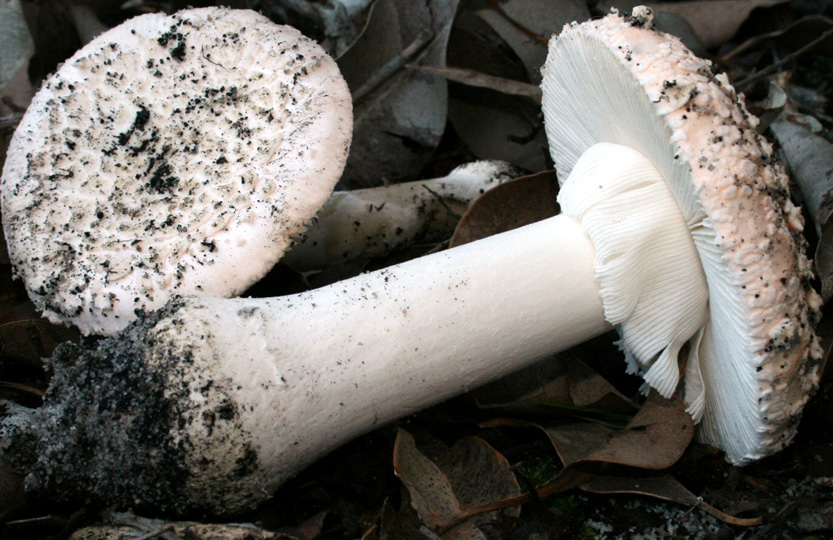
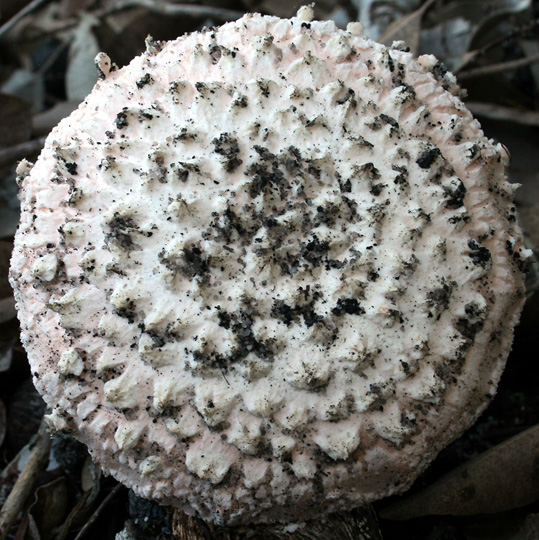
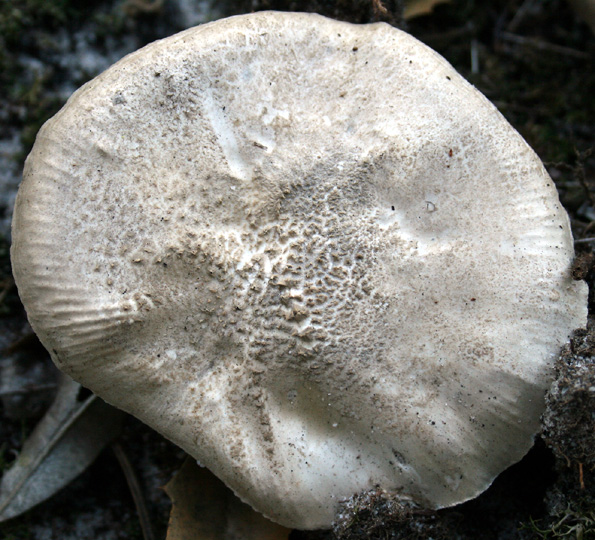
protolog: 32 - 34 mm wide, buff, darkening in age to light brown, convex, dry, areolate; context not described; margin nonstriate; universal veil as densely placed warts, light brown or gray-brown or broan, "nearly" or "often" pointed, with each wart centered in areola. |
| lamellae |
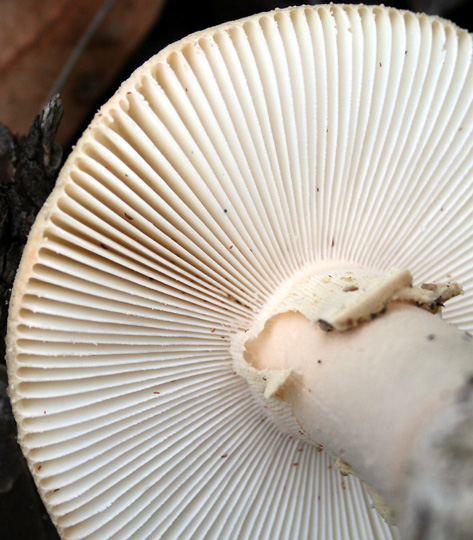
protolog: adnate, close, white, becoming light brownish with age, "thick"; lamellulae infrequent or absent. |
| stipe |
protolog: 22 - 32 mm × 5 - 10 mm, with upper surface in young specimens tinted orange-pink (6A2), dry, with rows of tufted, grayish-brown fibrils densely formed over the entire surface; bulb marginate to non-marginate; context not described; partial veil adhering to edges of lamellae, falling away at maturity leaving many orange (5A2) pieces clinging to edges of lamellae but forming neither [a membranous, skirt-like "annulus"] nor [leaving appendiculate remains on pileus margin]; universal veil on "upper bulb surface of two specimens." [Note: In the description of the partial veil, the editor has changed the word "surface" with relation to lamellae to "edge." The photograph in the protolog was used to interpret other parts of the description of the partial veil.—ed.] |
| odor/taste |
not recorded. |
macrochemical
tests |
none recorded. |
| pileipellis |
protolog: as mixocutis, up to 240 - 350 µm thick, not gelatinized, yellowish in KOH to light reddish-brown in Melzer’s Reagent; filamentous hyphae 3 - 9 µm wide, often branched, thin-walled. |
| pileus context |
protolog: hyaline in KOH and light yellowish orange in Melzer’s Reagent; filamentous hyphae 4 - 11 (-20) µm wide, interwoven, thin-walled; acrophysalides up to 20 µm wide. |
| lamella trama |
protolog: [bilateral, ]divergent, yellowish in KOH, light ochraceous in Melzer’s Reagent; filamentous hyphae 3 - 13 µm wide, with scattered inflated cells up to 36 µm wide, thin-walled. |
| subhymenium |
protolog: irregular, often angular, thin-walled, hyaline cells, 6 - 20 × 5 - 12 µm. |
| basidia |
protolog: 38 - 56 × 9 - 12 µm, 4-spored; clamps absent. |
| universal veil |
protolog: On pileus: filamentous hyphae 3 - 12 µm wide, abundant, interwoven, hyaline in KOH and Melzer’s Reagent; inflated cells "ovoid to vesiculose," (15-) 30 - 55 × (18-) 22 - 35 µm, intercalary or terminal (singly or sometimes in chains). On stipe not described. |
| stipe context |
not described. |
| partial veil |
not described. |
| lamella edge tissue |
protolog: inflated cells pyriform to subglobose to globose, 12 - 25 × 10 - 20 µm, thin-walled, hyaline, terminal singly or (often) in chains, "voluminous." |
| basidiospores |
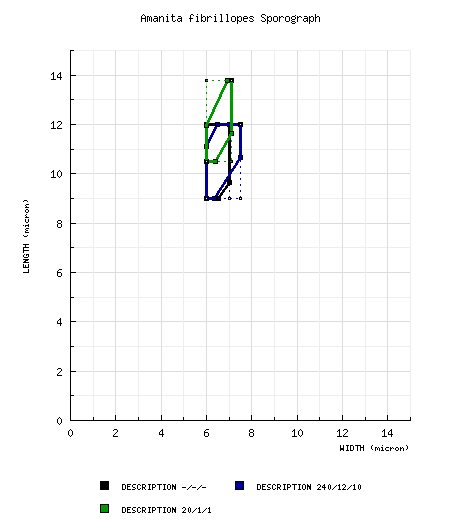
protolog: [-/-/-] 9.0 - 12.0 (-13.0) × 6.0 - 7.0 (-8.4) μm, (Q = 1.38 - 2.0; Q' = 1.70), thin-walled, inamyloid, ellipsoid to elongate; apiculus "prominent"; contents yellowish in Melzer's reagent; color in deposit not recorded.
Davison et al. (2013): [240/12/10] (8.5-) 9.0 - 12.0 (-14.0) × (5.0-) 6.0 - 7.5 (-8.0) μm, (L = 10.1 - 11.1 μm; L′ = 10.9 μm;
W = 6.2- 7.0 μm; W′ = 6.6 μm; Q = (1.29-) 1.42 - 1.85 (-2.08); Q = 1.49 - 1.78; Q′ = 1.65), hyaline, colorless, thin-walled, smooth, inamyloid, ellipsoid to elongate, occasionally adaxially flattened; apiculus sub-lateral, truncate, 1 × 1.5 μm; contents monoguttulate; white to pale cream in deposit.
RET: [20/1/1] (10.2-) 10.5 - 13.8 (-14.5) × 6.0 - 7.1 (-7.5) μm, (L = 12.1 μm; W = 6.7 μm; Q = (1.59-) 1.64 - 1.99 (-2.15); Q = 1.78), ellipsoid to elongate, infrequently cylindric. |
| ecology |
protolog: In clusters. In sandy soil of forest road under Eucalyptus jacksonii and Agonis juniperina.
Davison et al. (2013): Solitary or gregarious, in sandy or gravelly soil in dry sclerophyll forest and
Banksia woodland or in humus rich soil in seasonally wet eucalypt and paperbark woodland; often associated with Eucalyptus marginata, E. jacksonii, Allocasuariana fraseriana, Corymbia calophylla,
Melaleuca preissiana and Agonis sp. Amanita fibrillopes is a distinctive species that is widely distributed
and common. It occurs in the Swan Coastal Plain, Jarrah Forest and Warren bioregions (Department of the Environment 2013). It has not been recorded in South Australia (Grgurinovic 1997) or eastern Australia (Wood 1997). |
| material examined |
protolog: AUSTRALIA:
WESTERN AUSTRALIA—Walpole - Town of
Walpole-Nornalup Nat. For., Gully Rd.,
s.d. O. K. Miller 23890 [E623]
(holotype, VPI).
Davison et al. (2013): AUSTRALIA:
WESTERN AUSTRALIA: [localities withheld
for conservation reasons] 21.v.2006 N.L. Bougher
187 (PERTH), 12.vi.1988 E. M. & P. J. N.
Davison [E. Davison EMD 9-1988] (PERTH), 25.vi.2006
E. M. & P. J. N. Davison [E. Davison EMD 8-2006] (PERTH), 18.v.2008 E. M. & P. J. N. Davison [E. Davison EMD 9-2008] (PERTH, nrITS seq'd,), 18.v.2008
E. M. & P. J. N. Davison [E. Davison EMD
10-2008] (PERTH), 1.vi.2008 E. M. & P. J. N.
Davison [E. Davison EMD 12-2008] (PERTH 08353158), 28.v.2010
E. M. & P. J. N. Davison [E. Davision EMD
4-2010] (PERTH), 18.vi.2006 J. Keeble & A.
Francis s.n. [E. Davison EMD 6-2006] (PERTH),
20.v.2006 P. Robertson E 8315 (PERTH).
RET: AUSTRALIA: WESTERN
AUSTRALIA: [localities withheld for
conservation reasons] 18.v.2008 E. M. & P. J. N.
Davison [E. Davison EMD 9-2008] (PERTH 08353158; RET 447-2, nrITS seq'd.). |
| discussion |
The original description labors somewhat to describe the possibly abnormal basidiomes of the type collection. Revision based on additional collections of this species was necessary and was carried out by Davison et al. (2013).
Davison et al. (2013): "In 1975 R.N. Hilton (University of Western Australia) sent herbarium material of a salmon/cinnamon coloured Amanita (not seen by us) from the south-west of Western Australia to Bas at Leiden. Part of this collection (PERTH 7575386) was retained in Western Australia. Bas responded (letter dated 8 March 1976) that he believed it to be a new species, suggesting the informal name Amanita ‘persicina’ ined. to reflect its colour. It had amyloid spores, and Bas placed it in Amanita [subg. Lepidella] sect. Amidella E.-J.Gilbert. The name Amanita sp. ‘persicina’ has however also been used in Western Australia for pink- or peach-coloured amanitas with inamyloid spores which are placed in subg. Amanita (Bougher 2009). Thus the name has been used for two species with similar colouration but different microanatomy (R.E. Tulloss pers. comm.). Amanita ‘persicina’ sensu Bas (PERTH 7575386) awaits description.
"Amanita fibrillopes is placed within subg. Amanita because of the inamyloid spores, and in sect. Amanita because of the eccentric [development of the] primordium, which results in a distinct bulb at the base of the stipe (Bas 1969). This placement is supported by the nrITS RNA sequence. It is placed in Amanita [subsect. Amanitella (Earle) Tulloss & Zhu L. Yang comb. prov. ser. Farinosae Tulloss and Zhu L. Yang nom. prov.] stirps Roseitincta based on pigmentation [and] anatomy of the universal veil and pileipellis (R. E. Tulloss pers. comm.)." |
| citations |
The editors express their thanks to Dr. Elaine Davison for her assistance with Western Australia geographical and other data relating to Miller's original materials of this taxon.
—R. E. Tulloss |
| editors |
RET |
|




 Spore data sets and their composite