| name |
Amanita exiguirubescens Tulloss et al. |
| author |
Tulloss et al. |
| name status |
nomen provisorum |
| english name |
"Small American Blusher" |
| etymology |
exiguus, small + rubescens, existing epithet
in Amanita rubescens (Pers.) Fr. |
| GenBank nos. |
Due to delays in data processing at GenBank, some accession numbers may lead to unreleased (pending) pages.
These pages will eventually be made live, so try again later.
|
| intro |
Olive text indicates a specimen
that has not been thoroughly examined (for example,
for microscopic details) and marks other places in
the text where data is missing or
uncertain.
The following material is based on molecular studies
of Dr. K. W. Hughes and other original research
of R. E. Tulloss.
This species was formerly called "sp-amerirubescens05" on
these pages. |
| odor/taste |
neither recorded. |
macrochemical
tests |
none recorded. |
| lamella edge tissue |
sterile. |
| basidiospores |
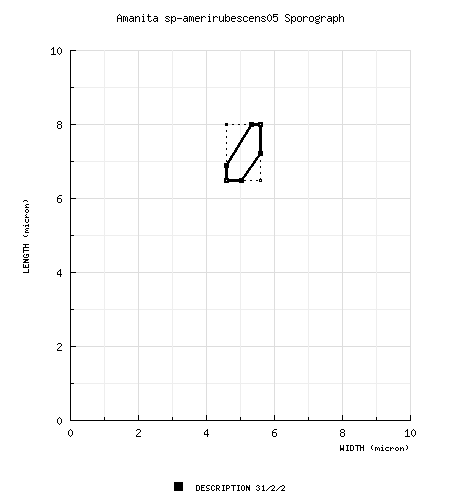
[31/2/2] (6.4-) 6.5 - 8.0 (-10.0) × (4.5-) 4.6 -
5.6 (-6.9) μm, (L = 7.1 μm; L' = 7.1
μm; W = 5.2 μm; W' = 5.2 μm; Q =
(1.25-) 1.29 - 1.50 (-1.60); Q = 1.37 - 1.40;
Q' = 1.38), ??,
??, smooth, thin-walled,
amyloid, dominantly ellipsoid, infrequently broadly
ellipsoid, usually adaxially flattened;
apiculus sublateral, cylindric;
contents ??;
?? in deposit. |
| ecology |
Missouri: In deciduous forest with Quercus (Oak) and
Fagus grandifolia (American Beech). Pennsylvania: Solitary. At ca. 430 m elev.
In wooded area dominated by Carya ovata
(Shagbark Hickory) with some Juglans nigra
(Black Walnut). |
| material examined |
U.S.A.:
INDIANA—Montgomery Co. - Waveland, Shades
St. Pk. [39.9378° N/ 87.0894° W, 223 m], 28.viii.2012
Stephen Russell 3668 (RET 530-9, nrITS seq'd.).
MISSOURI—Newton Co. - Neosho, Fort
Crowder Conservation Area [36.8167° N/ 94.3061°
W, 370m], 17.viii.2013 Jon Shaffer s.n.
[mushroomobserver
#143043]
(RET 563-4, nrITS & nrLSU seq'd.).
PENNSYLVANIA—Luzerne Co. - Hunlock Creek
[41.9321° N/ 76.0824° W, 430 m], 4.vii.2013 David
Wasilewski s.n. [mushroomobserver
#138822]
(RET 548-10, nrITS & nrLSU seq'd.). |
| discussion |
Both of the specimens from which spores were measured
were over mature when
dried. Moreover, RET 548-10 did not dry well.
In consequence, the sample of spore data is not only
small, but probably understates the dimensions of the
spores. Possibly, values of Q computed from the
spores are lower than they will be when data is
available from spore prints or gills of material that
is mature, but not over-mature.
The entity was formerly called "sp-amerirubescens05" on
these pages. |
| citations |
—R. E. Tulloss |
| editors |
RET |
|




 Spore data sets and their composite