| name |
Amanita eucalypti |
| author |
O. K. Mill. 1992a ["1991"]. Canad. J. Bot. 69: 2699, figs. 31-33, 48, 49. |
| name status |
nomen acceptum |
| english name |
"Thick-Limbed Death Cap" |
| etymology |
genitive of the name Eucalyptus; hence, "of Eucalyptus" or "belonging to Eucalyptus" |
| MycoBank nos. |
358172 |
| GenBank nos. |
Due to delays in data processing at GenBank, some accession numbers may lead to unreleased (pending) pages.
These pages will eventually be made live, so try again later.
|
| holotypes |
PERTH; isotype, VPI |
| intro |
The following text may make multiple use of each data field.
The field may contain magenta text presenting data from a type study
and/or revision of other original material cited in the protolog of the present taxon.
Macroscopic descriptions in magenta are a combination of data from the protolog and
additional observations made on the exiccata during revision of the cited original
material.
The same field may also contain black text, which is data from a revision of the present
taxon (including non-type material and/or material not cited in the protolog).
Paragraphs of black text will be labeled if further subdivision of
this text is appropriate.
Olive text indicates a specimen that has not been
thoroughly examined (for example, for microscopic details) and marks other places in the text
where data is missing or uncertain.
The following material is drawn entirely from the protolog of the present species.
from protolog: Basidiome medium-sized. |
| pileus |
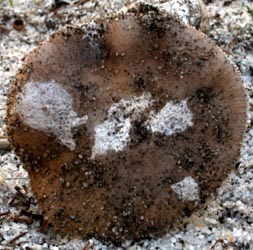
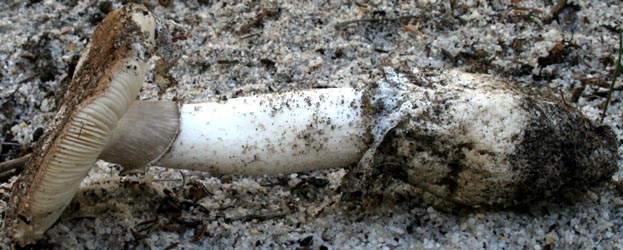
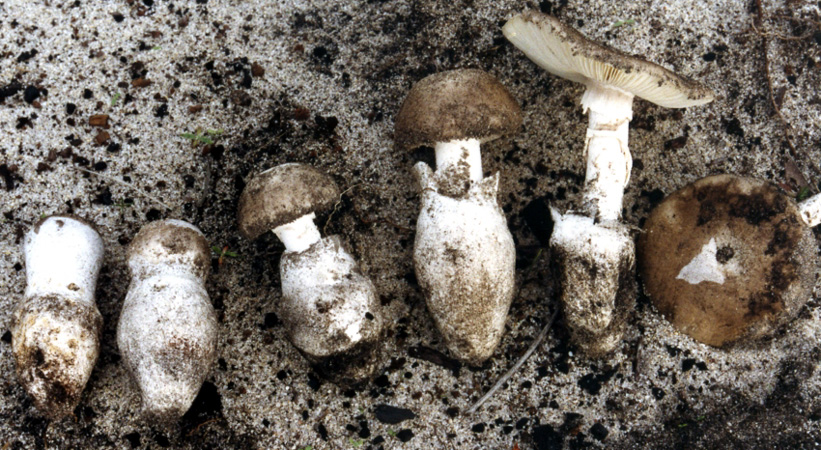
from protolog: 40 - 65 mm wide, brown (5D4-6), sometimes darker brown (5E5-6), broadly convex to nearly plane in age, smooth, glabrous; context firm, white, unchanging when bruised; margin nonstriate; universal veil as large, usually single, thin, white patch over disc. |
| lamellae |
from protolog: adnate, subdistant, white,yellowing (5A3-4) on drying; lamellulae "alternate" with lamellae. |
| stipe |
from protolog: 60 - 160 (-180) × (4-) 7 - 24 mm, white, with scattered loose fibrils; bulb ovoid, 18 - 33 mm wide, with short radicating base; context firm, white, unchanging when bruised; partial veil apical, [membranous, ]persistent, pendent, with striate [upper] surface; universal veil limbate, with limb as much as 20 mm high. |
| odor/taste |
from protolog: Odor indistinct. Taste not recorded. |
macrochemical
tests |
none recorded. |
| pileipellis |
from protolog: up to 100 µm thick; filamentous hyphae, 3.6[? "3 - 6"] µm wide, thin-walled, hyaline, tightly packed, refractive. [Note: The apparent application of "refractive" to all hyphae of the pileipellis is difficult to understand.—ed.] |
| pileus context |
from protolog: filamentous hyphae 4 - 13 µm wide, interwoven, ochraceous in Melzer’s Reagent, yellowish in KOH; inflated cells "slightly swollen." [Note: Because Miller sometimes did not recognize the presence of acrophysalides in the pileus context (and almost never described the stipe context), it would be worthwhile for the pileus context of the present species to be re-examined.—ed.] |
| lamella trama |
from protolog: [bilateral,] divergent; filamentous hyphae, 4 - 10 µm wide, thin-walled, yellowish in KOH, ochraceous in Melzer’s Reagent. |
| subhymenium |
from protolog: pseudoparenchymatous (cellular); inflated cells isodiametric, 5 - 10 µm wide, thin-walled, hyaline or nearly so in both KOH and Melzer’s Reagent. |
| basidia |
from protolog: 48 - 68 × 9 - 12.5 µm, 4-sterigmate; clamps not observed. |
| universal veil |
from protolog: filamentous hyphae (3-) 4 - 14 (-18) µm wide, thin-walled, hyaline, tightly interwoven; inflated cells clavate to cylindric, 90 - 120 × 5 - 8 µm, terminal. [Note: Miller does not indicate whether the sampled tissue of the universal veil came from the pileus or from the stipe base.] |
| stipe context |
not described in protolog. |
| partial veil |
not described in protolog. |
| lamella edge tissue |
not described in protolog. |
| basidiospores |
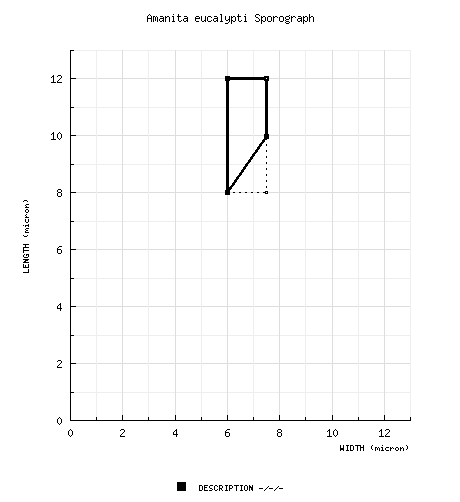
from protolog: [-/-/-] 8.0 - 12.0 × 6.0 - 7.5 (-8.5) μm, (Q = 1.33 - 2.0; Q' = 1.66), thin-walled, amyloid (dark blue), ellipsoid to elongate; apiculus "hyaline"; contents not described; cream in deposit. [Note: The word "hyaline" is provided as the description of the apiculus because that is the sole descriptive term provided for the apiculus in the protolog. The reader should be aware that the apiculus in the Amanitaceae is always hyaline and never participates in the amyloid reaction of the remainder of the spore wall. Hence, "hyaline" normally does not appear in the description of the apiculus.—ed.] |
| ecology |
from protolog: Subgregarious to gregarious. "Partially buried in sand under Eucalyptus marginata, E. patens, Banksia menziesii, Allocasuarina fraseriana, and, in one area, [exotic] Pinus pinaster." |
| material examined |
from protolog: AUSTRALIA: WESTERN AUSTRALIA—Shire of Dandaragan - ca. eastern border of Badgingarra National Park, Brand Hwy. at Mullering Brk. [30°40' S/ 115°29' E], s.d. O. K. Miller 23743 (paratype, VPI).
Shire of Denmark - Giants St. Pk., s.d. O. K. Miller 24723 (paratype, VPI).
City of Perth - unkn. loc., s.d. O. K. Miller 23614 [E512] (holotype, PERTH; isotype, VPI), O. K. Miller 23615 (paratype, VPI), O. K. Miller 23617 [E4277] (paratype, VPI), O. K. Miller 23618 [E4276] (paratype, PERTH), O. K. Miller 23631 (paratype, VPI), O. K. Miller 23737 (paratype, VPI), O. K. Miller 24620 (paratype, VPI).
Yanchep/Perth - Yanchep Nat. Pk., s.d. O. K. Miller 24616 (paratype, VPI). |
| discussion |
Miller placed this species in sect. Phalloideae. The editor concurs. Given the apparently solid color of the cap and the subradicating base of the bulb, this species is most similar to the small (apparently basal per H. Hallen, pers. corresp.) group of the Phalloideae that do not produce amanitins. It would be interesting to evaluate this species for the presence of these toxins. |
| citations |
The editors express their thanks to Dr. Elaine Davison for her assistance with Western Australia geographical and other data relating to Miller's original materials of this taxon and for her permission to use her photographs on these pages.
—R. E. Tulloss |
| editors |
RET |
|




 Spore data sets and their composite