| name |
Amanita eriophora |
| author |
(Berk.) E.-J. Gilbert. 1941. Iconogr. Mycol. (Milan) 27, suppl. (2): 230. |
| name status |
nomen acceptum |
| english name |
"Darjeeling Lepidella" |
| synonyms |
≡ Agaricus ( Amanita) eriophorus Berk. 1850. Hooker's J. Bot. Kew Gard. Misc. 2: 43.
≡ Amanitopsis eriophora (Berk.) Sacc. 1887. Syll. Fung. 5: 26.
≡ Pseudofarinaceus eriophorus (Berk.) Kuntze. 1891. Rev. Gen. Plant. 2: 868.
≡ Vaginata eriophora (Berk.) Kuntze. 1898. Rev. Gen. Plant. 3(2): 539.
The editors of this site owe a great debt to Dr. Cornelis Bas
whose famous cigar box files of Amanita nomenclatural information
gathered over three or more decades were made available to RET for computerization
and make up the lion's share of the nomenclatural information presented on this site.
|
| etymology |
eriophorus, "wool-bearing" |
| MycoBank nos. |
517341, 202377 |
| GenBank nos. |
Due to delays in data processing at GenBank, some accession numbers may lead to unreleased (pending) pages.
These pages will eventually be made live, so try again later.
|
| holotypes |
K |
| revisions |
Corner & Bas. 1962. Persoonia 2: 253, figs. 12-15.
Bas. 1969. Persoonia 5: 480, figs. 238-241. |
| selected illustrations |
E.-J. Gilbert. 1940. Iconogr. Mycol. (Milan) 27, suppl.: tab. 7 (fig. 3). |
| intro |
The following text may make multiple use of each data field.
The field may contain magenta text presenting data from a type study
and/or revision of other original material cited in the protolog of the present taxon.
Macroscopic descriptions in magenta are a combination of data from the protolog and
additional observations made on the exiccata during revision of the cited original
material.
The same field may also contain black text, which is data from a revision of the present
taxon (including non-type material and/or material not cited in the protolog).
Paragraphs of black text will be labeled if further subdivision of
this text is appropriate.
Olive text indicates a specimen that has not been
thoroughly examined (for example, for microscopic details) and marks other places in the text
where data is missing or uncertain.
The data below is derived from the revisions of Corner & Bas (1962) and of Bas (1969).
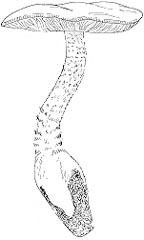
Bas (1969): Basidiomes large to very large, relatively slender. |
| pileus |
Bas (1969): 90 - 200 mm wide, pale dingy brown to pale brownish or yellowish, hemispheric then convex to planar or slightly concave, sometimes umbonate, subviscid; context white, slowly rufescent, fleshy; margin nonsulcate, appendiculate; universal veil at first as complete grayish umber covering of variable thickness, later as small to large grayish brown floccose-felted patches or subconic warts. |
| lamellae |
Bas (1969): free, crowded, white at first, becoming cream, with edge "thinly felted or appendiculate with greyish lilac remants of partial veil when young"; lamellulae attenuate. |
| stipe |
Bas (1969): 140 - 200 × 20 - 30 mm, narrowing upward, with upper two-thirds covered by greyish lilac "floccose-felted remains of friable partial veil," with lower part pale, slightly rufescent with age; bulb more or less napiform, radicating, immarginate to marginate, 30 - 70 × 35 -55 mm; context white, rufescent, apparently solid (per figures); partial veil friable; universal veil as floccose-felted covering of bulb (at least at first), grayish umber, adnate, "forming rim or even limb at top of bulb, but sometimes bulb glabrescent." |
| odor/taste |
Corner & Bas (1962), Bas (1969): Odor faint, slightly nutty. Taste not recorded. |
macrochemical
tests |
none recorded. |
| pileipellis |
Bas (1969): gelatinized near surface; filamentous hyphae 2 - 8 μm wide, brownish, interwoven to subradially arranged; vascular hyphae scattered, broad. |
| pileus context |
not described. |
| lamella trama |
Bas (1969): "insufficiently studied." |
| subhymenium |
Bas (1969): cellular. |
| basidia |
Bas (1969): 40 - 50 × 11 - 13 μm, 4-sterigmate; clamps absent.
RET: 42± × 11.0± μm, 4-sterigmate; no clamps observed. |
| universal veil |
Bas (1969): On pileus: elements irregularly disposed; filamentous hyphae 5 - 15 (-20) μm wide, abundant, repeatedly branching, with many branching elements inflated; inflated cells abundant, globose to ellipsoid to clavate, up to 100 × 75 μm, with brown contents, terminal singly or in short chains; vascular hyphae broad common; clamps absent. On stipe base: not described. |
| stipe context |
Bas (1969): longitudinally acrophysalidic; acrophysalides up to 300 × 35 μm; clamps absent. |
| partial veil |
not described. |
| lamella edge tissue |
Bas (1969): as sterile edge; inflated cells clavate, colorless, 35 - 60 × 12 - 25 μm, predominant in tissue. |
| basidiospores |
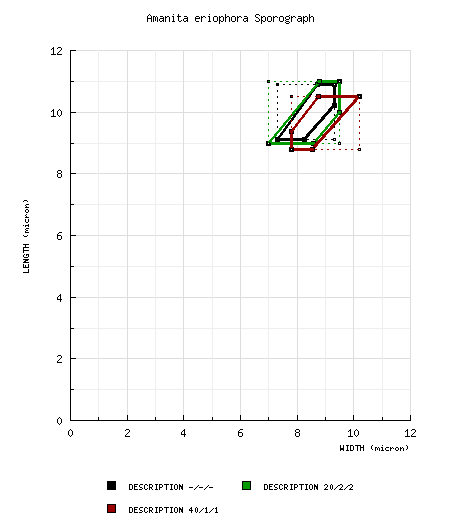
Corner & Bas (1962): [-/-/-] 9.1 - 10.9 × 7.3 - 9.3 μm,
(Q = 1.10 - 1.25; Q = 1.20), hyaline, colorless, smooth, thin-walled, amyloid, broadly ellipsoid, sometimes subglobose; apiculus proportionately rather large; contents cloudy-oleaginous; color in deposit not reported. [Fresh spores are reported to measure 9.0 - 10.0 × 7.0 - 8.5 μm.—ed.]
Bas (1969): [20/2/2] (8.0-) 9.0 - 11.0 (-12.0) × 7.0 - 9.5 (-10.5) μm, (Q = 1.05 - 1.25; Q = 1.15 - 1.20), colorless, hyaline, thin-walled, amyloid, subglobose to broadly ellipsoid; apiculus not described; contents cloudy; color in deposit not recorded.
RET & CRC: [40/1/1] (6.8-) 8.8 - 10.5 (-12.6) × (6.0-) 7.8 - 10.2 (-11.5) μm, (L = 9.6 μm; W = 8.9 μm; Q = (1.0-) 1.03 - 1.20 (-1.25); Q = 1.08), hyaline, yellowish, smooth, thin-walled, strongly amyloid, globose to subglobose to broadly ellipsoid, sometimes broadened at one end, adaxially flattened; apiculus sublateral, cylindric; contents monoguttulate; color in deposit not recorded. |
| ecology |
Bas (1969): Subgregarious. India: Terrestrial in forest. Singapore: Terrestrial in tropical forest. |
| material examined |
Corner & Bas (1962): SINGAPORE: Reservoir Jungle, 26.iii.1931 E. J. H. Corner (L).
Bas (1969): INDIA: WEST BENGAL—Darjeeling Distr. - Darjeeling, 2.ix ca. 1848 J. D. Hooker 111 (holotype, K).
SINGAPORE: Reservoir Jungle, 26.iii.1931 E. J. H. Corner (L).
RET: CAMBODIA: SIEM REAP—ca. Kouk Dong, ca. Angkor Wat, vi.2000 David Arora 00-9 (RET 350-4). |
| discussion |
Bas (1969): "Amanita eriophora is a large to very large, brownish species, easy to recognize because of the friable, grayish lilac partial veil leaving floccose-felted remnants at the margin of the cap, at the edges of the young gills, and especially at the upper two thirds of the stem.
"Because of the brown volva consisting of irregularly disposed, brown, inflated cells on abundant hyphae, the friable ring, the rather large, subglobose to broadly ellipsoid spores, the clampless basidia, and its large size A. eriophora resembles A. borneensis and A. berkeleyi. The volva is thicker, however, and contains more broad hyphae and more conspicuous, irregular, branching elements than in those two species. These last two characters of A. eriophora in addition to the rufescent flesh and the sometimes marginate bulb suggest a realtionship with A. sculpta."
This species was observed (but not collected) by Corner in Malaysia (Tebrau, Johor, 24.ix.1939). |
| citations |
—R. E. Tulloss |
| editors |
RET |
|


 Spore data sets and their composite