

| name | Amanita dunensis |
| name status | nomen acceptum |
| author | R. Heim ex Bon & Andary |
| english name | "Dune Death Cap" |
| intro | The following is based on the original description by Bon & Andary (1983). |
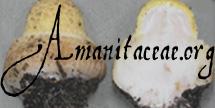
| cap | The cap of Amanita dunensis is (20-) 30 - 50 (-70) mm wide, not very fleshy, quickly becomes planar or depressed in the center, pale green which ranges from a whitish-green to a ochre-olivaceous, with the presence of imbedded radial fibers, with a thin and distinctly striate margin. Volval remnants are absent; microscopically, the cap may retain some hyphae of the volva. The flesh is white. |
| gills | The gills are broad in the middle, narrow at the ends, just attached to the stem, white, with an irregular edge. The short gills are numerous and not truncate. |
| stem | The stem is (40-) 50 - 70 (-80) × (3-) 5 - 8 (-10) mm, cylindric or very slightly narrowing upward, whitish or silvery, undecorated or with pale ochraceous fibers on the stem in a snake skin-like or flame-like pattern. The bulb is minimal. The ring is skirt-like, whitish, fragile, slightly striate on the upper surface. The volva is limbate, rather fragile, and white. The flesh is white. |
| odor/taste | No noticeable odor even in age or while drying. This species is probably deadly POISONOUS and should be assumed so. |
| spores | The authors provide the following spore measurements: (7-) 8 - 10 (-11.5) × (5.5-) 6 - 7.5 (-8) µm and are broadly ellipsoid to ellipsoid and amyloid. Clamps are absent at bases of basidia. |
| discussion |
This species was originally collected in the departement Vendée, France where it was associated with pine (Pinus pinaster) or oak (Quercus ilex) in dunes along the Atlantic coast. According to Neville and Poumarat (2004), this species is known only from France and Portugal on the Atlantic and Mediterranean coasts in sandy soil, 10 - 100 meters from the ocean where it occurs with pine, oak and Cistus. Bon and Andary considered the present species distinct from Amanita phalloides (Fr. : Fr.) Link because of the marginal striations of the cap and the fact that they found no amatoxins in a dried specimen and more phalloidin than they considered usual for A. phalloides. The remainder of their argument that A. dunensis is a distinct species is based upon the striate margin, the thin stature, and the pale coloration of the cap. Considering that the mushroom was found growing in the dunes, the supposed macroscopic difference with A. phalloides might be used instead to argue that the specimens were simply depauperate examples of the latter species. Neville and Poumarat (2004) describe a greater range of size of the fruiting bodies than in the original description and say that the caps are not always striate at first and may only be striate here and there on the margin at maturity. In addition, they say nonstriate and striate caps can be found in a single collection. Moreover within a single cap, the striations can be of extremely uneven length. This suggests that striations are related to the drying of the cap in an area exposed to direct sunlight. This environmental consideration can also contribute to the pale colors in the cap. The stem length may not be genetically determined. One occasionally sees specimens of very different species of Amanita with stems abnormally elongated in order to pass around an obstacle such as a rock or a root and get the mushroom's cap out of the substrate. RET has never examined a specimen of A. dunensis. We agree with Neville and Poumarat that molecular comparison to A. phalloides would be valuable. We are not aware of anyone repeating Andary's assay of toxins in the present species. It would be worth while to perform such an assay on recently collected material.—R. E. Tulloss and L. Possiel |
| brief editors | RET |
| name | Amanita dunensis | ||||||||||||||||||||
| author | R. Heim ex Bon & Andary. 1983. Doc. Mycol. 13(50): 13. | ||||||||||||||||||||
| name status | nomen acceptum | ||||||||||||||||||||
| english name | "Dune Death Cap" | ||||||||||||||||||||
| synonyms |
=Amanita phalloides f. dunensis R. Heim nom. inval. 1963. Rev. Mycol. 28(1): 3. [Lacking Latin diagnosis and specification of holotype. ICBN §36.1, §37.1] The editors of this site owe a great debt to Dr. Cornelis Bas whose famous cigar box files of Amanita nomenclatural information gathered over three or more decades were made available to RET for computerization and make up the lion's share of the nomenclatural information presented on this site. | ||||||||||||||||||||
| MycoBank nos. | 107715, 349020 | ||||||||||||||||||||
| GenBank nos. |
Due to delays in data processing at GenBank, some accession numbers may lead to unreleased (pending) pages.
These pages will eventually be made live, so try again later. Search:
Showing 0 to 0 of 0 entries | ||||||||||||||||||||
| holotypes | in herb. M. Bon | ||||||||||||||||||||
| intro |
The following text may make multiple use of each data field. The field may contain magenta text presenting data from a type study and/or revision of other original material cited in the protolog of the present taxon. Macroscopic descriptions in magenta are a combination of data from the protolog and additional observations made on the exiccata during revision of the cited original material. The same field may also contain black text, which is data from a revision of the present taxon (including non-type material and/or material not cited in the protolog). Paragraphs of black text will be labeled if further subdivision of this text is appropriate. Olive text indicates a specimen that has not been thoroughly examined (for example, for microscopic details) and marks other places in the text where data is missing or uncertain. The following material is derived from the protolog of the present taxon and its description by Neville and Poumarat (2004). The original Latin diagnosis (Bon and Andary 1983) follows: "Amanita phalloide differt statura gracili, pileo pallide ochraco-viridi, margine +/- striata ad instar specierum Amanitariae, sporis +/- elongatis: 8-10 × 6-7.5 μm, (sed amyloideis) atque chimica natura, in sabulosis locis prope mare atlanticum lectus: typus no 4119 in herbario M. B." | ||||||||||||||||||||
| pileus | protolog: (20-) 20 - 50 (-10) mm wide, pale whitish green or orchraceous-olivaceous with some radial virgation as in A. phalloides, subviscid, soon planar or depressed; context white, not very thick, thinning to toward margin with acute cross-section; margin distinctly striate as in subgenus Amanita; universal veil generally absent, but often as colorless remnants. | ||||||||||||||||||||
| lamellae | protolog: subadnate, rather close, white, slightly ventricose; lamellulae not truncate, scattered. | ||||||||||||||||||||
| stipe | protolog: (40-) 50 - 70 (-80) × (3-) 5 - 8 (-10) mm, whitish or silvery, subcylindric or slightly narrowing upward, undecorated or with light ochraceous snakeskin or flame or zebroid patterning; context white; bulb not distinct; partial veil whitish, fragile, pendent, slightly striate; universal veil as "saccate" [limbate?] volva, rather fragile, white. | ||||||||||||||||||||
| odor/taste | protolog: Odor insignificant even in age or as dried. Taste not recorded. | ||||||||||||||||||||
| macrochemical tests |
protolog: KOH - pale yellow on context. | ||||||||||||||||||||
| pileipellis | protolog: filamentous hyphae 5.0 - 8.0 (-10.0) μm wide, more or less gelatinized; clamps absent. | ||||||||||||||||||||
| hymenial trama | protolog: bilateral. | ||||||||||||||||||||
| subhymenium | protolog: subcellular. | ||||||||||||||||||||
| basidia | protolog: (30-) 40 - 50 (-55) × 10.0 - 12.0 (14.0) μm, 4-sterigmate. | ||||||||||||||||||||
| lamella edge tissue | protolog: inflated cells clavate or spheropedunculate, sometimes in chains. [Note: presented as cheilocystidia in the original.—ed.] | ||||||||||||||||||||
| basidiospores |
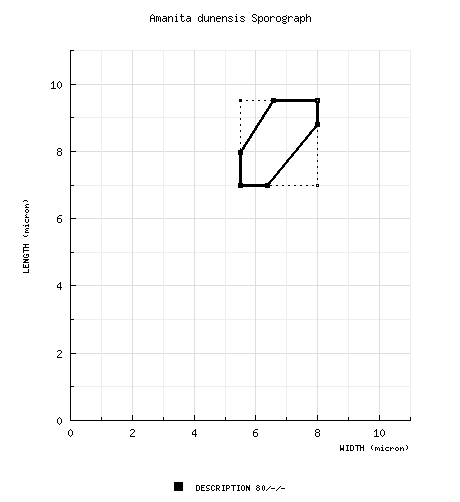
protolog: (7.0-) 8.0 - 10.0 (-11.5) × (5.5-) 5.0 - 7.5 (8.0) μm, amyloid, smooth, ovoid to ellipsoid, more or less elongate. Neville and Poumarat (2004): [80/-/-] 7 - 9.5 (-11.5) × 5.5 - 8 (-9) μm, (L' = 8.4 μm; W' = 6.8 μm; Q = (1.0-) 1.10 - 1.45 (-1.67); Q = 1.20 - 1.31), hyaline, smooth, amyloid, globose to subglobose to broadly ellipsoid to ellipsoid, rarely cylindric, rarely with crassospores present, rarely with giant spores present and these rarely having Q up to 1.77; apiculus sublateral (per figure); contents not recorded; color in deposit not recorded. | ||||||||||||||||||||
| ecology | protolog: In sandy soil of "fixed dunes" ca. Atlantic Coast under Pinus pinaster or Quercus ilex. | ||||||||||||||||||||
| material examined |
protolog: FRANCE: VENDÉE—Le Veillon, ca. Atlantic Ocean, | ||||||||||||||||||||
| discussion |
It may be the case that the present species is based on depauperate material of A. phalloides or on material of that species that has suffered from desiccation in direct sunlight. In fact the possibility that the present name is a synonym of A phalloides seems rather likely to RET. A comparison of the sporographs supports this hypothesis—especially if you consider the increased plenitude of smaller spores in the material of dunensis could be related to reduced availability of water in a sunny, hot, sandy environment: | ||||||||||||||||||||
| citations | —R. E. Tulloss | ||||||||||||||||||||
| editors | RET | ||||||||||||||||||||
Information to support the viewer in reading the content of "technical" tabs can be found here.
| name | Amanita dunensis |
| bottom links |
[ Section Phalloideae page. ] [ Amanita Studies home. ] [ Keys & Checklists ] |
| name | Amanita dunensis |
| bottom links |
[ Section Phalloideae page. ] [ Amanita Studies home. ] [ Keys & Checklists ] |
 Spore data sets and their composite
Each spore data set is intended to comprise a set of measurements from a single specimen made by a single observer; and explanations prepared for this site talk about specimen-observer pairs associated with each data set. Combining more data into a single data set is non-optimal because it obscures observer differences (which may be valuable for instructional purposes, for example) and may obscure instances in which a single collection inadvertently contains a mixture of taxa.

Text and User-Generated Sporographs are published under the Creative Commons License.

In the case of a taxon page, image credits are on the 'image' tab.