| name |
Amanita daucipes |
| author |
(Berk. & Mont.) Lloyd. 1898. Mycol. Writings 1: 7. |
| name status |
nomen acceptum |
| english name |
"Carrot-Footed Lepidella" |
| synonyms |
≡ Agaricus daucipes Berk. & Mont. in Mont. 1856. Syll. Gen. Spec. Cryptogr.: 96.
≡ Amanitopsis daucipes (Berk. & Mont.) Sacc. 1887. Syll. Fung. 5: 26.
≡ Pseudofarinaceus daucipes (Berk. & Mont.) Kuntze. 1891. Rev. Gen. Plant. 2: 868.
≡ Vaginata daucipes (Berk. & Mont.) Kuntze. 1898. Rev. Gen. Plant. 3(2): 539.
≡ Lepiota daucipes (Berk. & Mont.) Morgan. 1907. J. Mycol. 13: 12.
≡ Aspidella daucipes (Berk. & Mont.) E.-J. Gilbert. 1940. Iconogr. Mycol. (Milan) 27, suppl. (1): 79, tab. 55 (fig. 3).
The editors of this site owe a great debt to Dr. Cornelis Bas
whose famous cigar box files of Amanita nomenclatural information
gathered over three or more decades were made available to RET for computerization
and make up the lion's share of the nomenclatural information presented on this site.
|
| MycoBank nos. |
539487, 227654, 158539, 284321 |
| GenBank nos. |
Due to delays in data processing at GenBank, some accession numbers may lead to unreleased (pending) pages.
These pages will eventually be made live, so try again later.
|
| holotypes |
PC |
| revisions |
Bas. 1969. Persoonia 5: 447, figs. 184-188. |
| intro |
The following text may make multiple use of each data field.
The field may contain magenta text presenting data from a type study
and/or revision of other original material cited in the protolog of the present taxon.
Macroscopic descriptions in magenta are a combination of data from the protolog and
additional observations made on the exiccata during revision of the cited original
material.
The same field may also contain black text, which is data from a revision of the present
taxon (including non-type material and/or material not cited in the protolog).
Paragraphs of black text will be labeled if further subdivision of
this text is appropriate.
Olive text indicates a specimen that has not been
thoroughly examined (for example, for microscopic details) and marks other places in the text
where data is missing or uncertain.
The following material not directly from the protolog of the present taxon and not cited as the work
of another researcher is based on original research of R. E. Tulloss. |
| pileus |
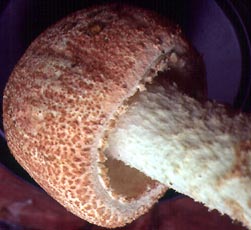
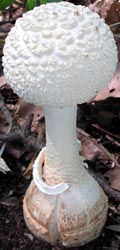
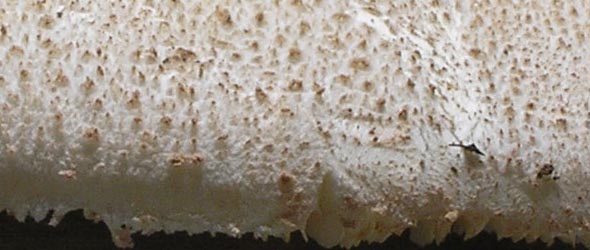
89 - 155+ mm wide, white or sordid very pale beige, darker over disk, hemispheric at first, then convex, dry, dull, sometimes becoming areolate with wart in center of each areole; context white, not staining/bruising when cut, slowly becoming pink and then more or less dark brick red in old wounds, 7 mm thick over stipe, thinning evenly to margin; margin nonstriate, appendiculate with large segments of partial veil or flocculose material, ??; universal veil as thick cake-like warts and/or narrow subconic or small pyramidal warts sometimes connected at tips suggesting decoration on some Lycoperdon spp., toward margin warts becoming smaller then reduced to floccose material, at first pinkish beiged to pinkish to reddish pink, becoming pallid on the sides and grayish on tope, detersile, ??. |
| lamellae |
free (or occasionally very narrowly adnate), without decurrent line on stipe, close to subcrowded, cream in mass, pale yellow or pale yellowish cream in side view, bruising/staining not observed, 7? mm broad, with margin flocculose (lens); lamellulae truncate to attenuate, plentiful, unevenly distributed, of many lengths. |
| stipe |
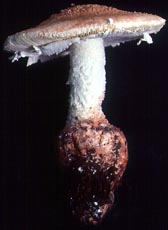
55 - 193 × 9 - 25 mm, white, narrowing downward, decorated with white to pale pinkish to pink flocculence (easily removed on fingers of collector), with flocculence often densest in upper half (approximately); bulb 60 - 85 × 31 - 56 mm, radicating, irregularly napiform or irregularly turbinate or dauciform, infrequently potatoe-like, often with longitudinally oriented clefts, with surface often staining/bruising strongly vinaceous or reddish vinaceous at maturity; context solid, mostly white or cream-white, not staining or bruising rapidly, sometimes with some grayish areas and/or with a few brick red spots in bulb, eventually staining-bruising, with old wounds colored as in case of pileus, larval tunnels not observed; partial veil superior to subapical to apical, white, submembranous/felted, tearing, pulling away from stipe, striate above, flocculose-fibrillose below, with underside having some or many flocculose pinkish areas; universal veil absent on bulb, often with limbus internus remaining as loose rather thick felted ring around base of stipe or as rather robust felted patch or patches at base of stipe, pinkish brown to white with pinkish regions. |
| odor/taste |
Odor strong and sweetish or nondescript in young material, meat-like to “old ham” or decaying protein in older material. [See (Bas 1969).] Taste not recorded. |
| basidiospores |
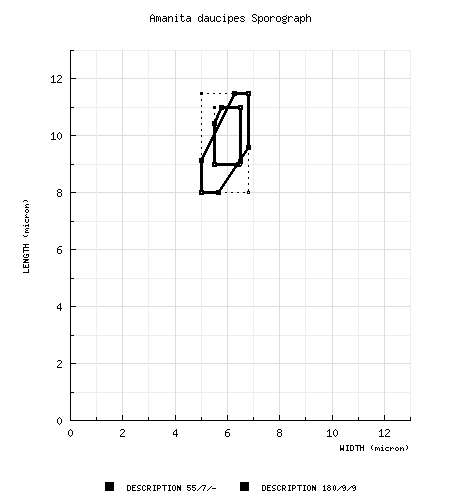
Bas (1969): [55/7/-] (8.5-) 9.0 - 11.0 (-11.5) × (5.0-) 5.5 - 6.5 (-7.0) μm, (Q = 1.40 - 1.90; Q = 1.50 - 1.80), colorless, hyaline, thin-walled, amyloid, ellipsoid to elongate, sometimes subreniform; apiculus not described; contents subgranular to guttulate, refractive; white in deposit.
[180/9/9] (7.7-) 8.0 - 11.5 (-13.8) × (4.5-) 5.0 - 6.8 (-9.9) µm, (L = (8.3-) 8.7 - 10.8 µm; L’ = 9.8 µm; W = 5.6 - 6.5 µm; W’ = 6.0 µm; Q = (1.22-) 1.41 - 1.83 (-2.11); Q = 1.46 - 1.68 (-1.74); Q’ = 1.62), colorless, hyaline, smooth, ??-walled, amyloid, ellipsoid to elongate, rarely broadly ellipsoid, rarely cylindric, adaxially flattened, sometimes expanded at one end, infrequently subfusiform or langeniform; apiculus sublateral, cylindric; contents ??; white in deposit. |
| ecology |
Solitary to subgregarious or (infrequently) gregarious in “fairy ring.” Edo. México: In mixed forest of Pinus and Quercus recovering from extensive logging. New Jersey: In closed canopy mixed deciduous forest with very little understory with Q. alba, Q. rubra, Carya, Ostrya, Acer, Betula, Liriodendron tulipifera, and Liquidambar styraciflua or under Quercus in sandy soil or with Quercus and L. tulipifera. North Carolina: Under Q. rubra. South Carolina: In mixed hardwood-Pinus forest. Tennessee: Under Quercus. Texas: ??. Virginia: ??. West Virginia: ??. |
| material examined |
Bas (1969):
U.S.A.:
MARYLAND—Unkn. Co. - unkn. loc., s.d. L. Krieger s.n. [Kelly 1978] (MICH)
NORTH CAROLINA—Orange Co. - Chapel Hill, 29.ix.1911 W. C. Coker 309 (NCU as "A. chlorinosma form B"), 21.ix.1944 W. C. Coker 14005 (NCU), 30.ix.1946 J. N. Couch 14042 (NCU).
OHIO—Franklin Co. - Columbus, s.d. Sullivant 193 (holotype, PC).
PENNSYLVANIA—Carbon Co. - Bowmanstown, 22.viii.1963 R. Homola s.n. [Bas 3856] (L).
TENNESSEE— Knox Co. - Roaring Springs, 15.vii.1934 L. R. Hesler 4213 (TENN).
U.S.A.:
ARKANSAS—Saline Co. - unkn. loc., 6.vii.2008 J. Justice s.n. (RET 435-8).
INDIANA—Monroe Co. - Bloomington, Griffey Lk. [39.2010° N/ 86.5188° W, 202 m], 21.vii.2012 Stephen Russell s.n. [mushroomobserver.org # 102311] (RET 533-2).
MISSISSIPPI—?? Co. - Upper Pascagoula R. Wildlife Mgmt. Area [30º54.134’ N/ 088º44.502’ W], 12.vii.2009 Alexandra & Phillip Tussing s.n. (RET 442-6).
NEW JERSEY—Hunterdon Co. - Lebanon, Oakmoss Mycol. Preserve [40°38'50.07" N/ 74°47'50.92" W], 26.vii.2006 R. Ballsley, L. Possiel & R. E. Tulloss 7-26-06-B (RET 401-7). Mercer Co. - Marquand Pk., 2.viii.1981 member New Jersey Mycol. Assoc. s.n. [Tulloss NJMA-8-2-81-A] (in herb. New Jersey Mycol. Assoc.); Princeton, Mt. Lucas Rd. [40°22'36" N/ 74°39'23" W, 91 m], 9.ix.1999 N. Macdonald & R. E. Tulloss 9-9-99-L (RET 297-8), ca. Princeton Water Works, vii?.1993 J. D. Montagne s.n. (RET 094-9). Monmouth Co. - Upper Freehold, ca. Imlaystown, Clayton Co. Pk., Bridges Tr. [40°09’26” N/ 74°30’10” W, 75 m], 19.viii.2012 M. A. & R. E. Tulloss 8-19-12-C (RET 508-4); Upper Freehold Twp., ca. Roosevelt, Assunpink Wildlife Mgmt. Area, 16.viii.1980 R. E. Tulloss 8-16-80-F (RET ??). Passaic Co. - unkn. loc., viii.2007 unkn. coll. s.n. (RET 409-3). Somerset Co. - New Brunswick, Rutgers Univ., Cook College, 24.vii.1981 E. Varney s.n. [Tulloss 7-24-81-A] (RET 221-4); ca. Rutgers Univ. (Cook College), grounds of E. R. Squibb & Sons, 29.ix.1989 R. E. Tulloss 9-29-89-A (RET 024-1). Warren Co. - Yards Crk. Reservoir, 20.viii.1982 “Peggy” s.n. [Tulloss 8-20-82-B] (RET 221-4).
NORTH CAROLINA—Iredell Co. - jct. St. Hwys. 64 & 70 & Westminster Rd., 6-10.vii.1987 Allein Stanley 258 p.p. (UNCC, mixed coll.). .
PENNSYLVANIA—Fulton Co. - Cowan’s Gap St. Pk., viii.1982 Emily Johnson s.n. [Tulloss 8-82-EJ] (RET 129-3; XAL). Northampton Co. - Blue Mtn., Game Lands 168, off Old Grade Rd. [40.83025° N/ 75.35626° W, 271 m], 4.viii.2012 Gene Binder s.n. [Tulloss 8-4-12-B] (RET 505-1). Unkn. Co. - ca. border of Franklin and Adams Cos., Michaux St. For., District Rd., 12.viii.2005 Georgiana Bender s.n. [Tulloss 8-12-05-F] (RET 386-8).
SOUTH CAROLINA—Edgefield Co. - Unkn. loc., x.1990 Richard E. Baird s.n. [Tulloss REB6B] (RET 546-9).
TENNESSEE— Blount Co. - GSMNP, Cades Cove, Hyatt Lane, 9.viii.2005 E. B. Lickey & D. J. Lodge [Lodge] DJL-TN-22 (TENN).
TEXAS—Hardin Co. - Big Thicket Nat. Preserve, Turkey Crk. Unit, Kirby Nature Tr., 17.viii.1980 D. P. Lewis 2239 (F; RET 013-8), 20.ix.1980 D. P. Lewis 2323 (F; RET 013-7). Jasper Co. - Jasper, U.S. 190, Catholic Church, 11.x.1997 D. P. Lewis 5925 (RET 286-4). Newton Co. - Bleakwood, 5.ix.1996 D. P. Lewis 5703 (RET 285-10). Orange Co. - Vidor, 10.x.1980 D. P. Lewis 2331 (F; RET 013-6). ?? Co. - Big Thicket Nat. Preserve, 20.ix.1981 participant Texas Mycol. Soc. foray s.n. [D. P. Lewis 2814] (RET 014-1).
VIRGINIA—Augusta Co. - Geo. Washington Nat. For., Todd Lake Campground [38°21'55" N/ 79°12'41" W, 610 m], 28.viii.1982 M. A. King & D. C., M. H. & R. E. Tulloss 8-28-82-B (RET 214-3).
WEST VIRGINIA—Giles Co. - Jefferson Nat. For., Pandapus Pond, 12.vii.1991 R. P. Bhatt 82 (VPI? n.v.). Greenbrier Co. - Monongahela Nat. For., Lake Sherwood Recreation Area [38°00'24" N/ 80°06'40" W, 825 m], 31.viii.1982 D. C. Tulloss 8-31-82-B (MU; RET 214-2). |
| citations |
—R. E. Tulloss |
| editors |
RET |
|



 Spore data sets and their composite