

| name | Amanita cyanopus |
| name status | nomen acceptum |
| author | C. Simmons, T. Henkel & Bas |
| english name | "Henkel's Blue Foot Amanita" |
| images |
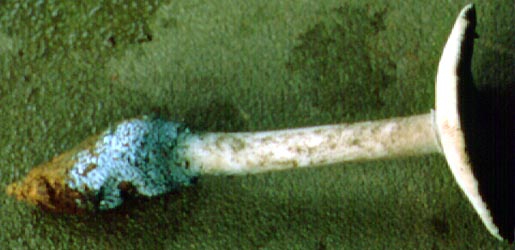  1. Amanita cyanopus, Pakaraima Mtns., Guyana. |
| intro |
This description is based on the original description (2002). |
| cap |
The cap of Amanita cyanopus is more or less 65 mm wide, plano-concave, rather dull grayish to bluish turquoise, with a smooth margin. The volva is present as flat, felted patches particularly near the margin. |
| gills |
The gills are free, crowded, thickish, occasionally forking, pale cream buff, with a finely uneven, light blue to grayish tan edge. |
| stem |
The stem is 95 × 12 mm, cylindric, annulate, light bluish under a coating of minute, gray, floccose scales. The bulb is slenderly turnip-shaped, 55 × 18 mm, and somewhat rooting, with small, bright blue, conical volval warts and ridges on a paler blue to whitish background. A ring is present at the top of the stem but is lost in the specimen that was photographed. The smell is unpleasant and "distinctly of chlorine." |
| spores |
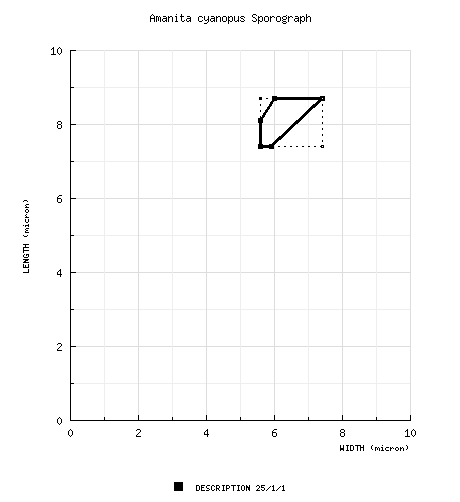
The spores measure 7.4 - 8.7 (-9.0) × (5.0-) 5.6 - 7.4 µm and are broadly ellipsoid to ellipsoid and amyloid. Clamps are absent at the bases of basidia. |
| discussion | The present species grows on an elevated root mat but with hyphae extending down into mineral soil. It was described from a forest dominated by Dicymbe corymbosa and is in the Pakaraima Mountains of Guyana and is known only from the type locality. This is the only species of Amanita known to have a blue pigment. Blue-green staining is known from Amanita pelioma Bas (sect. Lepidella)—an extremely distant relative.—R. E. Tulloss and L. Possiel |
| brief editors | RET |

 Spore data sets and their composite