| name |
Amanita curta |
| author |
(Cooke & Massee) E.-J. Gilbert. 1941. Iconogr. Mycol. (Milan) 27, suppl. (2): 295. |
| name status |
nomen acceptum |
| english name |
"Brick-Stipe Amidella" |
| synonyms |
≡ Agaricus curtus Cooke & Massee. 1888. Grevillea 16 (fasc. 79): 72.
≡ Amanitopsis curta (Cooke & Massee) Sacc. 1891a. Syll. Fung. 9: 3.
≡ Vaginata curta (Cooke & Massee) Kuntze. 1898. Rev. Gen. Plant. 3(2): 539.
The editors of this site owe a great debt to Dr. Cornelis Bas
whose famous cigar box files of Amanita nomenclatural information
gathered over three or more decades were made available to RET for computerization
and make up the lion's share of the nomenclatural information presented on this site.
|
| MycoBank nos. |
277516, 134262, 296072 |
| GenBank nos. |
Due to delays in data processing at GenBank, some accession numbers may lead to unreleased (pending) pages.
These pages will eventually be made live, so try again later.
|
| holotypes |
K |
| type studies |
Reid. 1980. Austral. J. Bot., Suppl. Ser. 8: 21, figs. 7, 45.
Tulloss, herein. |
| selected illustrations |
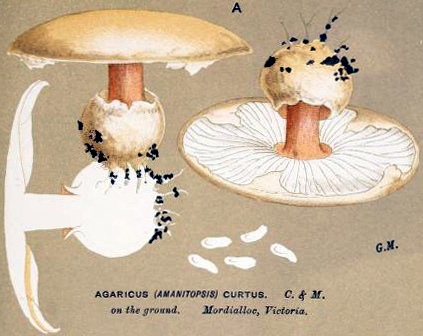
Cooke. 1890. Grevillea 18 (fasc. 88, following p. 360): pl. 3 (fig. A). |
| intro |
The following text may make multiple use of each data field.
The field may contain magenta text presenting data from a type study
and/or revision of other original material cited in the protolog of the present taxon.
Macroscopic descriptions in magenta are a combination of data from the protolog and
additional observations made on the exiccata during revision of the cited original
material.
The same field may also contain black text, which is data from a revision of the present
taxon (including non-type material and/or material not cited in the protolog).
Paragraphs of black text will be labeled if further subdivision of this text is appropriate.
Olive text indicates a specimen that has not been
thoroughly examined (for example, for microscopic details) and marks other places in the text where data is missing or uncertain.
The original description is a brief Latin diagnosis as follows:
"Pileo convexo, explanato, ochraceoalbo, laevi, glabro, margine velo appendiculato, stipite brevi, solido, bulboso, testaceo, glabro, volva ampla, circumscissa marginato, deorsum fibrilloso-radicato; lamellis liberis, remotis, subdistantibus, angustis, albis, sporis ellipticis, 19 - 22 × 10 μm.
"On ground. Mordialloc, Victoria."
[Communicated by Baron F. von Mueller.]
The basis of the following description is derived from the protolog and (Reid 1980). Partial data on microscopic anatomy are from a (regrettably) time-limited study of the type by R. E. Tulloss. |
| pileus |
from protolog: 51 - 64 mm wide, ochraceus white, convex, becoming flattened, even, smooth; context not described: margin nonstriate, appendiculate; universal veil absent. |
| lamellae |
from protolog: free-remote, rather distant, white, narrow; lamellulae not described. |
| stipe |
from protolog: ca. 25 mm long, brick-red, smooth; context not described; bulb subglobose(?), with rhizoids on base; partial veil appendiculate from pileus margin in holotype; universal veil as raised margin or limb on stipe bulb.
from Reid (1980): "...bulb surmounted by a narrow limb of volval tissue up to 5 mm high...." |
| odor/taste |
not recorded. |
macrochemical
tests |
none recorded. |
| pileipellis |
not described. |
| pileus context |
not described. |
| lamella trama |
not described. |
| subhymenium |
not described. |
| basidia |
RET: 46 - 61 × 10.7 - 15.8 μm, dominantly 4-, also 1-, 2-, and 3-sterigmate; form of cells giving rise to mature basidia not clear; clamps not observed. |
| universal veil |
not described. |
| stipe context |
not described. |
| partial veil |
not described. |
| lamella edge tissue |
not described. |
| basidiospores |
from Reid (1980): [-/-/-] (9.0-) 10.0 - 14.5 × 5.0 - 6.0 μm, (est. Q = 2.0 - 2.4), cylindric, amyloid; color in deposit not recorded.
RET: [22/1/1] 10.8 - 14.5 (-17.7) × (5.0-) 5.2 - 7.5 (-8.4)
μm; (L = 12.7 μm; W = 6.3 μm; Q = (1.44-) 1.78 - 2.66 (-3.04); Q = 2.05), hyaline, colorless, thin-walled, smooth, amyloid, elongate to cylindric (infrequently ellipsoid or bacilliform), sometimes constricted; apiculus proportionately small, sublateral; contents guttulate to granulose; color in deposit not recorded. |
| ecology |
not recorded. |
| material examined |
from protolog: AUSTRALIA: VICTORIA—City of Kingston - Mordialloc, 1887 C. French s.n. (holotype, K).
from Reid (1980): AUSTRALIA: VICTORIA—City of Kingston - Mordialloc, 1887 C. French s.n. (holotype, K).
RET: AUSTRALIA: VICTORIA—City of Kingston - Mordialloc, 1887 C. French s.n. (holotype, K).
|
| discussion |
Spore measurements from the protolog probably vary from those of the most recent type study due to the magnification under which the spores were examined; it is worth noticing that an estimate of Q from the protolog data would be 2.05, which is the value obtained from the measurement of 22 spores in the recent type study.
Reid's (1980) spore measurements are (9.0-) 10.0 - 14.5 × 5.0 - 6.0 μm. An estimate of Q is 2.23. The difference is largely due to significantly narrower range of spore width reported by Reid.
The other tissue treated by Reid (1980: 22) is the appendiculate material on the pileus margin: "The velar tissue at the edge of the cap is formed largely of oval to subglobose, thin-walled elements, 18 - 42 × 22 - 30 μm, intermixed with a few thin-walled hyphae." |
| citations |
—R. E. Tulloss |
| editors |
RET |
|



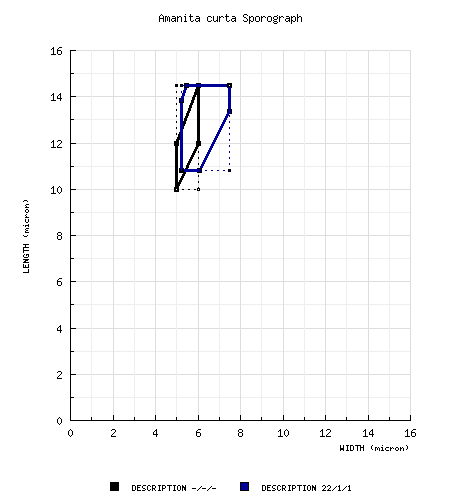
 Spore data sets and their composite