| name | Amanita crenulata |
| name status | nomen acceptum |
| author | Peck |
| english name | "Poison Champagne Amanita" |
| images |
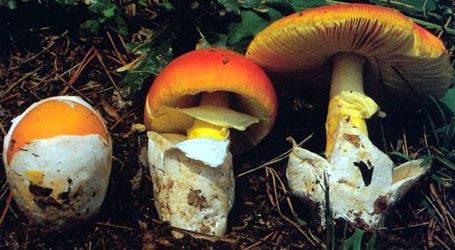
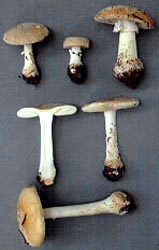 1. Amanita crenulata, Roosevelt, Monmouth Co., New Jersey, U.S.A. 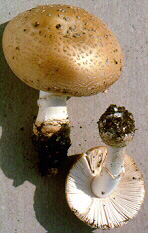 2. Amanita crenulata, Roosevelt, Monmouth Co., New Jersey, U.S.A. 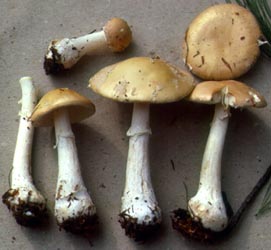  3. Amanita crenulata, New Jersey, U.S.A. |
| intro | Amanita crenulata is a very common species of the northeastern U.S.A., occurring most frequently in the Autumn, often in groups with Amanita muscaria var. guessowii Veselý. |
| cap | Its cap is very pale to pale tan with varying degrees of yellow and/or gray tones. The volva is distributed over the 22 - 90 mm wide cap as powdery, somewhat paler warts. (Their color has been called "champagne.") The cap's marginal striations take up only 10 - 20% of the cap radius. |
| gills | The gills are narrowly adnate, close to subcrowded, and white to cream. The short gills are truncate to subtruncate or (occasionally) subattenuate. |
| stem | The stipe is 17 - 100 × 3.5 - 16 mm and has a skirt-like annulus that is often quickly lost or left in torn fragments on the pileus margin. The notable bulb usually bears a distinct ring of champagne volval powder on its "shoulder." |
| odor/taste | The species is toxic and produces dramatic symptoms similar to those of A. muscaria (L. : Fr.) Lam. and A. pantherina (DC. : Fr.) Krombh. |
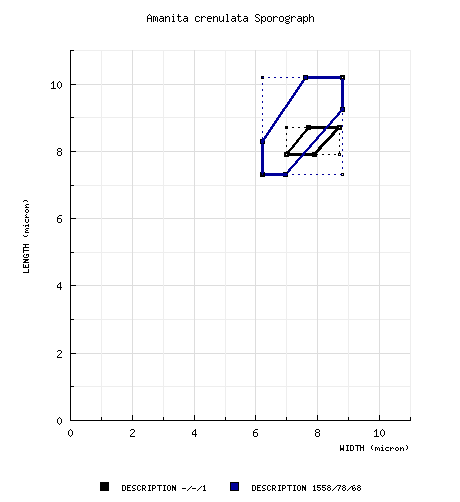
| spores | The spores measure (5.9-) 7.3 - 10.2 (-14.2) × (4.8 -) 6.2 - 8.8 (-14.2) µm and are subglobose to broadly ellipsoid to ellipsoid (infrequently globose or elongate) and inamyloid. Clamps are absent from the bases of basidia. |
| discussion | Amanita crenulata is mostly known from the northeastern U.S. and probably occurs in southeastern Canada. The species is associated primarily with oaks and diverse conifers.—R. E. Tulloss |
| brief editors | RET |
| name | Amanita crenulata | ||||||||||||||||||||||||||||||||||||||||
| author | Peck. 1900a. Bull. Torrey Bot. Club 27: 15. | ||||||||||||||||||||||||||||||||||||||||
| name status | nomen acceptum | ||||||||||||||||||||||||||||||||||||||||
| english name | "Poison Champagne Amanita" | ||||||||||||||||||||||||||||||||||||||||
| synonyms |
≡Venenarius crenulatus (Peck) Murrill. 1913. Mycologia 5: 77. The editors of this site owe a great debt to Dr. Cornelis Bas whose famous cigar box files of Amanita nomenclatural information gathered over three or more decades were made available to RET for computerization and make up the lion's share of the nomenclatural information presented on this site. | ||||||||||||||||||||||||||||||||||||||||
| etymology |
crenulatus (crenulate) The name probably was intended to refer to a character of the lamellae. Unfortunately, the lamellae are not usually crenulate. - RET | ||||||||||||||||||||||||||||||||||||||||
| MycoBank nos. | 205855 | ||||||||||||||||||||||||||||||||||||||||
| GenBank nos. |
Due to delays in data processing at GenBank, some accession numbers may lead to unreleased (pending) pages.
These pages will eventually be made live, so try again later. Search:
Showing 1 to 6 of 6 entries | ||||||||||||||||||||||||||||||||||||||||
| holotypes | NYS (implicit) | ||||||||||||||||||||||||||||||||||||||||
| type studies |
Jenkins. 1977. Biblioth. Mycol. 57: 84. Jenkins. 1977. Mycotaxon 7: 28. | ||||||||||||||||||||||||||||||||||||||||
| revisions |
Jenkins. 1977. Biblioth. Mycol. 57: 31. Tulloss. 1990a. Mycotaxon 39: 394, fig. 1. Tulloss, here. | ||||||||||||||||||||||||||||||||||||||||
| selected illustrations |
Hard. 1908. Mushrooms: 36, fig. 25. Krieger. 1936. Handbook: 87, fig. 24e. [Spores only.] Tulloss. 1990a. Mycotaxon 39: 394, Fig. 1. Phillips. 1991. Mushrooms North Am.: 21. Kibby. 1993. Illus. Guide Mushr. Other Fung. N. Amer.: 92 (middle). | ||||||||||||||||||||||||||||||||||||||||
| intro |
The following text may make multiple use of each data field. The field may contain magenta text presenting data from a type study and/or revision of other original material cited in the protolog of the present taxon. Macroscopic descriptions in magenta are a combination of data from the protolog and additional observations made on the exiccata during revision of the cited original material. The same field may also contain black text, which is data from a revision of the present taxon (including non-type material and/or material not cited in the protolog). Paragraphs of black text will be labeled if further subdivision of this text is appropriate. Olive text indicates a specimen that has not been thoroughly examined (for example, for microscopic details) and marks other places in the text where data is missing or uncertain. The following is based upon original research by R. E. Tulloss, except when the work of another author is cited. | ||||||||||||||||||||||||||||||||||||||||
| pileus | 22 - 90 mm wide, hemispheric to broadly campanulate at first, becoming convex then planoconvex or slightly depressed, occasionally becoming rimose, slightly sordid or brownish beige to grayish tan (e.g., 2.5Y 8/4) to slightly yellowish sordid beige to tannish cream with yellow and pinkish tints, at times darker or yellower on disc (3A3 to more tan than 3A4 to 4A2-4 to less orange than 4A2 to browner or more tan than 4A3 to browner/darker or yellower/brassier than 4A4 to brighter than 4B4-5 to 4B3-6 to paler and browner than 5B2 to yellower than 5B3), surface dull to slightly shiny, subviscid to viscid; context whitish to off-white to yellowish white (in some of smallest specimens), yellowish to yellowish tan in disc, yellowish or water-soaked immediately above lamellae, occasionally pale pinkish brown at interface with stipe context, slowly and slightly darkening on exposure, 2 - 8 mm thick at stipe, thinning evenly to margin or to a point 2 - 5 mm short of margin and then becoming a membrane; margin decurved, striate (less than 0.1R - 0.22R (-0.3R)), nonappendiculate or occasionally bearing submembranous shreds of the partial veil; universal veil in subverrucose to verruculose to flocculose, flattened to subpyramidal warts and scales, sometimes confluent, often rather dense in concentric circles, becoming more sparse near margin, slightly grayish creamy pale tan or beige (2-3A2 to 3B1 to between 4A2 and 5B2 to a little grayer than 4-5B2 to 4A3 to 4B2-3) or just slightly grayer than pileipellis, at times darkening in age, easily lost; pileipellis peeling from margin to disc, becoming brown at the edge of wounds or (uncommonly) developing slightly reddish areas, at times translucent. | ||||||||||||||||||||||||||||||||||||||||
| lamellae | narrowly adnate, at times with short decurrent line or tooth on the stipe, close to subcrowded, whitish to off-white to pale cream to pale pinkish cream to cream in mass, white to off-white to pale cream to pale yellowish cream in side view, drying pale orangish white (when freshly dried) to orangish brown to brownish orange (a little dingier than 2.5YR 6/8 or lighter than 7C6 to 5YR 6/8 to 7.5YR 6/6 to 7.5YR 7/8 or 5B5 to 7.5YR 8/6 or slightly yellower than 7.5YR 8/6 to a little paler/yellower than 10YR 8/6 to 10YR 8/4 to 4A4), 2 - 10.5 mm broad, broadest and rounded near pileus margin and often projecting below it, rarely forking, with edges fimbriate and white to cream; lamellulae truncate to subtruncate to occasionally subattenuate, irregularly spaced, absent between some pairs of lamellae, with tendency to an attenuate tooth at point of contact with pileus context. | ||||||||||||||||||||||||||||||||||||||||
| stipe | 17 - 100 × 3.5 - 16 mm, narrowing upwards or cylindric, rarely narrowest or thickest at mid-stipe, flaring at apex (slowly over a distance of up to one-third of stipe, usually of 10 mm or more), occasionally somewhat flattened so that the cross-section near the apex is ellipsoid, white or whitish to (rarely) pale yellowish, browning from handling, faintly longitudinally striate, finely pulverulent above partial veil, fibrillose to minutely fibrillose below, sometimes fibrillose-scaly for 10 or 20 mm above bulb, sometimes cracking into small or large recurved scales; context whitish to off-white or very pale tannish white, slightly browning or occasionally pinkening on bruising, stuffed with white or pale pinkish white material in 1 - 7 mm wide central cylinder, sometimes becoming hollow, larva tunnels concolorous to very pale tannish/brownish; bulb subglobose to globose to ovoid to ventricose to subnapiform to napiform, infrequently subabrupt, solid, 8 - 29 × 8 - 28 mm, with mycelium white; partial veil median to submedian to superior to (occasionally) subapical or apical, white or whitish, sometimes yellowing with age, skirtlike, submembranous, delicate, edge serrate, finely verruculose below, striate above, collapsing on stipe or tearing in shreds left on edges of lamellae, eventually disappearing; universal veil as an appressed sometimes scant band of pulverulent material around the top of the bulb, colored as on pileus, disappearing in older specimens, sometimes with a similarly colored or paler to whitish thin collar (continuous or as separate recurved scales) at top of bulb (limbus internus). | ||||||||||||||||||||||||||||||||||||||||
| odor/taste |
Odor absent or, according to Bas’ notes, “somewhat sourish spermatose” when crushed (Bas 3802). Taste “faintly unpleasant” (Bas 3802). POISONOUS: pantherine syndrome—producing symptoms associated with ibotenic acid and muscimol intoxication. | ||||||||||||||||||||||||||||||||||||||||
| macrochemical tests |
5-10% KOH soln. - negative (no color change) on pileipellils. L-tyrosine and paracresol spot tests for tyrosinase strongly and rapidly positive in stipe context. Test vouchers: t.b.d., Tulloss 10-12-14-B, -C. POISONOUS, producing symptoms similar to those associated with ibotenic acid and muscimol intoxications. | ||||||||||||||||||||||||||||||||||||||||
| pileipellis | radially oriented undifferentiated filamentous branching hyphae, partly to completely gelatinizing, 1.5 - 6.5 µm wide; vascular hyphae present, branching, 1.5 - 6.0 µm wide; yellow-orange region in or just below pileipellis contrasts to paler context of pileus. | ||||||||||||||||||||||||||||||||||||||||
| pileus context | undifferentiated filamentous branching hyphae, loosely interwoven, 4.0 - 8.0 µm wide; acrophysalides broadly ellipsoid to ellipsoid to elongate to clavate, to 110 × 48 µm; vascular hyphae present, 2.0 - 2.5 µm wide. | ||||||||||||||||||||||||||||||||||||||||
| lamella trama | bilateral, but not markedly so, with subhymenial base dominated by rather large inflated cells; wcs = 55 - 60 µm; undifferentiated filamentous branching hyphae 1.5 - 6.8 µm wide; inflated cells ovoid to ellipsoid, to 84 × 48 µm; vascular hyphae branching, locally common to plentiful, 2.0 - 17.5 µm wide. | ||||||||||||||||||||||||||||||||||||||||
| subhymenium | wst-near = 65 - 70 µm; wst-far = 80 - 85 µm; inflated cells ovoid to ellipsoid to subglobose, to 21 × 16 µm, at least sometimes in short branching chains, in mass appearing to be in two or three ranks, with basidia arising from these cells and from partially inflated or uninflated short hyphal segments; plentiful hyphae run parallel to central stratum among? and below inflated cells. | ||||||||||||||||||||||||||||||||||||||||
| basidia | 27 - 53 × 5.0 - 13.0 µm, thin-walled, clavate, 4- or occasionally 1-spored; clamps not observed. | ||||||||||||||||||||||||||||||||||||||||
| universal veil | On pileus: dominated by chains of inflated cells, ellipsoid to fusiform to ovoid to clavate to elongate-constricted (ellipsoid/ovoid to 58 × 29 µm, clavate to 54 × 22 µm, elongate-constricted to 56 × 24 µm); undifferentiated filamentous hyphae 3.0 - 7.8 µm wide; vascular hyphae branching, rather abundant?, 2.8 - 6.8 µm wide. On stipe base: similar structures to those found on pileus (e.g., chains of inflated cells which cells range to 56 × 43 µm), but with much greater proportion of filamentous undifferentiated hyphae. | ||||||||||||||||||||||||||||||||||||||||
| stipe context | longitudinally acrophysalidic; branching filamentous undifferentiated hyphae, 1.8 - 9.1 µm wide; acrophysalides narrow and elongated to 226 × 52 µm; vascular hyphae present, e.g. 5.0 µm wide. | ||||||||||||||||||||||||||||||||||||||||
| partial veil | in many regions almost entirely composed of branching undifferentiated filamentous hyphae 3.2 - 7.0 µm wide; inflated cells terminal, ellipsoid to 28 × 15.5 µm and clavate to 70 × 17 µm; vascular hyphae 2.5 - 8.2 µm wide. | ||||||||||||||||||||||||||||||||||||||||
| lamella edge tissue | sterile. | ||||||||||||||||||||||||||||||||||||||||
| basidiospores |
from type study of Jenkins (1978a): [-/-/1] 7.9 - 8.7 × 7.0 - 8.7 μm, (Q = 1.0 - 1.13; Q' = 1.04), hyaline, thin-walled inamyloid, globose to subglobose; apiculus sublateral, cylindric to truncate-conic; contents guttulate; color in deposit not recorded. [1558/78/68] (5.9-) 7.3 - 10.2 (-14.2) × (4.8-) 6.2 - 8.8 (-14.2) µm, (L = (7.5-) 7.9 - 9.6 (-10.4) µm; L’ = 8.7 µm; W = (6.3-) 6.8 - 8.0 (-8.8) µm; W’ = 7.5 µm; Q = (1.0-) 1.05 - 1.34 (-1.71); Q = (1.08-) 1.10 - 1.25 (-1.36); Q’ = 1.17), nonamyloid, smooth, thin-walled, hyaline, globose to subglobose to broadly ellipsoid to ellipsoid, very rarely elongate and then often malformed/subsigmoid, occasionally expanded at or near one end; contents guttulate; apiculus sublateral, cylindric to truncate conic, sometimes rounded, 1 - 2.5 µm wide at base; white in deposit. | ||||||||||||||||||||||||||||||||||||||||
| ecology | From August to November, often widespread and gregarious in September and October, ranging from approximately sea level to ?. Frequently found in pure stands of Picea abies, Pinus resinosa, or P. strobus—in soils varying from deep sand containing variable amounts of organic matter to loam over sandy clay to duff over sand to clayey loam, often appearing in association with the eastern yellow-orange color variant of A. amerimuscaria Tulloss & Geml nom. prov. Maine: Under Abies. Maryland: Under Quercus and Pinus (two-needled) in lawn. Massachusetts: Under Quercus sp. in mixed deciduous woods or in “fairy ring” in deciduous forest. New Jersey: Subgregarious to gregarious. In partially landscaped lawn built over underground stream (relatively close to the surface) with plantings included Picea abies, P. pungens, Ilex opaca, Cornus florida, Robinia pseudo-acacia, Pinus strobus, P. cembroides, Larix laricina, and Syringa vulgaris or under P. rigida, Acer rubrum, Azalea spp., Kalmia latifolia, and Juniperus virginiana or under Quercus spp. and Sassafras albidum in lawn or in typical pine-oak barrens consisting largely of P. rigida with several Quercus spp. often as scrub or under P. nigra or under Carpinus caroliniana, S. albidum, Liquidambar styraciflua, Viburnum recognitum, Acer sp., and Prunus sp. or in the rain in roadside grasses near low wet, deciduous woods containing Ulmus rubra, Acer saccharum, Quercus spp., Betula populifolia, S. albidum, L. styraciflua, and Cilia americana. New York: In sandy, dry, mixed woods under P. rigida, Q. ilicifolia, and Populus tremuloides or under “ancient” Pinus. | ||||||||||||||||||||||||||||||||||||||||
| material examined |
from type study of Jenkins (1978a): U.S.A.: MASSACHUSETTS—Unkn. Co. - "near Boston," U.S.A.: CONNECTICUT—Fairfield Co. - Darien, 11.ix.1986 Roger Phillips 3580 (RET 088-6). Middlesex Co. - Salmon River St. For. (South) [41°32’58” N/ 72°27’01” W, 21 m], 30.viii.1997 COMA foray participant s.n. [Tulloss 8-30-97-G] (RET 268-8). Tolland Co. - Hebron, The Hemlocks Nature Educ. Ctr. [41°37’11” N/ 72°23’22” W, 145-160 m], 20.ix.1998 R. E. Tulloss 9-20-98-A (RET 288-6). GEORGIA—Barrow Co. - Winder, Fort Yargo St. Pk., 17.xi.2017 Joan Knapp JSK-00042 [mushroomobserver #299326] (RET 814-9). Fayette Co. - Peachtree City, jct. of Kelly Drive and Dividend Drive, 19.xi.2017 Ian Blaylock s.n. (RET 816-2). McIntosh Co. - Harris Neck Wildlife Refuge, 26.xii.2014 Arlene & Allen Bassette ARB1350 (RET 675-9, nrITS & nrLSU seq'd.). MAINE—Knox Co. - Vinalhaven, 28.vii.1992 B. McAdoo 204#3 (RET 077-2). MARYLAND—Wicomico Co. - Salisbury, 10.x.1993 Lance T. Biechele s.n. (RET 110-4). MASSACHUSETTS—Barnstable Co. (Cape Cod) - Chatham, 13.x.1981 R. E. Tulloss 10-13-81-A (RET 165-4), -B (RET 165-5); Cape Cod Canal Mid-Way Station, 15.x.1981 R. E. Tulloss 10-15-81-D (RET 165-8). Berkshire Co. - ca. North Adams, viii.1986 Northeast Mycological Foray ‘86 (NEMF86) participant s.n. [R. Phillips 3387] (RET 088-7); unkn. loc., 14.viii.1986 NEMF86 participant 8-14-86-B (RET 669-7). Essex Co. - Lynn, Floating Bridge, viii.1909 Mrs. Eliza B. Blackford s.n. (FH). Franklin Co. - Mt. Grace St. For., 18.viii.1989 James Ginns s.n. [Tulloss 8-18-89-F] (RET 022-4); Mt. Toby St. For., 25.viii.1963 C. Bas 3802 (L). Hampshire Co. - Goshen, D.A.R. St. For., 1.ix.1960 Howard E. Bigelow & Margaret E. Barr-Bigelow [H. E. Bigelow 9217] (NY). Middlesex Co. - Concord, Estabrook Woods, 18.x.1998 Boston Mycol. Club member s.n. (RET 290-4); ca. Lincoln, Walden Pond, 17.x.1981 Mary A. King & R. E. Tulloss 10-17-81-A (RET 165-6); Waltham, | ||||||||||||||||||||||||||||||||||||||||
| discussion |
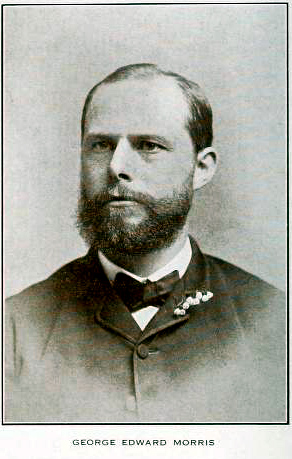
I have revised the lectotype and reviewed the protolog of A. crenulata, and the recent collections described herein share all microscopic characters with the lectotype. I believe all the material reviewed to be conspecific. The only notable differences between the protolog and modern collections are pileus coloration and edibility. In the protolog of A. crenulata, Peck (1900) described that entity as "whitish or grayish, sometimes tinged with yellow"; and he reported that his correspondent(s) had eaten the mushroom with no ill effect and that it was "of an excellent flavor." With the assistance of copies provided by Dr. John H. Haines, New York State Museum, Albany, I have read the portion of Peck’s correspondence concerning A. crenulata which has been preserved at NYS. It is interesting to see that the report of edibility which Peck received was third hand: Mrs. Eliza B. Blackford (letter of 22 September 1899) wrote, "A member of the [Boston Mycological] club who saw them said he had a friend who had found some of the same, had eaten them and found them delicious and was still living." I find this single sentence rather shaky grounds on which to conclude that A. crenulata is edible. Evidence for the poisonous character of the species is given below. As to the pileus color of A. crenulata, none of the preserved letters include any information. There is an entry in Peck’s unpublished field notebooks (23: 131-132, in NYS) for 1899 which is headed "+ 2 Amanita crenulata n. sp." and which is probably a description of fresh material, but certainly includes information transcribed from his correspondents’ letters. Fresh material sent by Mrs. Blackford is acknowledged in a letter from Peck dated 28 September 1899 (FH). The notebook entry includes the description of the pileus color as "grayish or subcinereous." These same notes include mention of the collecting sites (including Brighton, Newton, and Milford) and associated trees (maple, oak, and pine) which information correlates with that in a preserved letter from Mrs. Blackford (25 September 1899). (The only additional collecting site mentioned is Waltham in which lived Mr. George Edward Morris who was Peck’s second correspondent concerning the discovery of the new species and who supplied a paratype of A. crenulata.) Since Revere is not listed as a collecting site, I conclude that Peck’s notebook entries were made at the end of September or in the first few days of October. This is because Mrs. Blackford wrote (letter of 2 October 1899 in NYS) that she had collected the new species in Revere on the previous day. She wrote that she was sending the 1 October specimens in a metal box; they would seem to have arrived after Peck’s notebook entry was written. Peck acknowledged their receipt in good condition (letter of 7 October 1899 in FH). Therefore, Peck saw fresh material. What colors did he see? It was serendipitous that, at the moment when solving this problem seemed stymied, Dr. Haines, while moving some books, found a list of the
In the protolog, Peck reported the spores of A. crenulata to be “broadly elliptic to subglobose, 7.5 - 10 µm long” which is in very good conformance to my observations of both the type and recently collected specimens. Jenkins (1977) designated the lectotype. I have reviewed the lectotype and found the spores to match nearly perfectly with those from the recent collections: BASIDIOSPORES of A. crenulata lectotype (portions in NYS and CUP-A): [105/6/1] (7.2-) 7.5 - 10.5 (-12.8) × (5.8-) 6.0 - 8.5 (-9.8) µm, (L = 8.3 - 9.2 µm; L’ = 8.8 µm; W = 6.8 - 7.8 µm; W’ = 7.3 µm; Q = (1.05-) 1.07 - 1.33 (-1.46); Q = 1.15 - 1.25; average Q’ = 1.20), nonamyloid, thin-walled, smooth, hyaline, subglobose to broadly ellipsoid, less often globose or ellipsoid; apiculus sublateral, cylindrical to truncate conic, up to 2.5 µm broad at base; contents guttulate. Collection 9-14-86-A consists of one basidiome dried very close to the start of sporulation. As is often the case in Amanita, the spores of such material are abnormal including a giant spore (14.0 × 12.8 µm).There was also a general tendency for the spores to be more pip-shaped—resulting in the highest average Q for any specimen examined. In many species of Amanita, immature spores have lower Q value than do mature ones; Corner (1947) observed the same trend in other basidiomycetes. The situation seems reversed in A. crenulata. Most of the spores measured were taken from the middle region of a lamella. Occasionally, immature spores would be seen attached to their sterigmata; these spores were often elongate in profile. To further test the hypothesis that more mature spores are rounder, I isolated the data from spores which were measured from sporeprints. The lowest average Q (1.06) for any set of measurements resulted from measurement of 25 spores from the print associated with collection 10-11-80-A which also had the highest average spore width (8.5 µm). The results of spore measurements from sporeprints follow: BASIDIOSPORES measured from sporeprints: [185/9/?] (7.0-) 7.7 - 9.8 (-11.0) × (5.9-) 6.6 - 9.0 (-10.5) µm (L = 8.0 - 9.4 µm; L’ = 8.6 µm; W = 6.9 - 8.5 µm; W’ = 7.6 µm; Q = (1.0-) 1.07 - 1.24 (-1.51); Q = 1.06 - 1.19; Q’ = 1.14).Poisonings and poisons attributed to A. crenulata (Ford, 1911; Kauffman, 1918; Buck, 1965; Jenkins, 1977; Ammirati et al., 1985) have been reported in the literature. Before 1965, most references are to the work of William W. Ford who, often supported by collectors from the Boston Mycological Club, found that aqueous extracts of dried specimens of A. crenulata (1 gm of dried basidiome per 10 cc) were deadly to guinea pigs and rabbits when supplied in sufficient dosages. The poison was still active in dried specimens over a year old. Boiling the extract did not alter the poisonous effect on the test animals. Techniques of the period were insufficient to do more than broadly classify the poison with others found in the genus Amanita. Ford mentions that deaths of his animals for reasons other than the injected mushroom extracts were relatively common. Buck (1965) reported on the case of an obese man from Lunenberg, Massachusetts, who, after tasting two of his mushrooms raw, boiled up the remainder which made “a large dish full.” About an hour earlier he had drunk 3 ounces of whiskey in highballs. After his meal he slept for two hours awakening with nausea, vomiting, salivation, diarrhea, blurred vision, and seeing flashes of blue light. He lost consciousness and was admitted to a hospital about five hours after ingestion. On admission, he exhibited a pulse of 84, hypotension, pupils dilated to 7 mm and reactive to light, and muscular twitching. His heart, lungs, and abdomen were adjudged normal. Gastric lavage was performed. Within one hour of admission, systolic blood pressure had fallen to 95 mm of mercury. Exactly one hour after admission he was placed on 5% glucose IV (2000 ml); at this time “the mouth was observed...to contain a large amount of mucus; he was talkative, disoriented and incontinent of urine; and he exhibited muscular twitching.” His blood pressure had risen somewhat; his pulse was still 84. I continue with Dr. Buck’s words: “At 3:30 a.m. [four and one quarter hours after admission] he was restless, and the muscular twitching was more marked. Half an hour later he received atropine sulfate, 1.3 mg (1/50 gr.). At 6:30 a.m. he was again given 2000 ml of 5% glucose intravenously. At 7 a.m. spasm of the right arm was noted. The systolic blood pressure ranged between 170 and 190.It is not clear who made the diagnosis of the fungus in the case reported by Buck; his article was written from the notes of physicians who actually treated the patient. As part of his concluding paragraph Buck states,“The symptoms here reported are consistent with the intoxication that follows ingestions of mushrooms of the A. muscaria and A. pantherina group.” I have previously provided information on poisoning of a subject in very different condition (Tulloss, 1990a). On 15 October 1989, I received a call from the New Jersey Poison Information and Education System (NJPIES), Newark, asking for assistance in determining mushrooms involved in a poisoning case. An unidentified, homeless male of European ancestry weighing approximately 68 kg and 49 years of age had been found unconscious near railroad tracks in Gloucester County, New Jersey, in the early evening. The mushrooms found beside him mixed with pine needles were later identified by me as A. crenulata. He was brought to Underwood Memorial Hospital by paramedics who correctly identified the mushrooms involved as amanitas of the A. muscaria group. NJPIES was notified at 9:45 p.m. When aroused by the paramedics, the man attacked them and the emergency room personnel violently; he was incoherent and very combative. He was given valium which rendered him unconscious. At this time he was noted to have diarrhea, chills, and muscle spasms. There was no salivation or tearing; nor were there notable constrictions of throat muscles although he did gag a few times. His pupils were reactive, not restricted or dilated. His lungs sounded as if something had been aspirated. He was hypotensive and hypothermic (body temperature of 35.6° C) when brought in. The most remarkable phenomenon according to doctors treating him upon admission was profound diaphoresis. Doctors and nurses interviewed at the time said that they had never seen anyone sweat so continuously and profusely. (The diaphoresis ceased after four to five hours.) The NJPIES files indicate he was incontinent of urine. He was placed on saline IV with fluids warmed to combat hypothermia. A drug screen found acetone in his body fluids which was later attributed to starvation although ingestion of isopropyl alcohol was considered at first. Shortly after admission he entered a comatose state described by the attending doctor as a “death-like sleep.” This lasted for more than half a day. When he awoke the patient was again combative (reported to NJPIES at 1:30 p.m. on 16 October), slamming his face and legs against the siderails of his bed which were then padded. Four point restraint was applied. Sedation by valium was unsuccessful. Five hours later, the patient was calmer and valium appeared to be working. At 6:30 a.m. on 17 October, however, the patient was still violently responsive to touch and was again restrained; he exhibited an elevated temperature (37.8° C) throughout the day. On 18 October the need for restraint and sedation continued. Ventilation, which had been repeatedly considered throughout the episode was again considered, but never used; the patient’s lungs proved clear. On 19 October the patient was cooperative, but disoriented. He mouthed what was thought to be a name. He was unable to grasp a pen. The case records available to me end here. The patient fully recovered and is, once more, out of contact with his family. The evidence from this case indicates that A. crenulata contains poisons similar in action to ibotenic acid/muscimol.For those concerned with identifying mushrooms in poisoning cases, the macrochemical spot tests cited above are not diagnostic for the species. The reactions reported are common in many taxa of Amanita. While I have frequently seen A. crenulata misidentified as A. gemmata sensu lato at forays, with a little experience, A. crenulata can be recognized easily with the unaided eye. Jenkins (1977: 32) points out that the pulverulent character of the universal veil in A. crenulata clearly separates the two species. As far as I am aware, M. E. Hard (1908) published the only illustration of A. crenulata prior to that included in (Tulloss, 1990a). The Hard illustration is a rather poor, black and white photograph. Since he describes his experience with A. crenulata as being limited to specimens sent from Massachusetts by Mrs. Blackford, I think it is safe to assume that the photograph (for which no credit is given) is of fresh material sent by her or was taken by her or one of her colleagues in the Boston area. A unique and interesting study entitled “The Influence of Gravity on the Direction of Growth of Amanita” (Streeter, 1909) was largely based on experiments with a fungus diagnosed as A. crenulata which was said to be abundant during the period of the experiments. A collection labeled A. crenulata and collected by S. G. Streeter in Jersey City, New Jersey on 12 September 1908 (the second summer of her research) is in NYS. An annotation slip in the specimen box indicates D. T. Jenkins observed that the spores were amyloid. The specimens display a persistent annulus as well and appear to be assignable to section Validae. I deposited a number of collections of what I now believe to be A. crenulata in the personal herbarium of Dr. D. T. Jenkins, (Univ. Alabama, Birmingham). The collection numbers of these collections are 10-4-79-D, 10-4-79-G, 10-11-79-A, 10-11-79-B, and 10-13-79-C. | ||||||||||||||||||||||||||||||||||||||||
| citations | —R. E. Tulloss | ||||||||||||||||||||||||||||||||||||||||
| editors | RET | ||||||||||||||||||||||||||||||||||||||||
Information to support the viewer in reading the content of "technical" tabs can be found here.
 Spore data sets and their composite
Each spore data set is intended to comprise a set of measurements from a single specimen made by a single observer; and explanations prepared for this site talk about specimen-observer pairs associated with each data set. Combining more data into a single data set is non-optimal because it obscures observer differences (which may be valuable for instructional purposes, for example) and may obscure instances in which a single collection inadvertently contains a mixture of taxa.

Text and User-Generated Sporographs are published under the Creative Commons License.

In the case of a taxon page, image credits are on the 'image' tab.