| name |
Amanita clarisquamosa |
| author |
(S. Imai) S. Imai. 1938. J. Fac. Agric. Hokkaido Univ. 43(1): 29, pl. 1 (fig. 8). |
| name status |
nomen acceptum |
| english name |
"Larger-Spored East Asian Amidella" |
| synonyms |
≡ Amanitopsis clarisquamosa S. Imai. 1933. Bot. Mag. (Tokyo) 47: 430.
≡ Amidella clarisquamosa (S. Imai) E.-J. Gilbert. 1940. Iconogr. Mycol. (Milan) 27, suppl. (1): 77, tab. 25 (fig. 1).
The editors of this site owe a great debt to Dr. Cornelis Bas
whose famous cigar box files of Amanita nomenclatural information
gathered over three or more decades were made available to RET for computerization
and make up the lion's share of the nomenclatural information presented on this site.
|
| MycoBank nos. |
326090 |
| GenBank nos. |
Due to delays in data processing at GenBank, some accession numbers may lead to unreleased (pending) pages.
These pages will eventually be made live, so try again later.
|
| lectotypes |
in herb. S. Imai (SAP) (implicit); isolectotype, in herb. E.-J. Gilbert (lost) |
| lectotypifications |
E.-J. Gilbert. 1941. op. cit.: 294. [Gilbert states that he has half a basidiocarp of the type in his herbarium. He also refers to the spore illustrations in the first part of the work published in 1940. In the caption to this spore illustration in particular, a specific collection is cited. This must be the collection of which Imai had sent Gilbert a part. Hence, this collection is implicitly designated lectotype.] |
| revisions |
Z. L. Yang. 1997. Biblioth. Mycol. 170: 122, figs. 100-103. |
| intro |
Olive text indicates a specimen that has not been
thoroughly examined (for example, for microscopic details) and marks other places in the text
where data is missing or uncertain.
Following material not directly from the protolog of the present taxon or cited as from the work of Yang or others is based upon
original research by R. E. Tulloss.
NOTE: Spore measurements from papers by Z. L. Yang use his "Times New Roman" face for "Q"
and "Q'"—respectively, "Q" and
"Q." |
| basidia |
??; clamps lacking. |
| basidiospores |
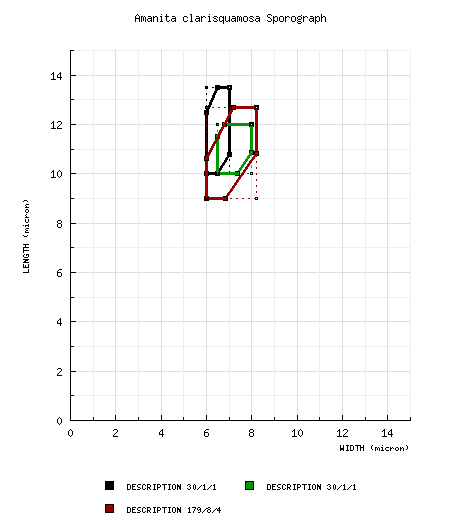
from Yang (1997): [30/1/1] (9.5-) 10.0 - 13.5 (-14.0) × (5.6-) 6.0 - 7.0 μm, (Q = 1.54 - 2.08 (-2.17); Q = 1.82 ± 0.19), ellipsoid, elongate, occasionally constricted, [occasionally—ed.] cylindric, amyloid, colorless, hyaline, or occasionally with yellowish or brownish granular contents, smooth, thin-walled; apiculus small.
from Yang (2000): [30/1/1] (9.5-) 10 - 12 (-13.0) × 6.5 - 8.0 (-8.5) μm, (Q = (1.28-) 1.36 - 1.77 (-1.85); Q = 1.51 ± 0.14), hyaline, colorless, smooth, thin-walled, amyloid, ellipsoid to elongate, rarely broadly ellipsoid.
composite of all spore data collected by RET: [179/8/4] (6.5-) 9.0 - 12.7 (-16.1) × (5.5-) 6.0 - 8.2 (-11.0) μm, (L = 9.9 - 11.7 (-12.3) μm; L' = 10.9 μm; W = 6.4 - 7.6 (-8.3) μm; W' = 7.0 μm; Q = (1.15-) 1.32 - 1.77 (-2.02); Q = 1.50 - 1.66 (-1.69); Q' = 1.58), hyaline, colorless, smooth, thin-walled, amyloid, ellipsoid to elongate, rarely broadly ellipsoid, rarely cylindric, sometimes swollen at one end, sometimes constricted, often adaxially flattened, with "giant" spores sometimes present; apiculus sublateral, cylindric, proportionately small; contents ??; ?? in deposit. |
| ecology |
Solitary or in small groups. China: At 2900 m elev. In forest with Quercus and Abies species. India: At 1850± - 2750± elev. In humus rich soil under Myrtica esculenta, Quercus lanata, and Rhododendron arboreum or in pure Abies pindrow forest on W slope or on road bank in coniferous forest (Picea smithiana, Abies pindrow, and Pinus wallichiana) on N slope. Japan: ??. Thailand: In Pinus-Castanopsis forest. |
| material examined |
from Yang (1997):
CHINA: YUNNAN—Yulong Nakhi Autonomous Co. - Lijiang (prefecture level) City, Yufengsi, 31.vii.1995 Z. L. Yang 2106 (HKAS 29514).
from Yang (2000): CHINA: JIANGSU—Nanjing (sub-provincial) City - former city of Nanjing, unkn. loc., 28.vi.1936 H. N. Shen 312 (formerly "IBN 5722"; BPI 751333, as "Amanitopsis volvata").
RET: INDIA: HIMACHAL PRADESH—Narkanda,6.viii.1964 C. Bas 4066 (L), 11.viii.1964 C. Bas 4118 (L).
UTTARAKHAND—Garhwal - Pauri Distr., Dandapani, 20.ix.1993 V.K. & R. P. Bhatt M-20168 (GUH).
THAILAND: CHIANG MAI PROV.—Om Koi, 12.ix.1999 D. Arora 99-281 (RET 351-6; SFSU). |
| discussion |
(t.b.d.)
A figure showing the sporograph comparison of the present taxon and A. avellaneosquamosa can be found on the technical tab of the latter species.
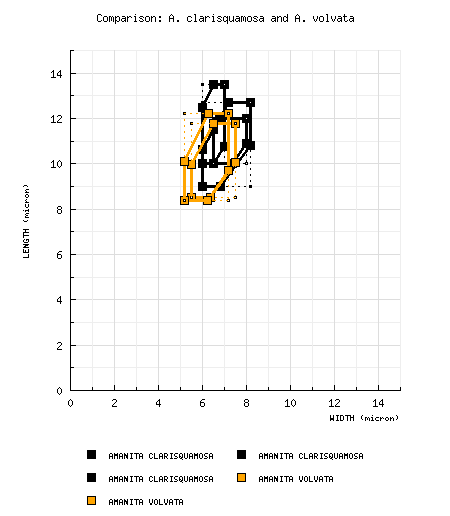
In the past, the present species was confused with the North American taxon A. volvata. A figure comparing sporographs of the two species follows.
|
| citations |
—Z. L. Yang & R. E. Tulloss |
| editors |
RET |
|



 Spore data sets and their composite