| name |
Amanita clarionensis |
| author |
Tulloss |
| name status |
nomen provisorum |
| GenBank nos. |
Due to delays in data processing at GenBank, some accession numbers may lead to unreleased (pending) pages.
These pages will eventually be made live, so try again later.
|
| intro |
The following is based on original research of R. E. Tulloss and C. Rodríguez Caycedo. |
| pileus |
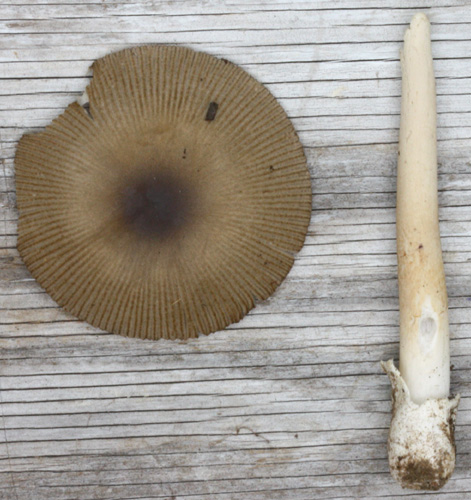
61 - 70+ mm wide, grayish brown with suggestion of olive tint (ca. 5D4), with disc a deep brown (near fuligineous), unchanging when cut or bruised, plano-convex, tacky to viscid when moist, dull; context 4.5 mm thick, white, except for gray region below pileipellis, unchanging when cut or bruised, narrowing evenly for ca. half of radius, then membranous to margin; margin tuberculate striate (0.65R), nonappendiculate; universal veil absent. |
| lamellae |
receding with decurrent line on stipe apex, subcrowded, sordid in mass, gray or watersoaked in side view, unchanging when cut or bruised, 5 mm broad, broadest ca. mid-length, with white minutely flocculose edge; lamellulae truncate with 1 noted exception (subattenuate), unevenly distributed, plentiful, of diverse lengths. |
| stipe |
95± × 8.0 - 8.5 mm, cream, becoming slightly orangish tan from handling, narrowing upward, sometimes somewhat flattened, flaring just at apex, finely pulverulent from apex downward for up to about 30 mm, finely striatulate below; context damaged by larvae in known specimens, off-white, unchanging when cut or bruised, concolorous in larva tunnels, with central cylinder 4.5± mm wide (after larval damage); exannulate; universal veil as saccate volva, 22 × 12 - 13 mm, firmly membranous, white throughout, with smooth dry exterior suggesting an eggshell, with limb 1± mm thick at mid-height; limbus internus minimal, appearing as 1 mm deep indentation on inner surface of limb, faint, visible as shadowy line in bright light. |
| odor/taste |
Odor lacking. Taste not recorded. |
macrochemical
tests |
none recorded. |
| basidia |
66 - 82 × 12.5- - 13.3+ μm, 4-sterigmate, with sterigmata up to ?? × ?? μm; clamps probably absent. |
| basidiospores |
composite of data from all material revised by
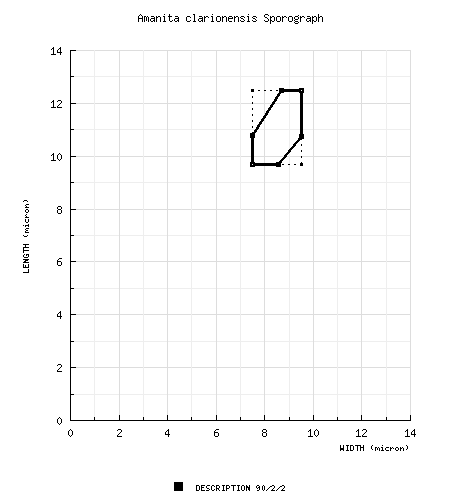
RET & CRC: [90/2/2] (8.5-) 9.7 - 12.5 (-14.3) ×
(7.0-) 7.5 - 9.5 (-11.0) μm, (L = 10.6 - 11.3
μm; L' = 11.0 μm; W = 8.7 - 8.8 μm;
W' = 8.7 μm; Q = (1.09-) 1.13 - 1.44 (-1.55);
Q = 1.21 - 1.31; Q' = 1.26), hyaline,
colorless, smooth, thin-walled, inamyloid,
predominantly ellipsoid, infrequently broadly
ellipsoid, at least somewhat adaxially flattened;
apiculus sublateral, cylindric or slightly
tapered; contents granular or mono- to
multiguttulate with additional small granules;
color in deposit not recorded. |
| ecology |
At ca. 420 m elev. In forest including
Quercus, Tsuga canadensis, and
Pinus. |
| material examined |
U.S.A.:
PENNSYLVANIA—Clarion Co. - Clarion, St.
Game Lands 63, Robert's Hill Rd. [41.1421° N/ 79.2830°
W, 419 m], 6.viii.2011 I. V. Hull s.n. [NAMA 2011-260;
Tulloss 8-6-11-A] (RET 478-8, nrITS-LSU seq'd.), D. K. Shankland s.n.
[Tulloss 8-6-11-D] (RET 478-4, nrITS-LSU seq'd.). |
| discussion |
The present species was previously knonw on this site
as "Amanita sp-N51." |
| citations |
—R. E. Tulloss & C. Rodríguez Caycedo |
| editors |
RET |
|



 Spore data sets and their composite