
| name | Amanita cinereoconia var. croceescens |
| name status | nomen acceptum |
| author | Bas |
| english name | "Yellowing American Gray Dust Lepidella" |
| images |
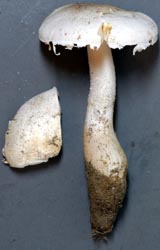 1. Amanita cinereoconia, before yellowing began, Tennessee, U.S.A. 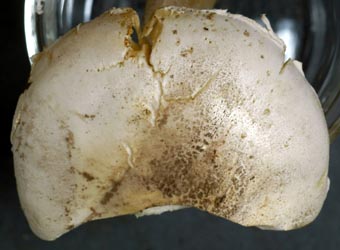  2. Amanita cinereoconia, before yellowing began, Tennessee, U.S.A. 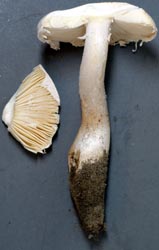 3. Amanita cinereoconia, after yellowing began, Tennessee, U.S.A. 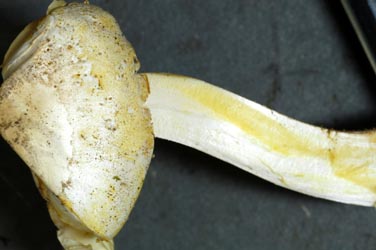 4. Amanita cinereoconia, after yellowing began, Tennessee, U.S.A. 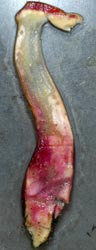 5. Amanita cincereoconia - syringaldazine spot test positive for laccase in bulb and lower stipe, Tennessee, U.S.A. |
| intro | The following description is based on the original description by Bas (1969). |
| cap |
The cap of Amanita cinereoconia var. croceescens is 60 - 100 mm wide, convex to plano-convex, with a broad, low umbo, yellowish-gray, dry, with a nonstriate and appendiculate, somewhat incurved margin. The volva is present as powdery-floccose remains that form small patches to a continuous layer over the margin, slightly darker than the cap color. The flesh is thin. |
| gills |
The gills are subdistant, slightly connected to the stem, often irregular and growing into each other, rather narrow, up to 7 mm broad, intermixed with many narrower ones, whitish with a creamy tinge. The short gills are attenuate. |
| stem |
The stem is 50 - 100 × 10 - 20 mm, usually subcylindrical or tapering slightly downward, sometimes conspicuously expanded at the top, solid, with or without a fragment of a ring. The bulb can be absent or somewhat turnip-like to somewhat spindle-shaped, usually rooting and is 25 - 40 × 15 - 25 mm. The stem is entirely covered with yellowish gray to gray-brown, soft flocculence, sometimes whitish at the top. The ring when present is apical, usually falls away, soft, pale yellowish gray, with fragments of the volva on the edge. The flesh is white, changing soon to deep bright orange when cut. |
| odor/taste |
The odor is distinctly like that of "chlorine." |
| spores |
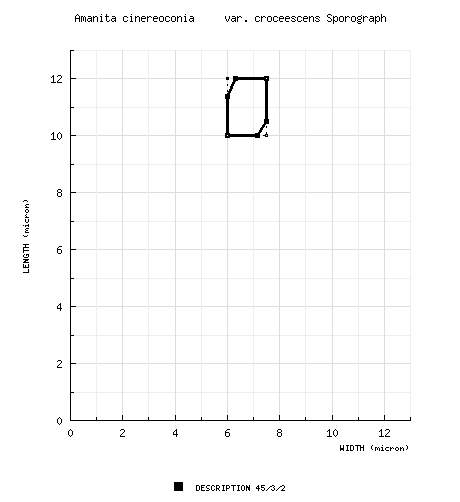
The spores measure (9-) 10 - 12 × (5.5-) 6 - 7.5 µm and are ellipsoid to elongate, sometimes broadly expanded at one end and amyloid. Clamps are absent at bases of basidia. |
| discussion |
This species was originally described from North Carolina (USA) and its tree associations are unknown. This variety differs from the type variety in its larger fruiting body, its proportionately broader spores, the irregular width of the gills, the tendency of adjacent gills to grow into each other (to anastomose), and the tendency of the flesh to turn orange when cut. After years of observing the "yellowing syndrome" in North American material in section Lepidella and taking into account the unusual irregular growth pattern of the gills in the present variety, RET suggests that this taxon may in fact simply consist of diseased specimens of A. cinereoconia. For more notes on the "yellowing syndrome" see A. subsolitaria (Murrill) Murrill. The illustration to the right shows a purple response to syringaldazine solution in ethanol in the bulb and lower stipe of a yellowing collection of A. cinereoconia. This response is positive for presence of laccase in the bulb.—R. E. Tulloss and L. Possiel |
| brief editors | RET |

 Spore data sets and their composite