| name |
Amanita chrysoblema red variant |
| author |
double click in markup mode to edit. |
| name status |
nomen acceptum |
| english name |
"American Fly Agaric" |
| synonyms |
≡ Amanita muscaria var. flavivolvata (Singer) Dav. T. Jenkins. 1977. Biblioth. Mycol. 57: 56.
≡ Amanita muscaria f. flavivolvata (Singer) Neville & Poumarat. 2002. Bull. Trimestriel Soc. Mycol. France 117(4): 314. [Misapplied in part to European material of A. muscaria var. muscaria.]
The editors of this site owe a great debt to Dr. Cornelis Bas
whose famous cigar box files of Amanita nomenclatural information
gathered over three or more decades were made available to RET for computerization
and make up the lion's share of the nomenclatural information presented on this site.
|
| etymology |
flavus "yellow" + volvatus "volvate" or "having a volva"; hence, approximately "yellow volva'd" because the intended meaning is very unlikely to have been "yellow and bearing a volva" |
| MycoBank nos. |
346526, 487346, 374044 |
| GenBank nos. |
Due to delays in data processing at GenBank, some accession numbers may lead to unreleased (pending) pages.
These pages will eventually be made live, so try again later.
|
| holotypes |
MICH [Found by neither Jenkins (ca. 1976) nor Tulloss (May, 1992).] |
| intro |
The following text may make multiple use of each data field.
The field may contain magenta text presenting data from a type study
and/or revision of other original material cited in the protolog of the present taxon. Macroscopic descriptions in magenta are a combination of data from the protolog and additional observations made on the exiccata during revision of the cited original material.
The same field may also contain black text, which is data from a revision of the present
taxon (including non-type material and/or material not cited in the protolog).
Paragraphs of black text will be labeled if further subdivision of
this text is appropriate.
Olive text indicates a specimen that has not been thoroughly examined (for example, for microscopic details) and marks other places in the text where data is missing or uncertain.
The following material not directly from the protolog of the present taxon is based upon
original research by R. E. Tulloss. |
| pileus |
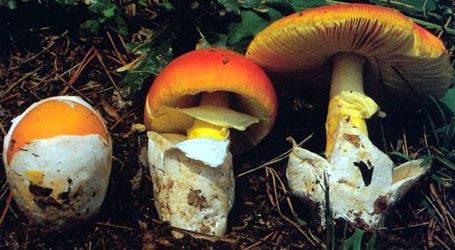
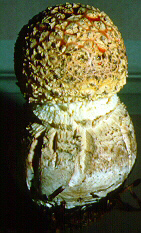
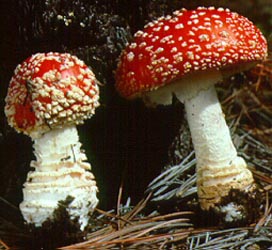
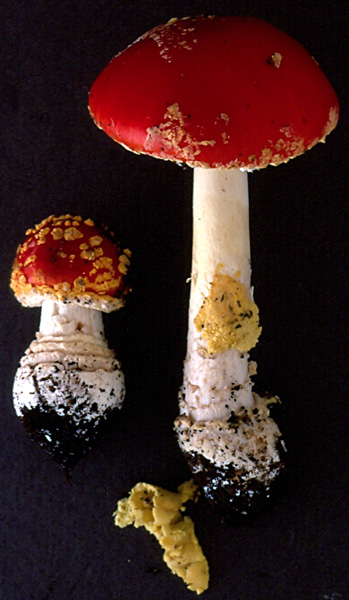
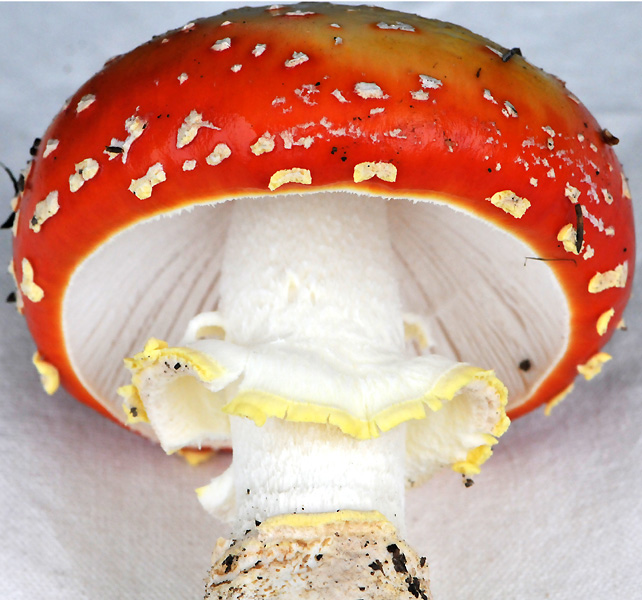
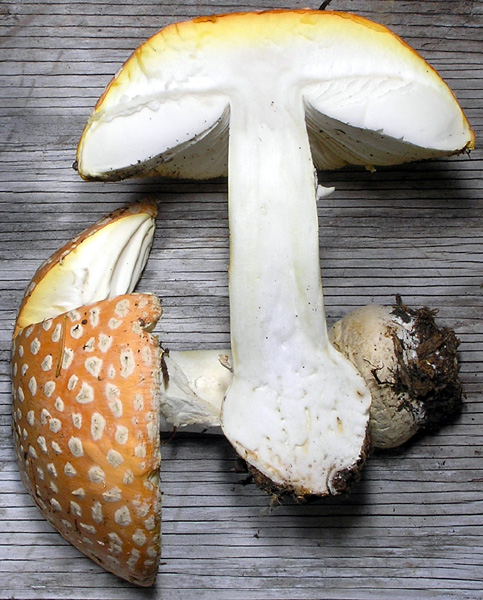
55 - 212 mm wide, at first entirely deep red or deep orange-red to red-orange with intensity not reproduced in available color references, then red to brownish red (e.g., 8C7 or more orange and brighter than 8E8 or 9E8) in disc (if not exposed to direct sun) or in most shaded part of pileus and otherwise orange (e.g., 6A8 or more yellow than 6B8 or 8A7-8) [sometimes yellow-orange close to margin (e.g., 4A5)], then fading to pale yellowish orange to pale orange, dull pinkish orange, and (finally) dull pale orangish tan to tannish yellow, fading last under warts or pieces of appressed detritus from substrate, sometimes virgate, subglobose to hemispherical to broadly ellipsoid at first (with incurved margin), then campanulate to convex with decurved margin, finally planoconvex (sometimes with depressed disc), viscid to subviscid and shiny when moist, then tacky or dry and matt or shiny; context yellow (e.g., 3A5 or 4A-B8) to yellowish orange to deep orange in wide band under pileipellis (even in most faded regions), with orange line sometimes separating yellow region from red cross-section of pileipellis in very young material, otherwise pale yellow to white, unchanging when cut or bruised, 3 - 17 mm thick at stipe, thinning evenly to margin or to just short of margin and from there membranous; margin nonstriate at first, becoming lightly striate at full expansion or if drying somewhat in situ (0.1- - 0.2R), nonappendiculate; universal veil as floccose-fibrillose to pulverulent warts, often in concentric rings, often rather densely set, entirely bright yellow (e.g., 4A4 or 4A8) in buttons, remaining yellow near pileus margin during early stages of pileus expansion, elsewhere becoming yellowish cream to pale yellowish cream (e.g., 3A3) to sordid cream to sordid pale yellowish white, with yellow pigment finally fading entirely, becoming pale buff to somewhat sordid pale buff, detersile, crumb-like or subpyramidal or flattened, becoming flattened with age or from handling, with polygonal base in young material. |
| lamellae |
free to narrowly adnate with decurrent line on stipe only at apex (lens), crowded to subcrowded, white to pale cream to cream to pale yellow in mass, pale cream to cream to pale yellowish white (e.g., 2A2) to off-white to white in side view, 5.5 - 18 mm broad, ventricose to subventricose, with broadest point about two-thirds radius from stipe, with minutely flocculose edge white or concolorous with face (e.g., 2A2), at times with minutely crenulate or denticulate edge apparently due to break up of flocculence (lens), ventricose; lamellulae truncate, plentiful, of diverse lengths, unevenly distributed. |
| stipe |
46 - 188 × 11 - 25 mm, white to cream to pale yellowish below annulus, white to pale yellow (3A2-3) above, unchanging or becoming pale orangish (e.g., 5A3 or 5B4) or yellow-orange or browning or becoming sordid from handling, narrowing upward or slightly so or cylindric or slightly narrowing downward, sometimes somewhat flattened in upper portion, flaring at apex or not, finely pulverulent (pale yellowish white) above annulus, fibrillose and longitudinally striate below, sometimes decorated with coarse upward-pointing concolorous fibrous scales on lower stipe; bulb subglobose to ovoid to ellipsoid to fusiform to longitudinally compressed subnapiform to napiform, 19 - 61 × 18 - 48 mm, with attached mycelium white; context sometimes white at apex and in bulb, otherwise white or off-white or yellowish white or pale yellow, sometimes darker yellow in lower portion, sometimes with watery yellowish streaks, in older specimens having watery tan streaks, unchanging when cut or bruised or watery brownish from bruising, concolorous or pale tan to brown in larva tunnels, stuffed with white cottony material or with rather firmly packed white fibrillose material (fibrils longitudinally oriented), infrequently (only in largest specimen seen) with hollow regions, with central cylinder 3.5 - 8 mm wide; partial veil subapical to superior to submedian, membranous to submembranous, often rather thin, white to creamy white to pale cream to yellowish to pale yellowish cream (e.g., 4A2) or pale orange (e.g., 5A4), skirt-like, copious, at times tearing and collapsing on stipe, at times with lobed margin, smooth to minutely fibrillose (barely striate or nonstriate) above, finely to coarsely fibrillose or floccose-fibrillose or felted-fibrillose below, with yellow (e.g., 4A6-8) and thickened edge, at times showing no pigmentation in "button" stage; universal veil in up to eight broken to nearly complete to continuous rings on lower stipe and top of bulb (sometimes with bulb ocreate as well) or solely as ocreate or irregularly ocreate limb on bulb, orangish yellow to bright yellow (e.g., 4A4 or 4A8) to yellow-cream at first, sometimes retaining yellow pigment longer than warts on pileus, with yellow coloration up 10 mm below lowest ring on bulb surface in large buttons, eventually becoming dingy buff to grayish. |
| odor/taste |
Odor lacking or very faintly sweetish or faintly earthy or fungoid or faint, but pleasant. Taste not recorded. |
macrochemical
tests |
KOH - yellowish to orangish (e.g., 5B8) on pileus, negative on context, changing from 3A2 to 4B4 on stipe apex (Montoya Esquivel 1463), sometimes darkening universal veil on stipe base (e.g., brown in Rodríguez Palma 1021). Spot test for laccase (syringaldazine) - completely negative in basidiomes from button with completely yellow universal veil to extensively faded and fully expanded specimen (Arizona and California specimens) or positive in very small spot near base of bulb (Estrada Torres 3596, Tulloss 6-28-95-A). Spot test for tyrosinase (paracresol) - scattered, but usually relatively large positive areas; largely in stipe and bulb of button; largely in cap and bulb or throughout except for remnants of universal veil (Tulloss 6-28-95-A) in expanded specimens still young enough to have yellow universal veil material somewhere on pileus; largely in disc, lamellae, and bulb in fully expanded and much faded specimen; minimum distribution (a few mm at surface of bulb) from "button" specimen from Marin Co., California (failed to expand after over 36 h in moist chamber). Test vouchers: CMP1345, Estrada Torres 3596, Franco-M. 1085, Montoya Esquivel 1463, Rodríguez Palma 1021, Tulloss 11-24-89-I, 8-19-92-AD, 6-28-95-A. POISON—producing Pantherine Syndrome in humans. |
| pileipellis |
125 - 210 µm thick overall; suprapellis 25 - 95 µm thick, colorless, with elements partially gelatinized to gelatinized; subpellis 60 - 155 µm thick, ranging from yellow-orange near context to orange-yellow to nearly colorless at interface with suprapellis, with elements ungelatinized; filamentous, undifferentiated hyphae 0.8 - 4.4 µm wide, branching, densely packed, subradially arranged in region away from disc; vascular hyphae 3.0 - 13.2 µm wide, occasionally branching, sinuous, brownish yellow, very common to locally plentiful, at surface and within tissue. |
| pileus context |
filamentous, undifferentiated hyphae 1.3 - 9.0 (-20) µm wide, branching, plentiful to dominating, very loosely interwoven, singly or in (sometimes loose) fascicles, with walls thin or up to 0.5 µm thick; acrophysalides common, narrowly fusiform to narrowly clavate to clavate, up to 164 × 46 µm, with walls thin or slightly thickened; vascular hyphae 2.8 - 10.4 µm wide, infrequent to locally common, occasionally branching; clamps present. |
| lamella trama |
bilateral; wcs = 30 - 65 µm; subhymenial base with plentiful intercalary inflated cells [ellipsoid (e.g., 36 × 25 µm) to clavate or narrowly clavate or narrowly fusiform (e.g., 40 × 14.5 µm)] diverging from central stratum in broad curve; central stratum without markedly inflated intercalary cells; refractive hyphae plentiful, 2.8 - 16.0 µm wide, mostly of smaller diameters; clamps relatively common. |
| subhymenium |
wst-near = 60 - 80 µm (good to very good rehydration); wst-near = 80 - 85 (-100) µm (excellent rehydration); wst-far = 85 - 100 µm (good to very good rehydration); wst-far = 95 - 100 (-110) µm (excellent rehydration); branching structure of uninflated and partially inflated hyphal segments and branched elements and small inflated cells (up to 21 × 14.0 µm), with basidia arising from elements of all types, but least frequently from inflated cells; clamps present. |
| basidia |
43 - 54 × 8.0 - 12.5 µm, dominantly 4-, occasionally 2-sterigmate, sterigmata up to 2.8 × 2.3 µm; clamps and proliferated clamps common, prominent. |
| universal veil |
On pileus: elements subvertically oriented in upper part of wart, subhorizontally oriented near base; filamentous, undifferentiated hyphae 3.9 - 7.7 µm wide, branching, plentiful to dominant (especially in “button” specimens), often with thickened walls, sometimes constricted at septa, sometimes with partially inflated intercalary segments; inflated cells terminal, singly or in short chains, plentiful to locally dominant (in mature specimens), clavate (up to 70 × 34 µm) to subcylindric (often constricted, up to 46 × 16.3 µm) to ovoid or ellipsoid or narrowly ellipsoid (up to 62 × 41 µm) to subpyriform or subglobose (up to 48 × 41 µm), with walls up to 1.4 µm thick and yellowish (at least in optical section); vascular hyphae 2.0 - 16.5 µm wide, but almost all under 6.0 µm wide, occasionally branching, yellow to brownish yellow in KOH solution, plentiful, sometimes coiling, sometimes clustered; clamps common. On stipe base: similar to that on pileus but with dominance of filamentous, undifferentiated hyphae and inflated cells reversed; filamentous, undifferentiated hyphae with some inflated intercalary segments up to 10.9 µm wide, very infrequently in fascicles; inflated cells fusiform or constricted or subcylindric (up to 69 × 29 µm) to pyriform or subglobose or ellipsoid or ovoid or narrowly ellipsoid (up to 56 × 40 µm). |
| stipe context |
longitudinally acrophysalidic; filamentous, undifferentiated hyphae 1.8 - 7.5 µm wide, branching, plentiful, singly or in fascicles, thin-walled, occasionally with yellowish walls; acrophysalides dominating in interior, thin-walled, up to 331 × 44 (-55?) µm; vascular hyphae 5.3 - 13.3 µm wide, scattered to locally common in region near apex, very infrequent at approximately mid-stipe, branching; clamps present. |
| partial veil |
filamentous, undifferentiated hyphae 1.5 -9.0 µm wide, branching, singly or in fascicles, many with yellow walls, densely subradially arranged on upper surface, without common orientation loosely interwoven below, with slightly swollen fusiform intercalary segments up to 13.5 µm wide, with walls thin or slightly thickened; inflated cells common to plentiful, terminal, singly, with walls thin or slightly thickened, occasionally with yellow walls, subcylindric to narrowly clavate to clavate to fusiform (up to 74 × 33 µm) or ellipsoid (up to 63 × 50 µm), occasionally constricted; vascular hyphae 8.9 - 14.0 µm wide, infrequent to rare; clamps common, prominent, yellow when on yellow hyphae. |
| lamella edge tissue |
not described. |
| basidiospores |
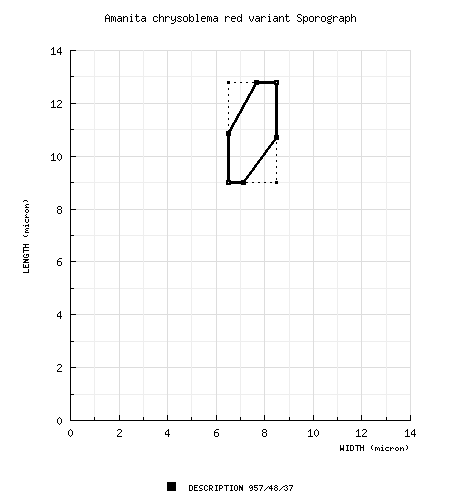
[957/48/37] (7.5-) 9.0 - 12.8 (-19.0) × (5.5-) 6.5 - 8.5 (-11.5) µm, (L = (8.9-) 9.4 - 12.1 (-14.6) µm; L’ = 10.8 µm; W = (6.6-) 6.9 - 8.2 (-8.4) µm; W’ = 7.6 µm; Q = (1.11-) 1.26 - 1.67 (-2.23); Q = (1.29-) 1.31 - 1.65 (-1.95); Q’ = 1.42), hyaline, colorless, thin-walled, smooth, inamyloid, broadly ellipsoid to ellipsoid, occasionally elongate, rarely subglobose, rarely langeniform; apiculus sublateral, cylindric to truncate-conic; contents dominantly monoguttulate, occasionally granular or multiguttulate; white in deposit. |
| ecology |
Solitary to scattered to subgregarious to gregarious. Argentina: In duff under introduced Pinus sp. Colombia: At 3385 m elev. On slopes in introduced Pinus forest. Costa Rica: At 1800 - 3000 m elev. Without any member of Pinaceae present, in Quercus copeyensis C. H. Mull. forest or in mixed broad leaf forest with Q. costaricensis Liebmann or in a dominantly Q. costaricensis forest. Edo. México, México: At 3700 m elev. In Pinus hartwegii Lindl. forest. Tlaxcala edo., México: At 2950 m elev. In Pinus-Quercus-Abies forest or in Pseudotsuga-Abies-Quercus-Pinus-Arbutus forest or in similar forest lacking Quercus or in P. teocote Schldl. & Cham.-P. montezumae Lamb forest. Veracruz edo., México: At 2450 - 2820 m elev. In Pinus or Pinus-Abies forest. Canary Islands, Spain: In introduced Pinus forest. Arizona, U.S.A.: At 1880 - 2570 m elev., in thick loam/duff. For site-by-site tree data see Gazetteer for the Chiracahua Mycoflora Project (not yet posted). California, U.S.A.: In duff under mixed conifers or under P. radiata or associated with Quercus; exclusively with Quercus in the southern coastal region (F. H. Nishida, pers. commun.) or with Eucalyptus globulus ?. Massachusetts, U.S.A.: With Betula in landscaping. New Mexico, U.S.A.: At 2475 - 3415 m elev. In associations with Abies and Pinus (Relf Price, pers. commun.). Oregon, U.S.A.: Solitary, ca. 1800 m elev. In packed soil of trail. Texas, U.S.A.: [?mMay be confused with A. muscaria var. persicina and must be confirmed.] In experimental forest plots in southeastern Texas, one plot planted solely with Q. alba L. and the other solely with Q. nigra L. (vouchers reportedly in F) (Zhang 1998). Washington, U.S.A.: J. E. Lindgren (pers. corresp.) writes that the present taxon occurs in her region with Pseudotsuga menziesii and other conifers and "is pound for pound the most common Amanita we can collect. It is found in huge quantities from the sand dunes of the Pacific Ocean to at least...[1350 m elev.] in the Cascade [Mtns]. To my knowledge it does not grow with our only native species of Quercus,...Q. garryana [Dougl. ex Hook].... It seems to favor fast draining soil like sand or pumice." She notes further that it often fruits simultaneously with, and in very close proximity to, Boletus cf. edulis.
The present taxon is also reported from Alabama, U.S.A. [?doubtful?] and from Guatemala by Jenkins (1977). Lindgren (pers. commun.) reports that it is common in Prov. British Columbia, Canada. I have unannotated material from Idaho that may belong to this taxon. Small, isolated, probably introduced populations occur rarely in the northeastern U.S.A.
[??need to make sure that all specimens from Geml et al. are accounted for in our range description??] |
| material examined |
COLOMBIA: CUNDINAMARCA—Bogotá, Monserrate, 12.i.1969 T. Plowman 2220-A (FH).
COSTA RICA: CARTAGO—Ctn. Unkn. - Parq. Prusia, Volcán Irazu, W slope [9°57’56”N/83°52’15”W], s.d. L. D. Gómez 22064 (F 1073356), 11.iii.1993 R. E. Halling, G. M. Mueller, B. Strack, M. Mata & A. E. Franco-Molano [Franco-M. 1085] (NY), R. E. Tulloss 6-28-95-A (RET 153-5; USJ); Sanatoria, ix.1982 L. D. Gomez 18469 (F 1051877).
HONDURAS: FRANCISCO MORAZAN—Valle Angeles, 6.vii.1991 Gregory M. Mueller, Betty A. Strack, Rolf & Martha Singer & Robert Andino [Mueller 4155] (F 1098698).
MÉXICO: EDO. MÉXICO—Isidro Fabela - Cima del Cerro Las Palomas, 25.x.1986 Alejandro Kong-Luz 153 (TLXM, as “A. aff. muscaria”). TLAXCALA—Mpio. Huamantla - km 3 camino Altamira-Antiguo Albergue CREA, NE slope of Volcán La Malintzi [19°14’24” N/ 97°58’35” W], 2.ix.1994 A. Estrada Torres 3596 (RET 145-2; TLXM); La Cañada Grande, E slope of La Malintzi volcano, Parq. Nac. La Malinche [19°14’45” N/ 97°59’56” W, 3110 m], 19.viii.1998 NAMA foray participant s.n. [Tulloss 8-19-98-B] (RET 292-2; TLXM). Sierra de Terrenate - N de Villarreal, Barranca El Conejo, 27.vii.1989 M. Rodríguez Palma 1021 (RET 140-10; TLXM). Mpio. Tlaxco - Barranca del Río Zahuapan, NE of Tlaxco, 29.vii.1994 G. Galindo Flores 1851 (RET 145-1; TLXM); Cerro El Peñon [19°41'19" N/ 98°14'02"W, 2775 m], 24.vii.1991 Adriana Montoya-Esquivel 1038 (RET 140-9; TLXM); km 31 Apizaco-Poza Rica rd., Rancho Escondido, Sierra Tlaxco, 15.vii.1996 A. Kong Luz, A. Estrada Torres, R. H. Petersen et al. s.n. [Tulloss 7-15-96-H] (RET 253-6), A. Estrada Torres s.n. [Tulloss 7-15-96-I] (RET 254-10). Mpio. Trinidad Sánchez Santos, Parq. Nac. La Malinche, Volcán La Malintzi, SE slope, 4-7 km E de Francisco Javier Mina, 27.vii.1994 A. Montoya Esquivel 1463 (RET 144-10; TLXM). VERACRUZ—Mpio. Ixhuacán - zona del Cofre de Perote, Los Laureles, 15.vi.1985 V. M. Bandala-Muñoz 166 (XAL) & L. Montoya-Bello 117 (XAL). Mpio. Las Vigas - Casa Blanca, approx. 34 km por la carretera nac. Xalapa-Perote, 25.x.1986 L. Montoya-Bello 1038 (XAL). Mpio. Perote - 39 km por la carretera nac. Xalapa-Perote, Cruz Blanca, 21.x.1986 L. Montoya-Bello 973 (XAL as "A. muscaria"). Mpio. Xico - zona E del Cofre de Perote, 1.5 km al N de Ingenio El Rosario, Los Gallos, 5.vii.1985 V. M. Bandala-Muñoz 266-A [or 269?] (XAL). Zona E del Cofre de Perote, ca. La Presa Alto Pixquiac, 6.vii.1990 E. Ochoa 83 (XAL as “A. muscaria”). Loc. unkn., s.d. V. M. Bandala-Muñoz 301 (XAL) & 1294 (XAL).
U.S.A.:
ARIZONA—Cochise Co. - CMP site #4, 15.viii.1989 Royce Harvey s.n. [CMP0071] (LAM), 26.viii.1991 Gerald Holmes s.n. [CMP1679] (LAM n.v.); CMP site #5, 19.viii.1992 R. L. Homola s.n. [CMP1345 ; Tulloss 8-19-92-AD] (LAM; MAINE; RET), Edie Windham s.n. [CMP1344 ; Tulloss 8-19-92-H] (LAM; RET); CMP site #6, 13.viii.1989 R. M. Chapman s.n. [CMP0063] (LAM n.v.); CMP site #10, 30.viii.1993 Dr. Susan B. Fleming s.n. [CMP3143] (LAM; RET); CMP site #30, 18.viii.1991 R. M. Chapman & R. E. Tulloss 8-18-91-C [CMP0643] (LAM); CMP site #43, 4.ix.1982 F. H. Nishida 4762 (FHN) & 4764 (FHN); CMP site #46, 18.viii.1991 F. H. Nishida s.n. [CMP0858 ; Tulloss 8-18-91-T] (LAM), R. E. Tulloss 8-18-91-H [CMP0648] (LAM), 21.viii.1992 S. B. Fleming s.n. [CMP1840] (LAM; RET). Coconino Co. - San Francisco Peaks, 26.viii.1992 J. S. States AEF948 (MICH). Pima Co. - Santa Catalina Mtns., Loma Linda, 29.viii.1992 S. B. Fleming 2 (RET). CALIFORNIA—Contra Costa Co. - Hercules, prop. D. Bojantchev, 6.i.2008 Dimitar Bojantchev s.n. (RET). Marin Co. - unkn. loc., 24.xi.1989 participant in Mycol. Soc. San Francisco foray s.n. [Tulloss 11-24-89-I] (RET). Mendocino Co. - Jackson St. For., "Suillus Park," 6.xi.1982 A. S. Methven 1923 (NY 45863 as “A. muscaria”). Monterey Co. - Aquahito Rd., 18.i.1975 H. D. Thiers 33358 (SFSU as "A. muscaria"). COLORADO—Summit Co. - Wearyman, 15.viii.1997 Pike’s Peak Mycol. Soc. membr. s.n. [RET 8-15-97-A] (RET).
MASSACHUSETTS—Middlesex Co. - Winchester, 2.xi.1994 Inge Dewald s.n. (RET).
NEW MEXICO—Sandoval Co. - Valles Caldera Nat. Preserve, Redondo Pk., 27-28.viii.2011 Relf Price s.n. (RET 457-9).
OREGON—Hood River Co. - MHNF, Cove Tr., Cloud Cap to Elk, 29.vii.1987 Janet E. Lindgren s.n. [RET 7-29-87-JL1] (RET).
WASHINGTON—Clallam Co. - Olympic Peninsula, "summer".1981 Harley E. Barnhart S-81-HB (RET).
Material examined from outside presumed natural range: ARGENTINA: BUENOS AIRES—Sierra de Los Padres, 16.vi.1991 E. Albertó s.n. (BAFC 32.380).
SPAIN:
ISLAS CANARIAS—Gran Canaria - Montaña Alta, 3.i.1976 A.-E. Torkelsen 153/76 (O). |
| discussion |
From morphological studies of RET and from the genetic studies of Geml et al. (2010, 2008), good evidence has been obtained that the present taxon is a species that is clearly segregated from the Eurasian A. muscaria. The provisional name Amanita amerimuscaria Tulloss & Geml ia been proposed for the present taxon.
A sporograph providing comparison of the present taxon to A. muscaria follows.
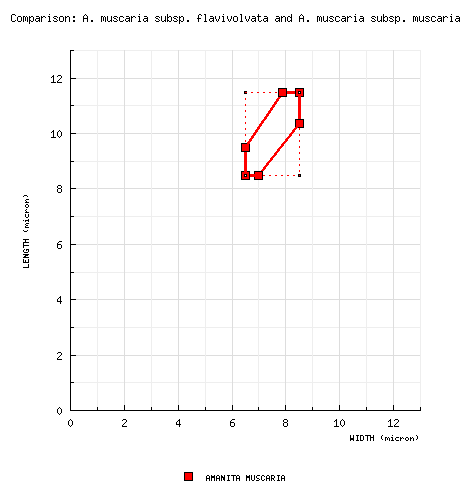
Comparison of spores alone is often sufficient to indicate whether a specimen falls into subsp. flavivovlata or subsp. muscaria; however, this is clearly not always the case given the figure above. Difference in the values of biometric variables of the subhymenium are an important, second, morphological differentiating factor for the two taxa.
The work of Geml et al. provides strong evidence that A. muscaria var. persicina is phylogenetically segregated from the present taxon. As a consequence, the limitations of the value of spore data alone for species differentiation are clearly illustrated by the following sporograph.

At present, the phylogenetic studies of Geml et al. have not supported segregation of the present taxon from A. muscaria var. guessowii; and at present, Tulloss and Geml are using the term "Amanita amerimuscaria yellow variant" as a proposed replacement for var. guessowii. For completeness, the following sporograph indicates the state of the present data on spore shape and size comparison for the red and yellow variants of the "American Fly Agaric."

[An extensive paper discussing the above material has been drafted by to be authored by Tulloss and Geml is in review.] |
| citations |
—R. E. Tulloss and J. Geml |
| editors |
RET |
|



 Spore data sets and their composite