

| name | Amanita campinaranae |
| name status | nomen acceptum |
| author | Bas |
| english name | "Campinarana Amanita" |
| images | |
| cap |
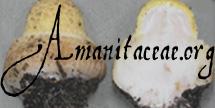
The cap of A. campinaranae is about 60 mm wide, white to pallid grayish, thin, convex, later nearly plane with a depressed center, with no apparent innate fibrils, solid, viscid when moist, with a nonstriate and nonappendiculate margin. The volva is present as subfelted, crust-like remnants over the center and more isolated patches away from the center. The flesh is white and unbruising. |
| gills |
The gills are free, between close and crowded, forked towards both the stem and margin, narrow, white, and turning cream to yellow when freshly dried, with a more or less concolorous edge. The short gills are attenuate. |
| stem |
The stem is 77 × 9 mm, slightly tapering upward, pale gray, and glabrous. The bulb 20 mm wide, globose, subabrupt, dirty ochre or white. The volva is grayish, powdery to slightly warty and forms a ring in the zone where the bulb and stem meet. The ring is apical, membranous, skirt-like, quite thin, white and smooth above, very pale gray underneath. The flesh is white and unbruising. |
| odor/taste |
Odor none. |
| spores |
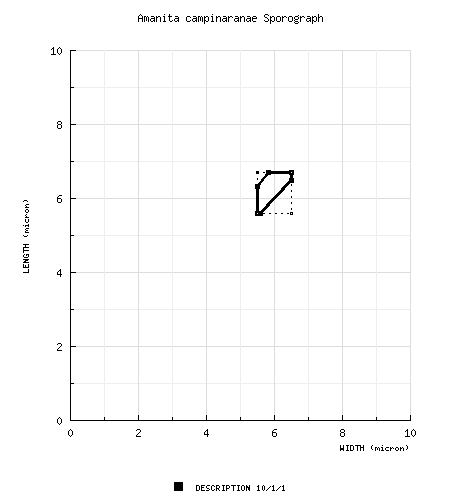
The spores measure 5.6 - 6.7 × 5.5 - 6.5 µm and are strongly amyloid and globose to subglobose. Clamps are absent at bases of basidia. |
| discussion |
This species occurs in Campinarana type vegetation under leguminous trees and trees of the family Sapotaceae in the Brazilian state of Amazonas. It is believed to be symbiotic with at least some of the associated trees. Information about the Campinarana vegetation type can be found on the Smithsonian Institute Department of Botany website. Bas says (1978): "Within section Validae it is well characterized by its small, (sub)globose spores, it's thin white to greyish pallid cap with grey, crust- to patch-like volval remnants and it's globose bulb decorated with a greyish volval rim giving the bulb a submarginate appearance." In a recent discussion of small spore size in Amanitas of tropical forests, the present species was used as an example of this characteristic; and, of the small spored species in the Americas, it's spores are smallest (Tulloss 2005). —R. E. Tulloss and L. Possiel |
| brief editors | RET |
| name | Amanita campinaranae | ||||||||||||||||||||
| author | Bas. 1978. Persoonia 10: 4, figs. 1-6. | ||||||||||||||||||||
| name status | nomen acceptum | ||||||||||||||||||||
| english name | "Campinarana Amanita" | ||||||||||||||||||||
| MycoBank nos. | 308543 | ||||||||||||||||||||
| GenBank nos. |
Due to delays in data processing at GenBank, some accession numbers may lead to unreleased (pending) pages.
These pages will eventually be made live, so try again later. Search:
Showing 0 to 0 of 0 entries | ||||||||||||||||||||
| holotypes | INPA; isotype, L | ||||||||||||||||||||
| intro |
The following text may make multiple use of each data field. The field may contain magenta text presenting data from a type study and/or revision of other original material cited in the protolog of the present taxon. Macroscopic descriptions in magenta are a combination of data from the protolog and additional observations made on the exiccata during revision of the cited original material. The same field may also contain black text, which is data from a revision of the present taxon (including non-type material and/or material not cited in the protolog). Paragraphs of black text will be labeled if further subdivision of this text is appropriate. Olive text indicates a specimen that has not been thoroughly examined (for example, for microscopic details) and marks other places in the text where data is missing or uncertain. The following material is derived from the protolog. | ||||||||||||||||||||
| basidiospores | from protolog: [10/1/1] 5.6 - 6.7 × 5.5 - 6.5 μm, (Q = 1.0 - 1.15 Q = 1.05; Q' = 1.05), "very pale brownish-yellowish when resoaked in NH4OH," smooth, with wall very slightly thickened, strongly amyloid, globose to subglobose, often tapering toward apiculus; apiculus [truncate-conic in illustration—ed.]; contents usually monoguttulate, with "oil drops" particularly brownish-yellowish in NH4OH; color in deposit not recorded. [Note: In the protolog, Bas makes this observation: "In view of the slightly thick-walled and in NH4OH somewhat yellowish-brownish spores, it is possible that the spore print of this species is slightly coloured."—ed.] | ||||||||||||||||||||
| ecology | "Terrestrial in Campinarana vegetation under Leguminosae and Sapotaceae...; forming ectotrophic mycorrhiza." | ||||||||||||||||||||
| material examined | from protolog: BRAZIL: AMAZONAS—on rd. from Manaus to Caracarai, km 45 [2.688° S/ 60.049° W], 3.ii.1978 R. Singer B10602 (holotype, INPA; isotype, L). | ||||||||||||||||||||
| citations | —R. E. Tulloss | ||||||||||||||||||||
| editors | RET | ||||||||||||||||||||
Information to support the viewer in reading the content of "technical" tabs can be found here.
| name | Amanita campinaranae |
| bottom links | [ Keys & Checklists ] |
| name | Amanita campinaranae |
| bottom links | [ Keys & Checklists ] |
 Spore data sets and their composite
Each spore data set is intended to comprise a set of measurements from a single specimen made by a single observer; and explanations prepared for this site talk about specimen-observer pairs associated with each data set. Combining more data into a single data set is non-optimal because it obscures observer differences (which may be valuable for instructional purposes, for example) and may obscure instances in which a single collection inadvertently contains a mixture of taxa.

Text and User-Generated Sporographs are published under the Creative Commons License.

In the case of a taxon page, image credits are on the 'image' tab.