This text is derived from the original description of
Amanita brunneomaculata. The fruiting bodies
of Amanita brunneomaculata are medium-sized.
cap
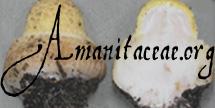
The cap is 50 – 90 mm wide, plano-convex to
planar, whitish, and has a brownish to brown
spot when mature. The volva is present as
fluffy to patchy, whitish to brownish
remnants, which are easily broken when
mature. The cap’s margin is non- or radially
grooved and has material hanging from
its edge. The flesh is white.
gills
The gills are free, crowded, and white, but
become grayish, gray-brown, brownish
to brown when dried. The short gills
are truncate and plentiful.
stem
The stem is 50 – 130 × 10 – 22 mm, nearly cylindrical or
narrowing upwards, white, brownish to brown,
covered with concolorous fluffy
squamules. The stem lacks a basal bulb. At
the stem's base, the volva is saccate,
15 – 50 × 15 – 40 mm, and membranous; the outer surface
is white, brownish to brown, and the inner surface
is brownish to brown. The ring hangs
from a region 30 – 40 mm below the stem's
top and is fluffy, whitish and fugacious.
odor/taste
The odor and taste were not recorded for the present species.
spores
The spores measure 10.0 – 13.0 × 6.5 – 8.0 µm
and are ellipsoid to elongate and amyloid. There
are no clamps at the bases of basidia.
discussion
Amanita brunneomaculata is described from
Yunnan Province, China. &nsbp;This taxon is often
in association with
trees of the family Pinaceae.—Yang-Yang
Cui and Rachel Warner
Due to delays in data processing at GenBank, some accession numbers may lead to unreleased (pending) pages.
These pages will eventually be made live, so try again later.
Search:
accession
locus
voucher
source
No data available in table
Showing 0 to 0 of 0 entries
holotypes
HKAS 70032
Information to support the viewer in reading the content of "technical" tabs
can be found here.
name
Amanita brunneomaculata
name status
nomen acceptum
author
Yang-Yang Cui, Qing Cai & Zhu L. Yang
name
Amanita brunneomaculata
name
Amanita brunneomaculata
no collection records available. Please create a collection record in order to enter spore measurements and derive sporograph from them. The form below will draw a sporograph based on data entered: