

| name | Amanita brunneibulbosa |
| name status | nomen acceptum |
| author | O. K. Mill. |
| english name | "Miller's Slender Amanita" |
| images | |
| intro | The following is based on the original description of Miller (1992). |
| cap | The cap of Amanita brunneibulbosa is 38 - 44 (-50) mm wide, conic to convex then planar in age, viscid, glabrous, brown, with a nonstriate margin, sometimes appendiculate in young material. The volva is present on the cap as light gray, powder areas, which are present at the margin in young material or as loose, white, easily removed patches over the center and (at times) irregularly elsewhere on the cap. The flesh is white, firm, and unchanging. |
| gills | The gills are subdistant, narrowly adnate, broad, white, sometimes becoming buff in age. Short gills are said to be present in a single tier. |
| stem | The stem is 75 - 110 × 4 - 7 mm, cylindric white covered with minute fibrils, tinted cream to buff. The basal bulb is subglobose, marginate to submarginate, 13 - 23 × 13 - 20 mm. The volva is white and submembranous and is visible as rings of tissue on the base, tinted cream to buff. The ring is dull white to grayish white, very fragile, sometimes present as a ragged skirt, sometimes absent. The flesh is white, firm, and unchanging. |
| odor/taste | The odor of the present species is said to be indistinct, and its taste has not been recorded. |
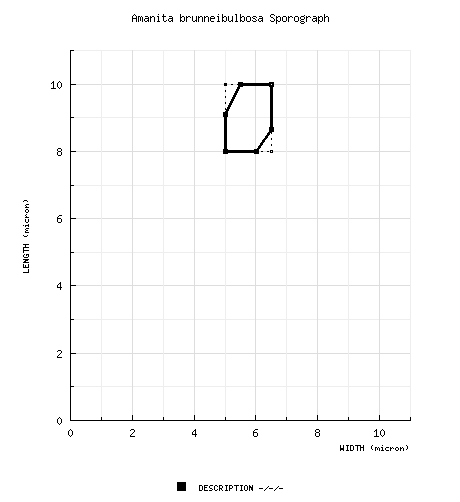
| spores | The spores measure 8 - 10 × 5 - 6.5 µm and are ellipsoid to elongate and amyloid. Clamps are absent at bases of basidia. |
| discussion |
The present species was originally described from the state of Western Australia where it occurs gregariously in litter under Eucalyptus. Miller proposed placement of A. brunneibulbosa in section Phalloideae. On the other hand, Miller states the most similar species is A. gossypino-annulata D. A. Reid, which is rather securely placed in section Lepidella. The original description is not clear about the nature of the volva in relation to the stem's bulb. In the accompanying photograph, the volva appears to be present on the lower stem as loose, appressed patches, not as a membranous limb attached to the bulb (as is typical of sect. Phalloideae). The pileus pigmentation suggests "radially oriented innate hairs" in the photograph. A ring is present although possibly damaged on the stem of every specimen in the photograph, thus suggesting any fragility has more to do with its thinness than with a microscopic structure that might argue for placement in section Lepidella. A submembranous, white volva that becomes tinted buff or gray is known in a number of species of sect. Validae. The absence of clamps and the small, but elongate, spores are also consistent with placement in sect. Validae. Therefore, at least for the moment, I propose the placement of this species in the latter section.—R. E. Tulloss |
| brief editors | RET |
| name | Amanita brunneibulbosa | ||||||||||||||||||||
| author | O. K. Mill. 1992a ["1991"]. Canad. J. Bot. 69: 2700, figs. 34-36, 50. | ||||||||||||||||||||
| name status | nomen acceptum | ||||||||||||||||||||
| english name | "Miller's Slender Amanita" | ||||||||||||||||||||
| MycoBank nos. | 358173 | ||||||||||||||||||||
| GenBank nos. |
Due to delays in data processing at GenBank, some accession numbers may lead to unreleased (pending) pages.
These pages will eventually be made live, so try again later. Search:
Showing 0 to 0 of 0 entries | ||||||||||||||||||||
| holotypes | PERTH; isotype, VPI | ||||||||||||||||||||
| intro |
The following text may make multiple use of each data field. The field may contain magenta text presenting data from a type study and/or revision of other original material cited in the protolog of the present taxon. Macroscopic descriptions in magenta are a combination of data from the protolog and additional observations made on the exiccata during revision of the cited original material. The same field may also contain black text, which is data from a revision of the present taxon (including non-type material and/or material not cited in the protolog). Paragraphs of black text will be labeled if further subdivision of this text is appropriate. Olive text indicates a specimen that has not been thoroughly examined (for example, for microscopic details) and marks other places in the text where data is missing or uncertain. The following material is drawn entirely from the protolog of the present species. from protolog: Basidiomes medium-sized. | ||||||||||||||||||||
| pileus | from protolog: 38 - 44 (-50) mm wide, brown (5C-D4), conic to convex then plane in age, viscid, glabrous; context firm, pure white, unchanging when cut or bruised; margin nonstriate, with very light gray, farinose material over unexpanded margin, absent in age, at times weakly appendiculate in young specimens; universal veil as patches, predominantly over disc, at times irregularly distributed, white, detersile. | ||||||||||||||||||||
| lamellae | from protolog: narrowly adnate, subdistant, white, sometimes buff in age, broad; lamellulae present in "one tier." [Note: Miller's reporting of the diversity of lengths of lamellulae was unreliable at times. E.g., see Amanita marmorata techtab.—ed.] | ||||||||||||||||||||
| stipe | from protolog: 75 - 110 × 4 - 7 mm, cylindric[, probably whitish—ed.]; bulb subglobose, 13 – 23 × 13 – 20 mm, white, covered with minute fibrils, obscurely marginate to marginate; context pure white, firm and unchanging when bruised; partial veil absent or as superior ragged "annulus," then very fragile, dull white to pale grayish white, separating irregularly; universal veil as irregular rings on stipe base, white or "tinted cream to buff," submembranous. | ||||||||||||||||||||
| odor/taste | from protolog: Odor indistinct. Taste not recorded. | ||||||||||||||||||||
| macrochemical tests |
none recorded. | ||||||||||||||||||||
| pileipellis | from protolog: up to 280 - 320 μm thick, ochraceous in Melzer's Reagent, light yellow-brown in KOH; filamentous hyphae 2 - 5 μm wide, thin-walled. | ||||||||||||||||||||
| pileus context | from protolog: filamentous to "vesiculose" hyphae 3 - 20 (-40) μm wide, thin-walled, interwoven, pale yellow in both KOH and Melzer's Reagent. [Note: Miller's description suggests that all inflated cells of the pileus context are intercalary. This is improbable. There is no known case of pileus context in Amanita that is not acrophysalidic.—ed.] | ||||||||||||||||||||
| lamella trama | from protolog: [bilateral, ]divergent; filamentous hyphae 3 - 11 µm wide, interwoven, thin-walled, hyaline. | ||||||||||||||||||||
| hymenial trama | double click in markup mode to edit. | ||||||||||||||||||||
| subhymenium | from protolog: comprising short cells 3 - 8 µm wide. [Note: In all cases examined by the editors, the subhymenium of species in both sections Phalloideae and Validae are pseudoparenchymatous (cellular).—ed.] | ||||||||||||||||||||
| basidia | from protolog: 35 - 58 × 9 - 11 µm, 4-spored; clamps not observed. | ||||||||||||||||||||
| universal veil | from protolog: filamentous hyphae 2 - 7 µm wide; inflated cells pyriform to ovoid, 28 - 42 × 10 - 24 µm, thin-walled, hyaline[, colorless], terminal singly or (occasionally) in chains. [Note: Miller does not indicate whether the sampled tissue of the universal veil came from the pileus or from the stipe base.] | ||||||||||||||||||||
| stipe context | not described. | ||||||||||||||||||||
| partial veil | not described. | ||||||||||||||||||||
| lamella edge tissue | not described. | ||||||||||||||||||||
| basidiospores | from protolog: [-/-/-] 8.0 - 10.0 × 5.0 - 6.5 μm, (Q = 1.33 - 1.82; Q' = 1.47), thin-walled, amyloid, ellipsoid to elongate; apiculus "hyaline"; contents not described; white in deposit. [Note: The word "hyaline" is provided as the description of the apiculus because that is the sole descriptive term provided for the apiculus in the protolog. The reader should be aware that the apiculus in the Amanitaceae is always hyaline and never participates in an amyloid reaction of the remainder of the spore wall. Hence, "hyaline" normally does not appear in the description of the apiculus.—ed.] | ||||||||||||||||||||
| ecology | from protolog: Subgregarious to gregarious. "In well-developed litter under Eucalyptus diversicolor, E. jacksonii, E. marginata, E. guilfoylei, and other species of Eucalyptus." | ||||||||||||||||||||
| material examined |
from protolog: AUSTRALIA: WESTERN AUSTRALIA—Town of Manjimup - unkn. loc., | ||||||||||||||||||||
| discussion |
It is very odd that Miller proposes to place the present species in sect. Phalloideae and states in the same paragraph that the most similar species is Amanita gossypionannulata, a species that appears to the editors to belong in Bas' stirps Grossa of sect. Lepidella. The text of the protolog of the present species is not clear about the nature of the universal veil in relation to the stem's bulb. In the accompanying photograph, the universal veil appears to be present on the lower stem as loose, appressed patches, not as a membranous limb. The pileus pigmentation appears virgate in the photograph; and an annulus is present although possibly damaged in every specimen in the photograph, thus suggesting the fragility has more to do with its thinness than with a microscopic structure that might argue for placement in section Lepidella. A submembranous, pallid universal veil that becomes tinted buff or gray is known in a number of species of section Validae. The absence of clamps and the small, but elongate, spores are also consistent with placement in section Validae. Therefore, at least for the moment, RET proposes the placement of A. brunneibulbosa in the latter section. | ||||||||||||||||||||
| citations | The editors express their thanks to Dr. Elaine Davison for her assistance with Western Australia geographical and other data relating to Miller's original materials of this taxon.—R. E. Tulloss | ||||||||||||||||||||
| editors | RET | ||||||||||||||||||||
Information to support the viewer in reading the content of "technical" tabs can be found here.
| name | Amanita brunneibulbosa |
| bottom links |
[ Keys & Checklists ] [ Australia/New Zealand List ] |
| name | Amanita brunneibulbosa |
| bottom links |
[ Keys & Checklists ] [ Australia/New Zealand List ] |
 Spore data sets and their composite
Each spore data set is intended to comprise a set of measurements from a single specimen made by a single observer; and explanations prepared for this site talk about specimen-observer pairs associated with each data set. Combining more data into a single data set is non-optimal because it obscures observer differences (which may be valuable for instructional purposes, for example) and may obscure instances in which a single collection inadvertently contains a mixture of taxa.

Text and User-Generated Sporographs are published under the Creative Commons License.

In the case of a taxon page, image credits are on the 'image' tab.