

| name | Amanita bharatensis |
| name status | nomen acceptum |
| author | A. V. Sathe & Jeys. Daniel |
| english name | "Kerala Red Amanita" |
| images | |
| intro |
The following is based on the description by Sathe and Daniel (1980). |
| cap |
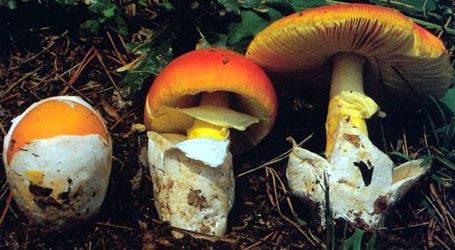
The cap of Amanita bharatensis is up to 70 mm wide, orange-red, darker towards the center, convex to planar, maybe slightly umbonate, with an entire and nonstriate margin. The volva is present as white patches or warts. The flesh is up to 5 mm thick [above the stem?], white, and not confluent with the stem flesh. |
| gills |
The gills are free, unequal, white, and up to 8 mm broad. |
| stem |
The stem is 130 × 8 mm, cylindric, smooth, white, with a bulbous base. The bulb at the base is 16 - 27 mm wide. The ring is membranous, superior, skirt-like, and white. The flesh is hollow. The volva is present as rings on the bulbous base. |
| spores |
The spores measure 11 - 12 × 7 - 8.5 µm and are ellipsoid to elongate and faintly amyloid [?]. Clamps are absent at bases of basidia. |
| discussion |
Originally described from the state of Kerala, India and is known from a single specimen. This species was found under solitarily under pine. The macroscopic description of this species strongly suggests Amanita muscaria (L. : Fr.) Lam., however the spores are said to be slightly amyloid. The authors interpret this species as being most similar to A. borneensis Boedijn as described by Bas (1969), a species of section Lepidella. However, the bright color of the cap, the presence of a membranous and persistent ring, the presence of a distinct bulb, and a friable volva indicate that the species belongs in either section Amanita or section Validae. It would be helpful to know if the pine under which this species was collected was in a plantation or in a natural forest. Also, the amyloid reaction of the spores should be rechecked.—R. E. Tulloss and L. Possiel |
| brief editors | RET |
| name | Amanita bharatensis | ||||||||||||||||||||
| author | A. V. Sathe & Jeys. Daniel. 1981 ["1980"]. Agaricales (Mushr.) S. W. India 1: 75-76, 104 (fig. 1). | ||||||||||||||||||||
| name status | nomen acceptum | ||||||||||||||||||||
| english name | "Kerala Red Amanita" | ||||||||||||||||||||
| MycoBank nos. | 115560 | ||||||||||||||||||||
| GenBank nos. |
Due to delays in data processing at GenBank, some accession numbers may lead to unreleased (pending) pages.
These pages will eventually be made live, so try again later. Search:
Showing 0 to 0 of 0 entries | ||||||||||||||||||||
| holotypes | AMH 4498 | ||||||||||||||||||||
| ecology | from protolog: Solitary. Above ca. 1,000 m elev. On decayed needles of Pinus. | ||||||||||||||||||||
| material examined | from protolog: INDIA: KERALA—Unkn. Distr. - Munnar, s.d. unkn. coll. s.n. (holotype, AMH4498). | ||||||||||||||||||||
| citations | —R. E. Tulloss | ||||||||||||||||||||
| editors | RET | ||||||||||||||||||||
Information to support the viewer in reading the content of "technical" tabs can be found here.
| name | Amanita bharatensis |
| bottom links |
[ Keys & Checklists ] [ Annotated Indian Checklist ] |
| name | Amanita bharatensis |
| bottom links |
[ Keys & Checklists ] [ Annotated Indian Checklist ] |
 Spore data sets and their composite
Each spore data set is intended to comprise a set of measurements from a single specimen made by a single observer; and explanations prepared for this site talk about specimen-observer pairs associated with each data set. Combining more data into a single data set is non-optimal because it obscures observer differences (which may be valuable for instructional purposes, for example) and may obscure instances in which a single collection inadvertently contains a mixture of taxa.

Text and User-Generated Sporographs are published under the Creative Commons License.

In the case of a taxon page, image credits are on the 'image' tab.