| name |
Amanita basiorubra |
| author |
O. K. Mill. 1992a ["1991"]. Mycologia 84: 679, figs. 1-4, 12, 13. |
| name status |
nomen acceptum |
| english name |
"Red Anklet Amanita" |
| MycoBank nos. |
360168 |
| GenBank nos. |
Due to delays in data processing at GenBank, some accession numbers may lead to unreleased (pending) pages.
These pages will eventually be made live, so try again later.
|
| holotypes |
PERTH; isotype, VPI |
| intro |
The following text may make multiple use of each data field.
The field may contain magenta text presenting data from a type study
and/or revision of other original material cited in the protolog of the present taxon.
Macroscopic descriptions in magenta are a combination of data from the protolog and
additional observations made on the exiccata during revision of the cited original
material.
The same field may also contain black text, which is data from a revision of the present
taxon (including non-type material and/or material not cited in the protolog).
Paragraphs of black text will be labeled if further subdivision of
this text is appropriate.
Olive text indicates a specimen that has not been
thoroughly examined (for example, for microscopic details) and marks other places in the text
where data is missing or uncertain.
The following material is derived from the protolog of the present species.
from protolog: Basidiomes medium-sized. |
| pileus |
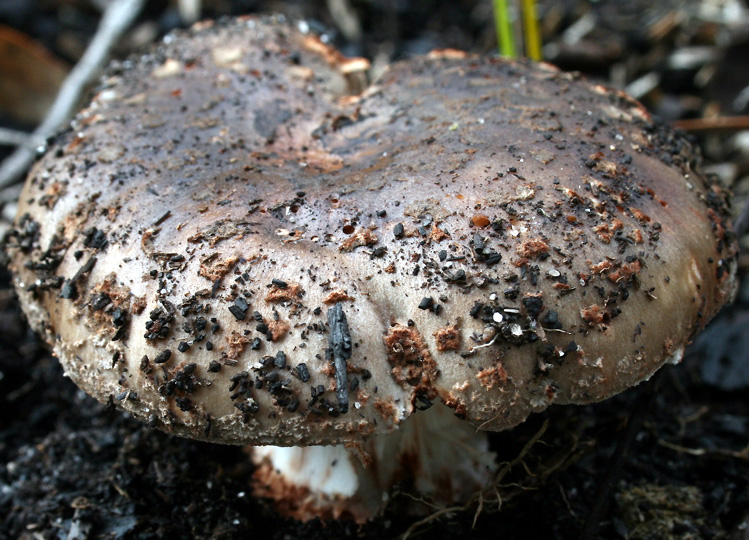
from protolog: 38 - 70 mm wide, convex to broadly convex, nearly plane in age, viscid, persistently sand-covered, smooth, brown, (6D5-6 to [6?]E5-6) at first, light brown to brownish orange (6C4) in age with small; context firm, white; margin smooth, often with scattered, small patches with fine, pink fibrils; universal veil as filmy white patches tinted pink to reddish (8A3-4) and concentrated over disc. |
| lamellae |
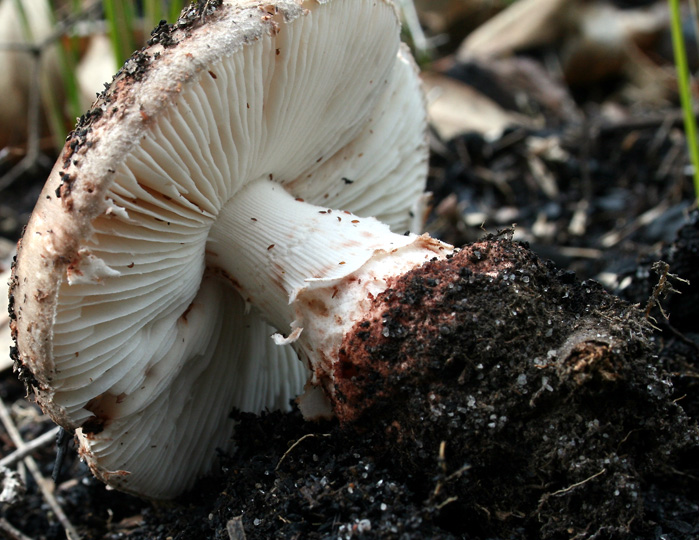
from protolog: narrowly adnate, close to subdistant, pure white, narrow, with smooth edges and emarginate in age; lamellulae reportedly in single tier. |
| stipe |
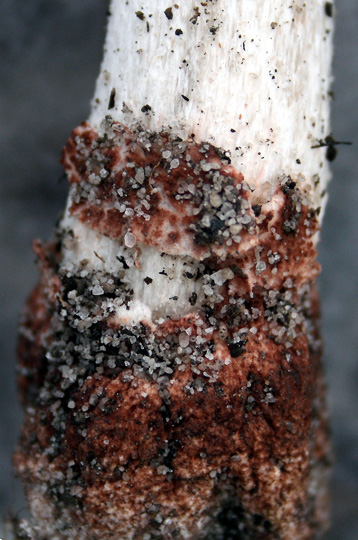
from protolog: 50 - 85 × 8 - 18 mm, white, equal or enlarging slightly downward; bulb submarginate to marginate, clavate, with upper half as red zone (9B5-6 to 9A6) comprising dense red (8A3) fibrils in tufts, with base tapering and sand covered; context firm, white in upper stipe, with red pigment (9D6-7) in stipe base at all ages in majority of specimens; partial veil persistent, white, skirt-like, striate above, with thin rim of red-tipped fibrils on edge; universal veil filmy white with outer covering of thin red fibrils, leaving scattered fragments on lower stipe in age. |
| odor/taste |
from protolog: Odor none. Taste not recorded. |
macrochemical
tests |
none recorded. |
| pileipellis |
from protolog: up to 245 - 355 µm thick; filamentous hyphae 3.4 - 8.4 (-10.5) µm wide, thin-walled, light yellowish to ochraceous in Melzer’s reagent, yellowish in 3% KOH. |
| pileus context |
[Note: Confused original text from protolog is omitted based on the judgment that it contained one or more typographical or other errors.—ed.] |
| lamella trama |
from protolog: [Bilateral,] divergent; ...; clamps “absent.” [Note: Text seeming to mix description of filamentous hyphae and "vesiculose cells" is omitted based on the judgment that it contained one or more typographical or other errors.—ed.] |
| subhymenium |
from protolog: hyaline layer of short, nearly rectangular[Perhaps "cylindric" was intended?—ed.], thin-walled cells 8 - 23 × 3.4 - 9 µm, several cells deep. |
| basidia |
from protolog: 38 - 48 × 9 - 10.5 µm, 4-sterigmate. [Presence/absence of clamps not described.—ed.] |
| universal veil |
from protolog: Exterior layer: oval to ovoid to elongate-clavate inflated cells 36 - 133 × 25 - 64 um, thin-walled, mostly hyaline, with scattered surface cells containing red pigment (observed in fresh material mounted in water) intermixed with filamentous, thin-walled hyphae 1 - 3 µm wide, mostly hyaline with scattered red pigmented cells (observed in fresh material mounted in water). Inner layer: filamentous hyphae 3.4 - 13.4 µm wide, hyaline, thin-walled, densely interwoven; clamps “absent.” |
| stipe context |
not described in protolog. |
| partial veil |
from protolog: filamentous hyphae 3 - 8.5 µm wide, hyaline, intermixed with “majority” of clavate, pyriform, ovoid to globose, thin-walled, hyaline inflated cells 46 - 120 × 10 - 46 µm; clamps “absent.” |
| lamella edge tissue |
from protolog: inflated cells 14 - 20 × 8 - 15 µm wide, hyaline, thin-walled, ovoid to pyriform, numerous; clamp connections “absent.” [Incorrectly called “cheilocystidia” by Miller in the protolog.—RET] |
| basidiospores |
from protolog: [-/-/3] 7.6 - 9.0 × 5.5 - 6.7 μm, (Q = 1.25 - 1.50; Q' = 1.39), thin-walled, amyloid, broadly ellipsoid to subellipsoid; apiculus not recorded; contents not recorded; pure white in deposit. |
| ecology |
from protolog: In small groups. In deep sand. "[A]ssociated with Eucalyptus marginata Donn ex Smith [and] Allocasuarina fraseriana Mig. or "under a planted strip of exotic Eucalyptus with Allocasuarina fraseriana in nearby natural woods." |
| material examined |
from protolog: AUSTRALIA: WESTERN AUSTRALIA—Shire of Albany - Two Peoples Bay Nature Reserve, 22.vi.1989 O. K. Miller 24011 (paratype, VPI), 7.vi.1991 O. K. Miller 24784 (holotype, PERTH; isotype, VPI). City of Perth - Kings Park, May Drive [31°57'52" S/ 115°49'53" E], 19.vi.1991 O. K. Miller 24890 (paratype, VPI). |
| discussion |
from protolog: “Microscopic examination of the fresh universal veil tissue from the cap of a button reveals a combination of filamentous hyphae 1 - 3 µm wide and a large proportion of ovoid to globose cells 30 - 70 µm wide, all without clamp connections. The outer layer of the universal veil mounted in water has dark red pigment in the walls and in varying amounts in the contents of both cell types. Material revived following drying and observed in water has reddish brown contents. The underlying white, veil tissue is morphologically similar but lacks pigmentation. The red zone over the upper part of the basal bulb of mature fresh specimens was also examined and found to have tissue identical with the universal veil tissue of the pileus described above. The darker red appearance results from a more concentrated proportion of red fibrils over the stipe base. The red pigment is similar in fresh water mounts from the pileus and stipe base. It appears that the ... tissue of the universal veil is spread apart as the cap expands exposing more white tissue and[, hence, creating] a pink overall color. ... The species readily cultures and has been synthesized to form ectomycorrhizae with Eucaluptus diversicolor F. Muell. in growth chambers at Virginia Tech. (unpubl. data).” |
| citations |
The editors express their thanks to Dr. Elaine Davison for her assistance with Western Australia geographical and other data relating to Miller's original materials of this taxon.
—R. E. Tulloss |
| editors |
RET |
|




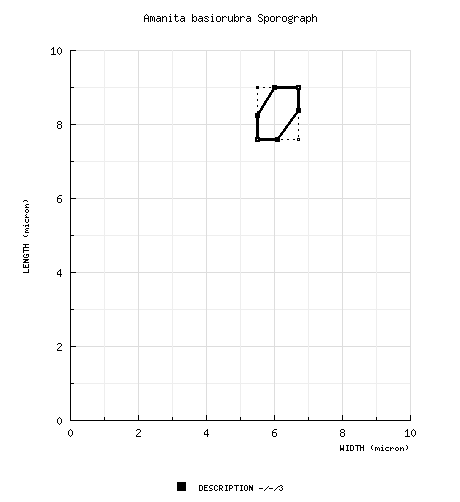
 Spore data sets and their composite