| name |
Amanita australis |
| author |
G. Stev. 1962. Kew Bull. 16: 67, pl. 1/1. |
| name status |
nomen acceptum |
| english name |
"Far South Amanita" |
| synonyms |
?= Limacella macrospora G. Stev. 1962. Kew Bull. 16: 65, pl. 2/1. ≡Oudemansiella macrospora (G. Stev.) Horak. 1971. information requested.
The editors of this site owe a great debt to Dr. Cornelis Bas
whose famous cigar box files of Amanita nomenclatural information
gathered over three or more decades were made available to RET for computerization
and make up the lion's share of the nomenclatural information presented on this site.
|
| etymology |
australis, "southern" |
| MycoBank nos. |
326087, 333374, 319066 |
| GenBank nos. |
Due to delays in data processing at GenBank, some accession numbers may lead to unreleased (pending) pages.
These pages will eventually be made live, so try again later.
|
| holotypes |
A. australis & L. macrospora—K |
| revisions |
A. australis—Ridley. 1991. Austral. Syst. Bot. 4: 336, fig. 5(a-j).
L. macrospora—Ridley. 1993. Austral. Syst. Bot. 5: 155. |
| intro |
The following text may make multiple use of each data field.
The field may contain magenta text presenting data from a type study
and/or revision of other original material cited in the protolog of the present taxon.
Macroscopic descriptions in magenta are a combination of data from the protolog and
additional observations made on the exiccata during revision of the cited original
material.
The same field may also contain black text, which is data from a revision of the present
taxon (including non-type material and/or material not cited in the protolog).
Paragraphs of black text will be labeled if further subdivision of
this text is appropriate.
Olive text indicates a specimen that has not been
thoroughly examined (for example, for microscopic details) and marks other places in the text
where data is missing or uncertain.
The following material is largely based on the revision of Ridley (1991). Some data (as indicated in text) is from original research of R. E. Tulloss.
Basidiomes very small to medium. |
| pileus |
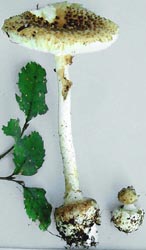
From the protolog (Ridley 1991): 20 - 90 mm wide, convex to plano-convex, then plano-depressed, at margin occasionally splitting and rolling back to give a ragged appearance, with disc dark buff, honey or isabelline, paling to buff at margin, viscid when young or wet, drying with age; context white, occasionally pale isabelline under disc, rarely as gray line above lamellae; margin not described; universal veil as conical to pyramidal warts, aggregated over disc, becoming sparse and low towards margin, at first white then greyish sepia or isabelline, with white to buff tips. |
| lamellae |
From the protolog (Ridley 1991): free, crowded, 6 - 10 mm wide, white, margin entire; lamellulae truncate. |
| stipe |
From the protolog (Ridley 1991): 37 – 90 × 6 – 26 mm [length includes bulb], narrowest at center, hollow, above partial veil white, floccose, below white with white, buff or sordid transverse, striate bands; bulb from slightly distinguished from stipe to abrupt, 14 – 38 mm wide, marginate to marginate-depressed; context white, hollow; partial veil membranous, striate, white to buff, pendulous then adhering to stipe; universal veil absent or as sordid buff to grayish pulverulence on bulb's rim. |
| odor/taste |
From the protolog (Ridley 1991): Odor and taste not recorded. |
macrochemical
tests |
From the protolog (Ridley 1991): none recorded. |
| pileipellis |
From the protolog (Ridley 1991): 220 – 270 µm thick, comprising gelatinised suprapellis and non-gelantinised subpellis. |
| basidia |
From the protolog (Ridley 1991): 43.5 – 76.5 × 10.5 – 17 µm, mostly 4-spored; clamps present. |
| universal veil |
From the protolog (Ridley 1991): On pileus: filamentous undifferentiated hyphae 4 – 10 µm wide, moderately abundant; inflated cells abundant, globose to clavate to napiform, 10 - 86 × 9 - 85 µm, pale umber to umber, in chains perpendicular to pileus surface, becoming smaller and paler toward tip of wart; vascular hyphae not described; clamps abundant. On stipe base: not described. |
| lamella edge tissue |
From the protolog (Ridley 1991): including numerous inflated cells, 16 - 40 × 10.5 - 28 µm, globose, elliptic or clavate, hyaline. |
| basidiospores |
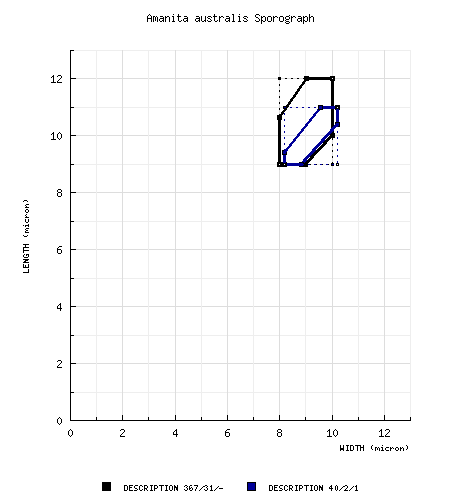
From the revision of Ridley (1991): [367/31/-] (8-) 9 - 12 (-14.5) × (7-) 8 - 10 µm, (Q = 1.0 – 1.33 (- 1.60); Q' = 1.10), hyaline, colorless, thin-walled, ??smooth??, globose to subglobose to broadly ellipsoid to ellipsoid, inamyloid; apiculus undescribed; contents undescribed; white in deposit.
RET: [40/2/1] (8.8-) 9.0 - 11.0 (-12.8) × (8.0-) 8.2 - 10.2 (-11.5) μm, (L = 9.8 - 10.2 μm; L’ = 10.0 μm; W = 9.2 - 9.5 μm; W’ = 9.3 μm; Q = 1.02 - 1.15 (-1.17); Q = 1.07 - 1.08; Q’ = 1.07), smooth, with walls subopaque and thin or slightly thickened, moderately amyloid, globose to subglobose, infrequently broadly ellipsoid, adaxially flattened; content monoguttulate; apiculus sublateral, cylindric, proportionately rather small. |
| ecology |
From the revision of Ridley (1991): Solitary or (rarely) gregarious. Known from both the North and South Islands of New Zealand: Under Nothofagus fusca, N. menziesii, N. solandri var. solandri, N. truncata, Leptospermum scoparium and Kunzea ericoides.
RET: Under Nothofagus truncata. |
| material examined |
From the revision of Ridley (1991): NEW ZEALAND: AUCKLAND—Henderson, Sharp’s Bush, 25.iv.1971 J. M. Dingley s.n. (PDD 29021); Hunua Range, Mangatangi Gorge, 26.iv.1972 J. M. Dingley s.n. (PDD 29906). NELSON—Karamea, Umere, 26.xii,1969, R. F. R. McNabb (PDD 31204); Nelson Lakes Nat. Pk., Lk. Rotoiti, 5.iii.1955 G. Stevenson 970 (holotype, K). SOUTHLAND—Fiordland Nat, Pk.(?), Mt. Grey, 11.vi.1983 G. Stevenson 83/191 (CHR). WELLINGTON— Eastbourne, Day’s Bay, 7.vi.1952 G. Stevenson 863 (K); Orongorongo Track, 9.iv.1986 G. S. Ridley 60 (PDD 56162), 18.iii.1987 S. Brodie & S. Frisby [G. S. Ridley 313] (PDD 56164), 25.iii.1987 G. S. Ridley 325 (PDD 56165); Orongorongo Valley, Paua Ridge, 19.iii.1986 G. S. Ridley 15a (PDD 56161); Rimutaka For. Pk., Catchpool, 3.v.1958 G. Stevenson 1297a (K).
RET: NEW ZEALAND:
NORTHLAND—Ornahuta For., 14.iv.1992 Steven L. Stephenson NZ 1992-1 (RET 071-2). |
| discussion |
Since the revision of this species by Ridley (1991), the species has been considered to be assignable to Amanita section Validae. However, the fact that clamps are rather common at bases of basidia is something at odds with all other known taxa in the section. Moreover, if sections Validae and Phalloideae have a common ancestor as has been proposed on both phylogenetic and morphological grounds, the fact that clamped basidia are not known in either section, leads one to considering that
-
the present species is the only known case of plentiful clamps appearing on a species with a long clampless ancestral line or
-
the present species is a rare example of a pigmented species of section Lepidella or
-
the present species an amyloid-spored species "near basal" to the inamyloid spored taxa of Amanita section Amanita or
-
the present species fits none of the above descriptions and is of unknown relationship to all other extant taxa in the genus.
|
| citations |
—R. E. Tulloss |
| editors |
RET |
|



 Spore data sets and their composite