

| name | Amanita aurantiobrunnea |
| name status | nomen acceptum |
| author | C. Simmons, T. Henkel & Bas |
| english name | "Grandfather Death Cap" |
| images |
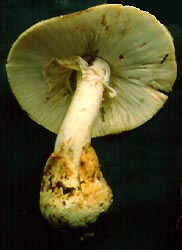 1. Amanita aurantiobrunnea, Pakaraima Mtns., western Guyana. 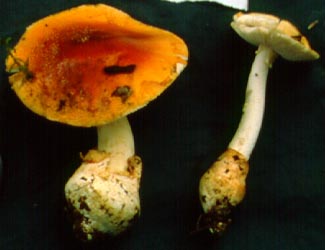  2. Amanita aurantiobrunnea, Pakaraima Mtns., western Guyana. |
| intro |
The description is based on the original description (2002). |
| cap |
The cap of Amanita aurantiobrunnea is 30 - 70 mm wide, convex to applanate, plano-concave with age, sometimes with a low broad umbo, viscid when wet, tacky when dry, and rich orangish tan to light orange at the margin. The flesh is white. The volva is often present as inconspicuous, tiny, whitish to concolorous fragments on the outermost margin. |
| gills |
The gills are free, thin, close to rather close, and white. The short gills are attenuate. |
| stem |
The stem is 64 - 88 × 7 - 16 mm, slightly narrowing upwards, white with white floccose squamules when young, and becoming bare with age. The bulb is 22 × 35 mm and is enclosed by a membranous, white to pale brownish salmon limbate volva that either spreads away from the stem or collapses on it. The ring is at the top of the stem, white, and weakly membranous, often reduced to small white scales, but sometimes skirt-like, sometimes remaining as white fragments on the edge of the cap. |
| spores |
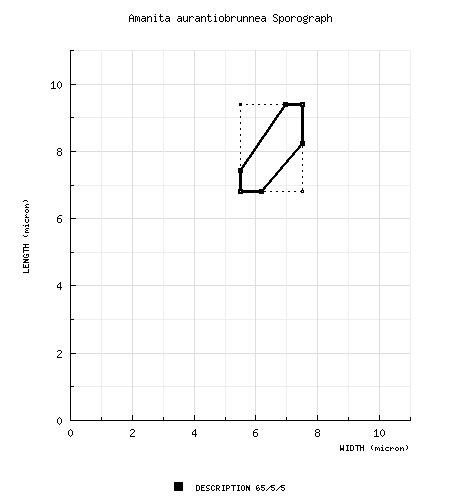
The spores measure (6.2-) 6.8 - 9.4 × (5.0-) 5.5 - 7.5 (-7.9) µm and are subglobose to broadly ellipsoid to ellipsoid and amyloid. Clamps are absent at the bases of basidia. |
| discussion |
This species was originally described from the Pakaraima Mountains of Guyana and is still known only from this region. It was collected in slope forests dominated by Dicymbe corymbosa on gray sands. For a comparison to the little known A. gayana (Mont.) Mont. in Gay, see the discussion of that species. In the original description, the authors state: "Amanita aurantiobrunnea has a peculiar character, that, as far as we know has not yet been described in the section Phalloideae, viz. a fin, white to colored, friable inner layer at least on the [inner surface of the free] limb of the volva that is responsible for the frequent presence of the rather inconspicuous, small, thin volval patches on the outermost margin of the pileus." The above is very fascinating discussion because it suggests that while sect. Amidella is unknown in South America, the present species may well a basal taxon of Amanita sect. Phalloideae that has retained the layered volva that leaves remnants of its inner layer on the cap and that tends to take on a pinkish or pinkish brown tint in section Amidella. Morphological reasons led Bas (1969) to believe that sect. Phalloideae may have arisen from an ancestor that could be placed in what we call today sect. Amidella. Recent molecular data suggests the same possibility.—R. E. Tulloss and L. Possiel |
| brief editors | RET |

 Spore data sets and their composite