| name | Amanita atrobrunnea |
| author | Thongbai, Raspé & K.D. Hyde in Li et al. 2016. Fungal Div. 78(1): 132, sp. 320. |
| name status | nomen acceptum |
| etymology | atra, black + brunneus, brown; for the dark pileus coloring. |
| MycoBank nos. | 551652 |
| GenBank nos. |
Due to delays in data processing at GenBank, some accession numbers may lead to unreleased (pending) pages.
These pages will eventually be made live, so try again later. |
| holotypes | MFLU 15–1415 |
| lamella edge tissue | Sterile. |
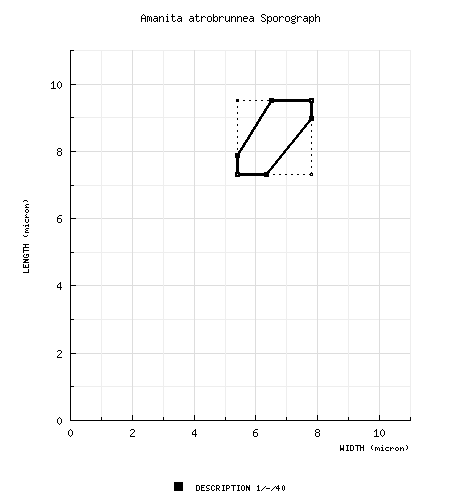
| basidiospores | protolog: [1/-/40] 7.3 – 9.5 × 5.4 - 7.8 μm, (L = 8.3 μm; W =6.6 μm; Q = 1.15 - 1.46; Q = 1.26), thin-walled, colourless, amyloid, smooth; apiculus small. |
| ecology | protolog: Thailand: In forest dominated by Fagaceae species. |
| material examined | protolog: THAILAND: CHIANG MAI—Doi Saket Distr. - Tepsadet Subdistr. [18.9503° N/ 99.3336° E, 1145 m], 30.vi.2014 B. Chuankid BZ–2014–09 (holotype, MFLU 15–1415). |
| discussion | This species is based on a single collection. |
| editors | RET |
Information to support the viewer in reading the content of "technical" tabs can be found here.
Spore data sets and their composite
Each spore data set is intended to comprise a set of measurements from a single specimen made by a single observer; and explanations prepared for this site talk about specimen-observer pairs associated with each data set. Combining more data into a single data set is non-optimal because it obscures observer differences (which may be valuable for instructional purposes, for example) and may obscure instances in which a single collection inadvertently contains a mixture of taxa.