
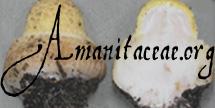
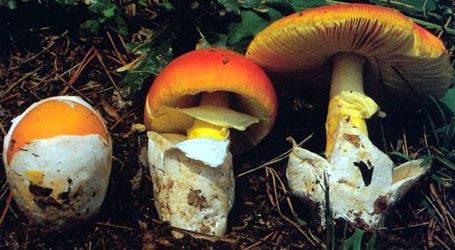

| name | Amanita arocheae |
| name status | nomen acceptum |
| author | Tulloss, Ovrebo & Halling |
| english name | "Latin American Death Cap" |
| images |
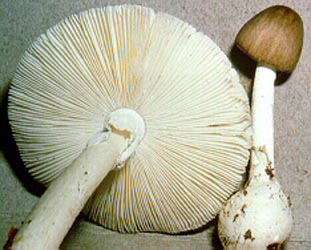  1. Amanita arocheae, oak (Quercus) forest, Andean Colombia. |
| intro | Amanita arocheae is a species apparently restricted to Mesoamerica and Andean Colombia. The way pigment is distributed on the cap and the general form of the fruiting body is strongly suggestive of this mushroom's relationship to A. phalloides. In fact, the species is reported to contain deadly Amanita toxins and has been called "A. phalloides" in the past by mycologists in Mexico. |
| cap | The cap of A. arocheae is 30 - 110 mm wide, rounded conic at first and then convex; it may become flattened and umbonate with further expansion. The cap's color is grayish to umber-brown, and it is streaked with apparent radial fibrils. It tends to be grayest when young and browner at maturity. The margin is not striate. The cap's flesh is white. Volval remnants are almost always absent from the cap. |
| gills | The gills are free or only very narrowly attached to the top of the stem, close to crowded, thin, and white. Short gills are frequent, with variable length, and are not squarely cut off. |
| stem | The stem is 80 - 200 × 5 - 17 mm, white (not changing color when cut or bruised), and bears white to pale gray fibrils on its surface. The stem's flesh is white and does not bruise or stain. The stem has a pronounce, nearly spherical bulb at its base; and the volva is notably present as a white membranous flap (or limb) arising from the bulb. A white, skirt-like ring is present at the top of the stem. |
| odor/taste | The odor is mild to disagreeable. The taste was not reported. Amanita arocheae contains amatoxins and is deadly POISONOUS. |
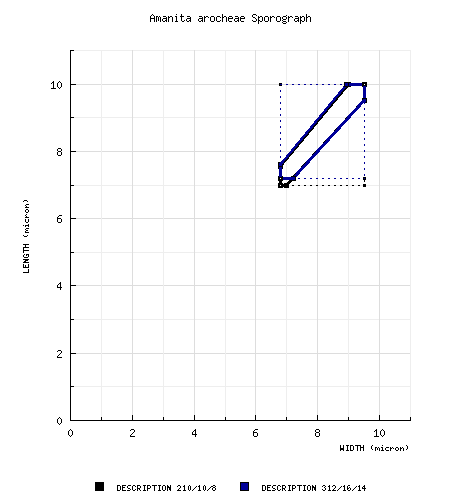
| spores | The spores measure (5.8-) 7.2 - 10.0 (-12.8) × (5.3-) 6.8 - 9.5 (-12.0) µm and are globose to subglobose (infrequently broadly ellipsoid) and amyloid. Clamps are not present at bases of basidia. |
| discussion |
The species is known from oak (Quercus) forests from central Mexico to Andean Colombia. A common name for the species in Mexico is "hongo gris." This mushroom is somewhat similar to A. phalloides (Fr. : Fr.) Link. For other similar taxa, see the latter species. The reader may want to examine the recently revised key to the taxa of sect. Phalloideae in North America.—R. E. Tulloss |
| brief editors | RET |

 Spore data sets and their composite