| name |
Amanita armillariiformis |
| author |
Trueblood & Dav. T. Jenkins in O. K. Mill., Trueblood & Dav. T. Jenkins. 1990. Mycologia 82: 120, figs. 1-4, 11-12. |
| name status |
nomen acceptum |
| english name |
"Armillaria-Like Lepidella" |
| MycoBank nos. |
133537 |
| GenBank nos. |
Due to delays in data processing at GenBank, some accession numbers may lead to unreleased (pending) pages.
These pages will eventually be made live, so try again later.
|
| holotypes |
MICH |
| intro |
The field may contain magenta text presenting data from a type study
and/or revision of other original material cited in the protolog of the present taxon.
Macroscopic descriptions in magenta are a combination of data from the protolog and
additional observations made on the exiccata during revision of the cited original
material.
The same field may also contain black text, which is data from a revision of the present
taxon (including non-type material and/or material not cited in the protolog).
Paragraphs of black text will be labeled if further subdivision of
this text is appropriate.
Olive text indicates a specimen that has not been
thoroughly examined (for example, for microscopic details) and marks other places in the text
where data is missing or uncertain.
Information not marked as derived from the protolog is based on original research of R. E. Tulloss. |
| pileus |
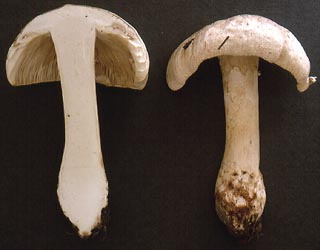
40 - 105 (-160) mm wide, dull white to dull pinkish buff, robust, convex to plane at maturity, glabrous, dry to very slightly viscid when wet; context white, unchanging when cut or bruised, thick at stipe, tapering evenly to margin; margin smooth, nonstriate, strongly incurved at first, with a distinct sterile rim, appendiculate, frequently rimose in age, almost becoming petaloideous; pileipellis very thin, submembranous, very slightly gelatinized, not readily separable from context; universal veil often absent or occasionally in thin floccose patches or crusts with pale salmon tint on low polygonal to irregularly shaped areolae separated by shallow to fairly deep fissures. |
| lamellae |
very narrowly adnate or joined to stipe by line, subdistant, white at first, then cream to pale tan at maturity, with slightly flocculose edges; lamellulae abundant, attenuate, roughly in two tiers and with those of longer group reaching half way or more to stipe. |
| stipe |
(35-) 50 - 90 × 17 - 24 mm, equal or swollen slightly near base, nearly glabrous above, with fine tufts of white fibrils or scales below; context white, solid or slightly[?] stuffed; partial veil thin, membranous, white, superior to median, easily torn, frequently adhering to stipe or pileus margin or disappearing; universal veil in concentric rings or random chunks or patches, with pale salmon tint. |
| odor/taste |
Odor “unpleasant, sometimes strong and medicinal” (protologue). |
macrochemical
tests |
none recorded. |
| basidia |
43 - 63 × 9.0 - 12.0 µm, 4- or, occasionally 2- and rarely 3-sterigmate, with walls ranging from colorless to distinctly yellow in 3% KOH, with sterigmata up to ?? × ?? µm; clamps rather common. |
| universal veil |
On pileus, exterior surface: filamentous, undifferentiated hyphae ?? µm wide, ??; inflated cells in easily separated chains with periclinal orientation, subcylindric to subfusiform to very narrowly clavate, with slightly thickened walls, colorless, up to 170 × 28 µm; vascular hyphae ?? µm wide, ??. On pileus, interior: ??. On pileus, lower surface: ??. On stipe base, exterior surface: ??. On stipe base, interior: ??. On stipe base, inner surface: ??. |
| stipe context |
longitudinally acrophysalidic; filamentous, undifferentiated hyphae ??9.0 - 14.0 (or 16.0)??
µm wide, branching, often in fascicles, common in interior, dominant near surface[, with many near stipe surface refractive?]; acrophysalides in interior conspicuously inflated-swollen clavate with tapering pedicel to narrowly clavate or more rarely utriform to subutrifrom to sublageniform, near surface less inflated, up to 230 × 83 µm [up to 300 µm long per C. Bas (unpub. data)], with walls up to ??
µm thick, sometimes arising from a less inflated subterminal cell; vascular hyphae ??
µm wide, infrequent, ??; clamps ??
. |
| basidiospores |
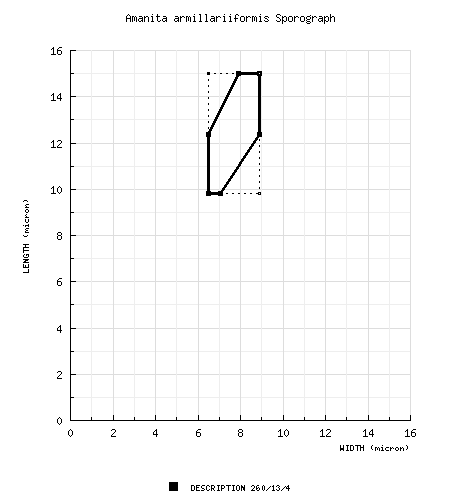
[260/13/4] (8.8-) 9.8 - 15.0 (-17.0) × (5.8-) 6.5 - 8.9 (-11.3) µm, (L = (10.4-) 10.6 - 13.4 µm; L’ = 12.3 µm; W = 6.7 - 7.8 (-8.3) µm; W’ = 7.5 µm; Q = (1.18-) 1.39 - 1.90 (-2.20); Q = (1.39-) 1.56 - 1.79; Q’ = 1.65), hyaline, colorless, smooth, thin-walled, amyloid, broadly ellipsoid to ellipsoid to elongate, often adaxially flattened, sometimes with one end expanded, occasionally taking on abnormal forms (e.g., subtriangular, V-shaped or heart-shaped in optical cross-section); apiculus sublateral, cylindric; contents monoguttulate; white in deposit. |
| ecology |
Solitary to gregarious. Alberta: In lawn of city park (association with trees, if any, not recorded). Colorado: Gregarious. At 1700 m elev. In grass of park away from woody plants. Idaho and Oregon: In xeric areas on hard ground, apparently associated with Populus tremuloides Michx., Pseudotsuga menziesii Mirb., and/or Salix spp. or in desert with Myosurus aristatus ?? and Artemisia tridentata Nutt. or among grasses (probably Poa according to collector) and near Lupinus or in dry area grazed down by cattle. |
| material examined |
from protolog: U.S.A.: IDAHO—Owyhee Co. - Nancy’s Gulch, 13.vi.1987 Jack & Ellen Trueblood 7202 [O. K. Miller 29120] (paratype, VPI n.v.); Peter’s Gulch, 13.vi.1987 J. & E. Trueblood 7205 [Miller 24121] (paratype, VPI n.v.).
OREGON—Malheur Co. - Oasis, 2.v.1978 E. Trueblood 6454 (holotype, MICH, n.v.); Ontario, ix.1987 Leeds & Marie Bailey & O. K. Miller [OKM 18505] (paratype, VPI, n.v.)
RET: CANADA: ALBERTA—Calgary, City Pk., 7.viii.1981 R. M. Danielson 3102 [Scott A. Redhead 82M-121] (DAOM 184734; L).
U.S.A.: COLORADO—Arapaho Co. - Littleton, Ketring Pk., N of Ketring Lk. [39°36’31.2” N/ 104°59’58.63” W], 11.viii.1997 E. Jacobson s.n. [Tulloss 8-11-97-EJ] (DBG; RET 266-8), 18.viii.1997 E. Jacobson, J. Justice, M. Shaw, R. E. Tulloss 8-18-97-B (DBG; RET 265-8). Jefferson Co. - Bear Crk. Lk. Pk., 22.v.1993 Vera Evanson s.n. (DBG 16088; RET 266-7).
IDAHO—Owyhee Co. - Nancy’s Gulch, 13.vi.1987 Jack & Ellen Trueblood 7202 [O. K. Miller 29120] (paratype, VPI, n.v.); Peter’s Gulch, 13.vi.1987 J. & E. Trueblood 7205 [Miller 24121] (paratype, VPI, n.v.); Reynold’s Crk. drainage, 14.v.1978 E. Trueblood 6484 (L, n.v.).
OREGON—Malheur Co. - Keeney Pt., 8.v.1978 E. Trueblood 6473 (L, n.v.; MICH, n.v.); Lytle Blvd., 22.iv.1978 E. Trueblood 6442 (L, n.v.); btwn. Negro Rock & Mitchell Butte, 17.v.1959 E. Trueblood 691 (L, n.v.; MICH); Oasis, 2.v.1978 E. Trueblood 6454 (holotype, MICH, n.v.); ca. Oasis, 8.iv.1978 E. Trueblood 6440 (L, n.v.); Ontario, ix.1987 Leeds & Marie Bailey & O. K. Miller [OKM 18505] (paratype, VPI, n.v.); 6.1 km S of Vale, Lytle Blvd., 2.v.1978 E. Trueblood 6467 (MICH, n.v.; fragments at L, n.v.); ca. Rock Springs Cyn., 2.x.1959 E. Trueblood 828 (MICH). |
| discussion |
I was not able to locate refractive pseudocystidia and vascular hyphae in the subhymenium in any of the material of this species that I examined after a diligent search of many lamella sections. If these tissues are examined at 125×, the scattered basidia and basidioles containing refractive contents (due to stage of maturity) may appear to be pseudocystida; and an optical illusion may make it seem that there are refractive elements in the subhymenium. At 1250×, such pseudocystida and refractive elements cannot be found. Given these observations, the present species is
....
Blaaa....
The material in Danielson 3102 is immature and the spore size and Q values are skewed downward—Q = 1.39 and 1.56.
The name of the present species was proposed in manuscript by Dr. A. H. Smith based on Mrs. Trueblood’s material. |
| citations |
—R. E. Tulloss |
| editors |
RET |
|



 Spore data sets and their composite