
| name | Amanita armeniaca |
| name status | nomen acceptum |
| author | A. E. Wood |
| english name | "Gypsy Peach Amanita" |
| images |
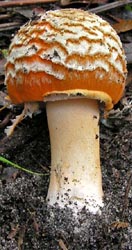 1. Amanita armeniaca, Victoria, Australia. 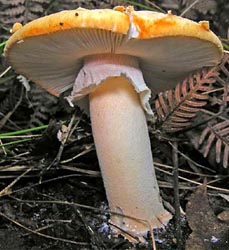 2. Amanita armeniaca, Victoria, Australia. |
| intro | The following is largely based on the original description (Wood 1997). |
| cap |
The cap of Amanita ameniaca is up to 90 mm wide, hemispheric at first, then convex becoming plane, smooth, dry, vaguely radially fibrillose, bright orange, powdery [with universal veil remnants], lacking striations in Wood's illustration, with the center almost granular, with some soft membranous, flat, dull scales near the center that are soon lost. |
| gills |
Gills are free, thin, crowded, white, with a concolorous margin. The short gills are present in at least one series. |
| stem |
The stem is up to 130 × 12 mm, equal, firm, with a small bulbous base, [often] pale clear orange throughout, sometimes paler with strong color only at apex and top of swollen base, mostly granular but slightly fibrillose towards the base. The ring is present and well-developed, membranous but soft, fragile, and easily falling off. It''s said to be bright orange, and hangs like a skirt, not striate on the top. The basal bulb is subglobose and largely white. The volva is absent or often with a few irregular scales on the stem above the bulb or a few indistinct fibrillose zones. |
| spores |
The spores measure (7.4-) 8.1 - 10.2 × 6.9 - 9.6 µm and are globose to subglobose and inamyloid. Clamps are absent at bases of basidia. |
| discussion |
Wood describes the mushroom as occurring in sclerophyll forests and "tall open forests" from the state of New South Wales, Australia. A sclerophyll forest in the Australian bush is a forest of hard-leaved plants including Eucalyptus in the overstory (wikipedia). This mushroom presents a combination of characters that is quite unusual in section Amanita—bright colors, non-striate cap margin, powdery volva, membranous annulus, and absence of clamps. The photographs received from Paul George are marked "cf. armeniaca" in the original web document from which they are copied. RET is hoping to be able to examine voucher material for these photographs. The photographs suggest that the volva is orange at first and becomes bleached. The partial veil is distinctly striate above, which is a contradiction of Wood''s original description as is noted in the cited document.—R. E. Tulloss and L. Possiel |
| brief editors | RET |

 Spore data sets and their composite