
| name | Amanita angustispora |
| name status | nomen acceptum |
| author | Cleland |
| english name | "Australian Narrow-Spored Limbate Lepidella" |
| intro |
The description of this species is based on the account of Reid (1980). |
| cap |
The cap of Amanita angustispora is 18 - 50 mm wide, irregularly convex, then nearly plane or with the center depressed, viscid when moist, appendiculate with subfibrillose material, whitish with a "slightly biscuity-brown tint" in the center, or with a "pale chocolate or grayish-brown tint." |
| gills |
The gills just reach the stem (adnexed or nearly adnate) and are moderately close, not ventricose, 7 mm or more broad, and white with a slight cream tint. |
| stem |
The stem is 50 - 62 × 10 - 12.5 mm, equal, moderately stout to moderately slender, solid, with a bulbous base about 25 × 19 mm and rounded to subradicating below, with a volva that has a distinct free edge. (See discussion below.) The upper part of the stem is flocculose and bears lines marking the oposition of the gills edges prior to expansion of the fruiting body. The lectotype selected by Reid lacks any remnant of an annulus, but other material that Cleland treated as conspecific still has a well-preserved annulus according to Reid. |
| spores |
The spores measure 9 - 13 × 5.5 - 6 µm (Cleland and Gilbert) or 8.8 - 13.2 × (4.5-) 5.0 - 6.6 µm (Reid) and are elongate to cylindric and amyloid. Clamps are present at the base of some basidia as Reid illustrates. |
| discussion |
No fruiting body of this species was illustrated by Cleland or Gilbert. Gilbert (1940) illustrated spores. Reid illustrated some microscopic detail. The illustrations of Reid show a volva structure that is not indicative of a membranous volva. In fact, one might well expect pyramidal warts in this case. The persistent reporting that there is a "sheathing," "ample" volva on the species appears to contradict the field notes that Reid reports for the type specimen. Based on the field notes with the type collection, the appendiculate cap margin, Reid's microscopic drawings, and the rareness of clamps in the species of section Amidella (I am not aware of a named species that has clamped basidia), I propose that this species be treated as a member of section Lepidella for the time being. Reid (1980) points out that Cleland's original material apparently includes some specimens that are not the same species as the type. Reid also notes that a later collection he felt was conspecific with the type lacked any sign of a saccate or limbate volva. See also A. clelandii E.-J. Gilbert. This species was originally described from the state of South Australia, Australia. The original specimens were deeply inserted in sandy soil. No other habitat information is available.—R. E. Tulloss |
| brief editors | RET |
| name | Amanita angustispora | ||||||||||||||||||||
| author | Cleland. 1927. Trans. Roy. Soc. S. Austral. 51: 298-299. | ||||||||||||||||||||
| name status | nomen acceptum | ||||||||||||||||||||
| english name | "Australian Narrow-Spored Limbate Lepidella" | ||||||||||||||||||||
| synonyms |
≡Amidella angustispora (Cleland) E.-J. Gilbert. 1940. Iconogr. Mycol. (Milan) 27, suppl. (1): 77, tab. 27 (fig. 5-6). The editors of this site owe a great debt to Dr. Cornelis Bas whose famous cigar box files of Amanita nomenclatural information gathered over three or more decades were made available to RET for computerization and make up the lion's share of the nomenclatural information presented on this site. | ||||||||||||||||||||
| etymology | angustus, "narrow" + spora, "spore" | ||||||||||||||||||||
| MycoBank nos. | 256883, 284127 | ||||||||||||||||||||
| GenBank nos. |
Due to delays in data processing at GenBank, some accession numbers may lead to unreleased (pending) pages.
These pages will eventually be made live, so try again later. Search:
Showing 0 to 0 of 0 entries | ||||||||||||||||||||
| lectotypes | AD | ||||||||||||||||||||
| lectotypifications | Reid. 1980. Austral. J. Bot., Suppl. Ser. 8: 12-13. | ||||||||||||||||||||
| revisions | Reid. 1980. Austral. J. Bot., Suppl. Ser. 8: 12, figs. 2(a-e), 48, 49. | ||||||||||||||||||||
| intro |
The following text may make multiple use of each data field. The field may contain magenta text presenting data from a type study and/or revision of other original material cited in the protolog of the present taxon. Macroscopic descriptions in magenta are a combination of data from the protolog and additional observations made on the exiccata during revision of the cited original material. The same field may also contain black text, which is data from a revision of the present taxon (including non-type material and/or material not cited in the protolog). Paragraphs of black text will be labeled if further subdivision of this text is appropriate. Olive text indicates a specimen that has not been thoroughly examined (for example, for microscopic details) and marks other places in the text where data is missing or uncertain. The following material is based on the protolog and the revision of Reid (1980). We discuss below some concerns with regard to the revision of the present species by Grgurinovic (1997). The history of the present species has several complications beginning with Dr. Cleland's making several collections with more or less narrow spores in the vicinity of Encounter Bay in the state of South Australia. He published the name A. angustispora in 1927 without designating a type (which was not a requirement of valid publication at the time) and citing three months over two years in which collections had been made; however, specific dates of collection were not given; and, from what can be gleaned from subsequent literature (Gilbert 1940 & 1941, Reid 1980, Grgurinovic 1997), Cleland was not in the habit of assigning collection numbers; therefore, there is no decision about typification that can be made from Cleland's original publication alone. | ||||||||||||||||||||
| pileus | from collector's annotations on lectotype (Reid 1980): 38 mm wide, white with slight "biscuity brown" ting over disc, convex, subviscid; context not described; margin not described; universal veil as inconspicuous, thin, felty-pruinose remnants. | ||||||||||||||||||||
| lamellae | from collector's annotations on lectotype (Reid 1980): just reaching stipe, rather crowded, white with slight cream tint, not ventricose; lamellulae not desribed. | ||||||||||||||||||||
| stipe | from collector's annotations on lectotype and observations of exsiccatum (Reid 1980): 51 × 8 mm, color not described, mealy above partial veil, slightly fibrillose below; bulb 19 mm wide, indistinct in exsiccatum; context stuffed; partial veil "definite," superior, white; universal veil "with definite free edge," not "sheathing" as in protolog. | ||||||||||||||||||||
| odor/taste | from collector's annotations on lectotype (Reid 1980): Odor "slightly strong." | ||||||||||||||||||||
| macrochemical tests |
none described. | ||||||||||||||||||||
| pileipellis | not described. | ||||||||||||||||||||
| pileus context | not described. | ||||||||||||||||||||
| lamella trama | not described. | ||||||||||||||||||||
| subhymenium | not described. | ||||||||||||||||||||
| basidia |
from revision of lectotype by Reid (1980): 40 - 56 × 9.0 - 13.2 μm, mostly 4-, occasionally 2-sterigmate; clamps occasional. from Grgurinovic (1997): [14/1/1] 32 - 62 × 8.6 - 15.2 μm, with mean length = 50 μm, with mean width = 11.2 μm, rarely 2-, dominantly 4-sterigmate, with sterigmata up to 5.2 μm long; clamps present. | ||||||||||||||||||||
| universal veil |
from revision of lectotype by Reid (1980): On pileus: impregnated with soil and difficult to revive for examination; hyphae 3 - 4 μm wide, thin-walled, present; inflated cells dominant, organization not discernable due to condition of tissue, globose to ovoid, up to 80 × 40 μm, thin-walled, collapsed. from Grgurinovic (1997): On pileus: filamentous hyphae [25/1/1] 3.4 - 9.6 μm wide, with mean width = 5.5 μm, thin-walled; inflated cells dominating, globose to ovoid to obpyriform, thin-walled, [17/1/1] 24 - 38 × 19.0 - 29 μm, with mean length = 31 μm, with mean width = 23 μm. | ||||||||||||||||||||
| stipe context | not described. | ||||||||||||||||||||
| partial veil | absent from exsiccatum per Reid (1980). | ||||||||||||||||||||
| lamella edge tissue | from (Grgurinovic 1997): inflated cells clavate to broadly clavate, [9/1/1] 34 - 65 × 17.6 - 26 μm, with mean length = 46 μm, with mean width = 21 μm. [Note: These cells originally described and illustrated as "veil fragments" may represent cells of the lamella edge tissue.—ed.] | ||||||||||||||||||||
| basidiospores |
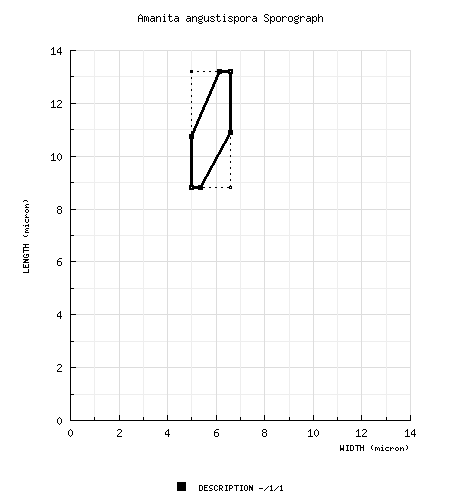
from revision of lectotype by Reid (1980): [-/1/1] 8.8 - 13.2 × (4.5-) 5.0 - 6.6 μm, (est. Q = 1.65 - 2.15; est. Q = 1.90), amyloid, elongate to cylindric; apiculus sublateral (per figures); contents not described; color in deposit not described. [Note: An estimated range of Q is necessary in order to have an approximate sporograph.—ed.] from Grgurinovic (1997): [46/-/2] 9.6 - 13.6 × 5.5 - 7.9 μm, (L' = 11.9 μm; W' = 6.4 μm; Q' = 1.80), amyloid, elongate; apiculus sublateral and cylindric (per figure); content not described; color in deposit unknown. [Note: The spores measured come from two of four collections of which two were original material. Without unpublished information, it cannot be known whether any, some, or all of the spore measurements came from original material; hence, the data are presented in black type.—ed.] [Note: We have not estimated a range for Q based on the (Grgurinovic 1997) spore data for this species in order to prevent automatic generation of a sporograph that we believe would be misleading. We evaluated the Amanita spore length and width ranges from (Grgurinovic 1997) in comparison to comparable data published by other authors and often based on revision of the same specimens. This experiment involved a total of 19 descriptions of a total of 13 species from the work of 3 authors. In a range of the form "x - y" of spore length (width) from (Grgurinovic 1997) compared to a range of the form (a-) b - c (-d) of spore length (width) in the other works, the value of "y" was compared to the value of "c" as a ratio. In the case of spore length ranges, on average (per author), the ratio y/c ranged from 1.06 - 1.10 (possibly due to the non-segregation of a "d" value in the ranges of concern). In the case of spore width ranges, on average (per author), the ratio ranged from 1.14 - 1.23 (indicating the probability of compounding causes at play—possibly, the absence of the "d" value in the ranges of concern and failure to restrict spore measurement to spores strictly presenting in lateral view). When sporographs were attempted from the Grgurinovic data, the results were not useful.—ed.] | ||||||||||||||||||||
| ecology | from protolog: In sandy soil. | ||||||||||||||||||||
| material examined |
from (Reid 1980): AUSTRALIA: SOUTH AUSTRALIA—Encounter Bay, 26.viii.1927 J. B. Cleland s.n. (lectotype, ADW 9193 p.p. => AD 3008 p.p.?). non-lectotype material considered by Reid (1980): AUSTRALIA: SOUTH AUSTRALIA—Encounter Bay, 8.v.1926 J. B. Cleland s.n. (orig. matl., ADW 9192 => AD ), 10.ix.1927 J. B. Cleland s.n. (orig. matl., ADW 9193 p.p. => AD 3008 p.p.); Encounter Bay, Halls Crk., 23.v.1931 J. B. Cleland s.n. (ADW 9196 => AD 3459). [Note: Identifying dates and numbers based in part on data from (Grgurinovic 1997).] from Grgurinovic (1997): AUSTRALIA: SOUTH AUSTRALIA—Encounter Bay, 26.viii.1927 J. B. Cleland s.n. (lectotype, ADW 9193 p.p. => AD 3008 p.p.?), 10.xi.1927 J. B. Cleland s.n. (paratype, ADW 9193 p.p. => AD 3008 p.p.); Encounter Bay, Halls Creek, 23.5.1931 J. B. Cleland s.n. (ADW 9196 => AD 3459). Sturt Co. - Kinchina, 1.viii.1925 J. B. Cleland s.n. (AD 3460). [Note: There are a number of reasons to find this set of material examined confusing. First it appears that ADW 9193, which was separated into its two separately collected components by Reid so that one could be designated the lectotype, has been reassembled into a single collection to the whole of which the term "lectotype" is applied. Second, an AD accession number followed by a semicolon (punctuation not otherwise used in the paragraph)—"AD 3458;"—is inserted between "Encounter Bay" and the description for what appears to be the recombined collection. We will attempt to obtain clarification.] | ||||||||||||||||||||
| discussion |
In the past, this taxon was treated as belonging in section Amidella; however, a true bulb with limbate volval remains excludes A. angustispora from that section. It is the editor's view that this taxon belongs in section Lepidella. Unfortunately, we know nothing of the structure of the volval limb described for the bulb of the present species. If this limb were to have an exterior layer dominated by hyphae (a "submembranous" outer layer per Bas (1969: 528), then, because of the occasional clamps at bases of basidia, this taxon might be assignable to Bas' stirps Limbatula of subsection Limbatulae Bas. If such an outer layer were not present on the universal veil, then this taxon would be assignable to subsection Solitariae Bas. The crust-like remnants of the universal veil on the pileus of the present species and the presence of clamps on its basidia would strongly suggest placement in Bas' stirps Grossa in which it would be extremely close to A. subalbida. Indeed, the two taxa appear strikingly similar based on what is known of them. The following figure compares sporographs of A. subalbida and A. angustispora: Because of the striking similarity to A. subalbida and to promote research into the anatomy of the present species, the editor has provisionally placed this species in stirps Grossa. | ||||||||||||||||||||
| citations | —R. E. Tulloss | ||||||||||||||||||||
| editors | RET | ||||||||||||||||||||
Information to support the viewer in reading the content of "technical" tabs can be found here.
 Spore data sets and their composite
Each spore data set is intended to comprise a set of measurements from a single specimen made by a single observer; and explanations prepared for this site talk about specimen-observer pairs associated with each data set. Combining more data into a single data set is non-optimal because it obscures observer differences (which may be valuable for instructional purposes, for example) and may obscure instances in which a single collection inadvertently contains a mixture of taxa.

Text and User-Generated Sporographs are published under the Creative Commons License.

In the case of a taxon page, image credits are on the 'image' tab.