
| name | Amanita angustilamellata |
| name status | nomen acceptum |
| author | (Höhn.) Boedijn |
| english name | "von Höhnel's Ringless Amanita" |
| images |
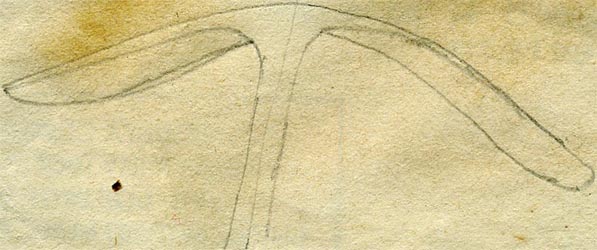  1. Amanita angustilamellata, drawing with type collection (FH), from Tjibodas, Java, Indonesia. 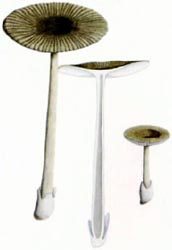 2. Amanita angustilamellata, Singapore. 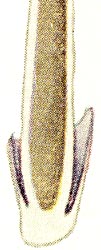 3. Amanita angustilamellata, Singapore. |
| intro | The following is based on the description by Boedijn (1951) and the original description by von Höhnel (1914. Sitzungsber. Kaiserl. Akad. Wiss. Wien, Math.-Naturwiss. Kl., Abt. I 123: 74). |
| cap | The cap of A. angustilamellata is 40 - 90 mm wide, smoke brown, darkest in the center (original description) or gray, darkest in the center about "drab", gradually fading to light drab to smoky-gray towards the margin (Boedijn), convex to plano-convex, sometimes with a slightly subumbonate, matte, with a sulcate-striate margin (about 50% of the radius). The volva is either absent or present as a few large, white patches. The flesh is thin, white, 2 - 3 mm thick over the stem, and rapidly thinning toward the margin. |
| gills | The gills are free, white or about pale pinkish buff, 3 - 7 mm broad in the middle. |
| stem | The stem is 90 - 125 × 7 - 15 mm, narrowing upward, dirty white to whitish, hollow, nearly smooth, with some indistinct dark fibrils near the base. The diameter of the stuffed part of the stem is up to 11 mm wide. The saccate volva is attached to the stem only at the base and 45 -51 × 12- 14 mm. |
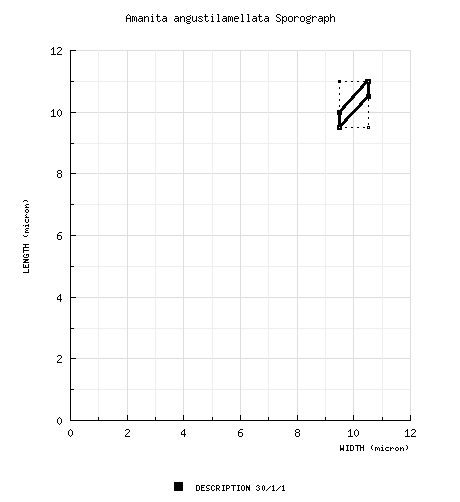
| spores | The spores measure 9 - 12 µm in length and are globose according to Boedijn. According to Corner and Bas (1962) the spores from Singapore material measured 11 - 13 (-15) µm and are "globulose" and inamyloid. Z. L. Yang's unpublished study of the type (Farlow Herbarium) yielded these measurements: 11.0 - 14.0 (-15.0) × (10.0-) 10.5 - 13.0 (-14.5) µm, globose to subglobose. Yang (1997) reported the following spore data from southwestern Chinese material: (9.0-) 9.5 - 11.0 (-12.0) × (8.0-) 9.5 - 10.5 (-11.5) µm, globose or (infrequently) subglobose and inamyloid. Yang reports that clamps are absent at bases of basidia. |
| discussion |
This species was originally described from Java (Indonesia) and has since then been reported from Singapore, Sri Lanka, Thailand, and southwestern China (Yang). Variations in spore measurements suggest that not all the material studied falls into a single species. However, sample sizes are so small that no conclusion can be drawn.—R. E. Tulloss |
| brief editors | RET |

 Spore data sets and their composite