

| name | Amanita albifimbriata |
| name status | nomen acceptum |
| author | O. K. Mill. |
| english name | "Miller's Lonesome Lepidella" |
| intro | The following is based on the original description of Miller (1992). |
| cap |
The cap of Amanita albifimbriata is 65 - 80 mm wide, broadly convex to planar, sometimes slightly depressed in the center with age, ivory white, glistening, moist but not viscid, with a nonstriate and appendiculate margin. The volval remnants are present as easily removed, superficial, detersile, white warts clustered over the center, more scattered toward the margin. The margin extends over [?beyond the ends of?] the gills. The flesh is firm and white. |
| gills |
The gills are nearly free, close, pure white to cream color in age; the short gills are present in two tiers. |
| stem | The stem is 75 - 85 × 7 - 17 mm, cylindric or slightly expanded at the top, with scattered, white, sticky fibrillose material below the ring. The basal bulb is napiform, appearing vertically compressed, marginate to obscurely marginate, 18 - 25 × 26 - 32 mm, with a [downward-]tapering blunt base. The flesh is firm and white. The volva is present as a thin, white membrane, with a free margin. |
| odor/taste |
Odor of old hambones or old tennis shoes, notably in all stages of development. |
| spores |
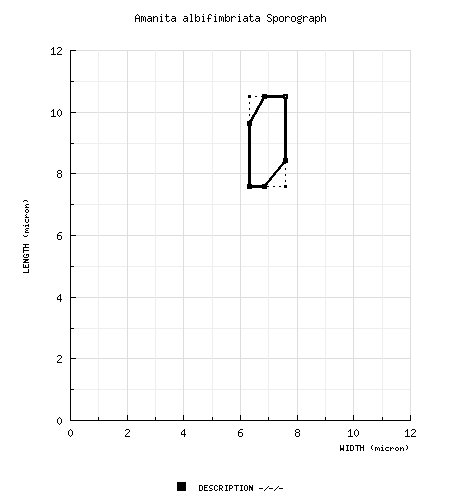
The spores measure 7.6 - 10.5 × (5.4-) 6.3 - 7.6 (-8) µm and are subglobose to broadly ellipsoid to ellipsoid and amyloid. Clamps are absent at bases of basidia. |
| discussion |
Originally described from the state of Western Australia, often in association with Eucalyptus and with Xanthorroea in the under story. As Miller indicates, placement of A. albifimbriata within section Lepidella is not resolved using the key of Bas (1969). The combination of distinct warts on the pileus with distinctive membranous volval remains on the stipe bulb makes the entity difficult to place. The spores are simply too small and too round to fit in Bas' stirps Preissii and pointed warts on the cap are also unknown in that stirps. On the other hand, a distinctly membranous, limbate volva combined with a clampless basidia does not really find a home other than stirps Preissii. We're left with the choice of leaving the species unclassified in Bas' system, creating a new stirps in which to place it, or placing it in stirps Pressii, which Bas already considered heterogeneous. The first choice seems most appropriate at this time.—R. E. Tulloss |
| brief editors | RET |
| name | Amanita albifimbriata | ||||||||||||||||||||
| author | O. K. Mill. 1992a [“1991”]. Canad. J. Bot. 69: 2695, figs. 12-15, 46. | ||||||||||||||||||||
| name status | nomen acceptum | ||||||||||||||||||||
| english name | "Miller's Lonesome Lepidella" | ||||||||||||||||||||
| variant spellings | albofimbriata | ||||||||||||||||||||
| MycoBank nos. | 358167 [as A. albofimbriata] | ||||||||||||||||||||
| GenBank nos. |
Due to delays in data processing at GenBank, some accession numbers may lead to unreleased (pending) pages.
These pages will eventually be made live, so try again later. Search:
Showing 0 to 0 of 0 entries | ||||||||||||||||||||
| holotypes | PERTH; isotype, VPI | ||||||||||||||||||||
| intro |
The following text may make multiple use of each data field. The field may contain magenta text presenting data from a type study and/or revision of other original material cited in the protolog of the present taxon. Macroscopic descriptions in magenta are a combination of data from the protolog and additional observations made on the exiccata during revision of the cited original material. The same field may also contain black text, which is data from a revision of the present taxon (including non-type material and/or material not cited in the protolog). Paragraphs of black text will be labeled if further subdivision of this text is appropriate. Olive text indicates a specimen that has not been thoroughly examined (for example, for microscopic details) and marks other places in the text where data is missing or uncertain. The following material is derived from the protolog of the present species. | ||||||||||||||||||||
| pileus | from protolog: 65 - 80 mm wide, ivory white, broadly convex to plane or slightly depressed in center with age, glistening, moist, but not viscid; context firm, white, unchanging; margin nonstriate, appendiculate at first, overlapping outer ends of lamellae resulting in distinctive sterile margin 2.5 - 3.5 mm broad; universal veil as easily removed superficial, detersile, white warts, 2 - 3 mm wide, 1 - 2 mm high, clustered over disc, more scattered toward margin, absent in immediate area of margin. | ||||||||||||||||||||
| lamellae | from protolog: nearly free, adnate by narrow attachment, close, pure white to cream color in age, broad in center, with clearly fimbriate edge remaining pure white even in age; lamellulae "irregular," in two tiers. | ||||||||||||||||||||
| stipe | from protolog: 75 - 85 × 7 - 17 mm wide, (width measured near apex), pure white, cylindric, sometimes slightly enlarged at apex, with mealy remains of partial veil forming irregular annular zone at first but often missing in age, below bearing scattered sticky fibrils of either partial veil or universal veil remnants; bulb napiform, marginate to obscurely marginate, 18 - 25 × 26 - 32 mm, tapered to blunt base, covered with soil; context firm white, unchanging; universal veil [originally described as part of bulb context—ed.] forming thin white layer over bulb and contributing to marginate appearance of bulb, distinguishable from bulb context in cross-section. | ||||||||||||||||||||
| odor/taste | from protolog: Odor of old ham bones or old tennis shoes in all stages of development. Taste not recorded. | ||||||||||||||||||||
| macrochemical tests |
none recorded. | ||||||||||||||||||||
| pileipellis | from protolog: 190 - 350 µm thick; a mixocutis composed of interwoven filamentous hyphae (3 -) 4 - 9 µm wide, thin-walled, hyaline in KOH and light yellowish in Melzer’s solution. | ||||||||||||||||||||
| pileus context | from protolog: filamentous hyphae 5 - 30 (- 40) µm wide, thin-walled, hyaline in KOH and ochraceous in Melzer’s solution; acrophysalides present [per reported widths of "hyphae"—ed.]; clamps absent. | ||||||||||||||||||||
| lamella trama | from protolog: divergent; filamentous hyphae dominant, 4 - 13 µm wide, hyaline in KOH and yellowish in Melzer’s solution; inflated elements present; clamps absent. | ||||||||||||||||||||
| subhymenium | from protolog: as cellular layer of hyaline, predominantly isodiametric cells 6 - 13 µm wide; clamps absent. | ||||||||||||||||||||
| basidia | from protolog: 49 - 53 × 9 - 11 µm clavate, thin-walled, hyaline, 4-sterigmate; clamps absent. | ||||||||||||||||||||
| universal veil | from protolog: [On pileus ?—ed.] filamentous hyphae 2 - 5 µm wide, dominating, hyaline, thin-walled; inflated cells abundant, globose to clavate, 33 - 50 × 22 - 35 µm, thin-walled, usually terminal, clamps absent. | ||||||||||||||||||||
| stipe context | not described. | ||||||||||||||||||||
| lamella edge tissue | from protolog: inflated cells abundant, pyriform to clavate, 25 - 44 × 9 - 13 µm, thin-walled, hyaline. [Note: This tissue misdescribed by Miller as "cheilocystidia."—ed.] | ||||||||||||||||||||
| basidiospores | from protolog: [-/-/-] 7.6 - 10.5 × (5.4-) 6.3 - 7.6 (-8.0) μm, (Q = 1.11 - 1.53; Q' = 1.32), thin-walled, amyloid, subglobose to broadly ellipsoid to ellipsoid; apiculus "hyaline"; contents not described; white in deposit. [Note: The word "hyaline" is provided as the description of the apiculus because that is the sole descriptive term provided for the apiculus in the protolog. The reader should be aware that the apiculus in the Amanitaceae is always hyaline and never participates in the amyloid reaction of the remainder of the spore wall. Hence, "hyaline" normally does not appear in the description of the apiculus.—ed.] | ||||||||||||||||||||
| ecology | from protolog: Solitary or in small groups, "often buried, sometimes up to three-fourths of total height." "Usually associated with marri (Eucalyptus calophylla), often with scattered Xanthorrhoea preissii Endl. in the understory." | ||||||||||||||||||||
| material examined |
from protolog: AUSTRALIA: WESTERN AUSTRALIA—Town of Busselton - Ludlow, | ||||||||||||||||||||
| discussion | from protolog: "Most specimens do not have the partial veil in place at maturity. The remains of the partial veil could be seen around the fruiting bodies on the soil and several fruiting bodies had a very distinct annular zone." | ||||||||||||||||||||
| citations |
The editors express their thanks to Dr. Elaine Davison for her assistance with Western Australia geographical and other data relating to Miller's original materials of this taxon. —R. E. Tulloss | ||||||||||||||||||||
| editors | RET | ||||||||||||||||||||
Information to support the viewer in reading the content of "technical" tabs can be found here.
| name | Amanita albifimbriata |
| bottom links |
[ Keys & Checklists ] [ Australia/New Zealand List ] |
| name | Amanita albifimbriata |
| bottom links |
[ Keys & Checklists ] [ Australia/New Zealand List ] |
 Spore data sets and their composite
Each spore data set is intended to comprise a set of measurements from a single specimen made by a single observer; and explanations prepared for this site talk about specimen-observer pairs associated with each data set. Combining more data into a single data set is non-optimal because it obscures observer differences (which may be valuable for instructional purposes, for example) and may obscure instances in which a single collection inadvertently contains a mixture of taxa.

Text and User-Generated Sporographs are published under the Creative Commons License.

In the case of a taxon page, image credits are on the 'image' tab.