| name |
Amanita advena |
| author |
Tulloss, Ovrebo & Halling. 1992. Mem. New York Bot. Gard. 66: 19, figs. 13-15, 3 |
| name status |
nomen acceptum |
| english name |
"Newcomer Lepidella" |
| etymology |
advena, "stranger"
The species belongs to a stirps very rarely represented in South America. |
| MycoBank nos. |
359391 |
| GenBank nos. |
Due to delays in data processing at GenBank, some accession numbers may lead to unreleased (pending) pages.
These pages will eventually be made live, so try again later.
|
| holotypes |
HUA; isotype, NY |
| revisions |
Tulloss, here |
| intro |
The following text may make multiple use of each data field.
The field may contain magenta text presenting data from a type study
and/or revision of other original material cited in the protolog of the present taxon.
Macroscopic descriptions in magenta are a combination of data from the protolog and
additional observations made on the exiccata during revision of the cited original
material.
The same field may also contain black text, which is data from a revision of the present
taxon (including non-type material and/or material not cited in the protolog).
Paragraphs of black text will be labeled if further subdivision of
this text is appropriate.
Olive text indicates a specimen that has not been
thoroughly examined (for example, for microscopic details) and marks other places in the text
where data is missing or uncertain.
The following material not directly from the protolog is based on original research by R. E. Tulloss. |
| pileus |
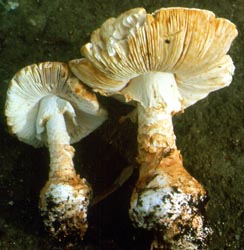
85 - 120 mm diam., whitish to light buff when young, becoming tinged with cinnamon in time, not otherwise discoloring, viscid when moist, in maturity broadly convex to slightly concave, dry, becoming areolate; context whitish buff, 10? mm thick; margin nonstriate, appendiculate, decurved at first, becoming rimose; universal veil as flattened to slightly erumpant, large warts to small patches, at times in concentric rings, white at first, then browning. |
| lamellae |
free, close, light cream, becoming dingy ochraceous in age near pileus margin, 8 - 11 mm broad, with edge strongly fimbriate; lamellulae numerous. |
| stipe |
110 - 130 × 15 - 25 mm, buff, becoming cinnamon above basal bulb, narrowing upward, surface scabrous in places, also breaking into scales; bulb ovoid, tapering to rounded point, white mycelial "threads" present on lower third; context
??; partial veil at very apex, white, then browning in spots, membranous to submembranous, striate above, smooth below, margin thickened, becoming lacerate; universal veil remains whitish at first, browning, in series of obscure rings from slightly above top of bulb to below broadest part of bulb. |
| odor/taste |
Odor slightly putrid. Taste indistinct. |
macrochemical
tests |
3% KOH - light ochraceous on stipe, faintly yellow on less mature pileus. Test voucher: holotype. |
| pileipellis |
yellowish brown to nearly colorless, rather thin, 30 - 90 µm thick, only gelatinizing at surface; filamentous, undifferentiated hyphae 1.5 - 10.0 µm wide, branching, subradially oriented, interwoven; vascular hyphae 2.8 - 9.5 µm wide, branching, locally plentiful. |
| pileus context |
filamentous, undifferentiated hyphae 2.5 - 14.5 µm wide, branching; acrophysalides subglobose to ovoid to clavate to ellipsoid to elongate, dominant, up to 86 × 64 µm; vascular hyphae 4? µm wide, scarce. |
| lamella trama |
bilateral, divergent; wcs = 50?? µm (poor to moderate rehydration); subhymenial tree as branching structure of inflated and partially inflated cells, more frequently inflated in subhymenium than in subhymenial base; filamentous, undifferentiated hyphae 1.2 - 11.5 µm wide, branching, with some segments partially inflated (up to 18.0 µm wide), occasionally loosely coiling locally, sometimes with yellowish subrefractive walls; inflated cells ellipsoid to elongate to clavate to pyriform, up to 71 × 49 µm; branching vascular hyphae reported originally as "2.2 - 6.2 µm wide, common, locally plentiful in knots," not observed in 1995 review; clamps present. |
| subhymenium |
wst-near = 45+ - 55+ µm (moderate to good rehydration); wst-far = 70+ - 80+ µm (moderate to good rehydration); locally appearing cellular (pseudoparenchymatous), branching structure evident in other regions, with basidia arising from subglobose and clavate inflated cells and from partially inflated hyphal segments. |
| basidia |
(28-) 41 - 63 × 11.0 - 17.5 (-27) µm, dominantly 4-sterigmate, also 3-, 2-, and occasionally 1-sterigmate; clamps and proliferated clamps present. |
| universal veil |
On pileus: gelatinizing on top and bottom surfaces; becoming orange-brown in some regions on upper surface of wart, but always browner than adjacent pileipellis; alignment of elements subvertical; filamentous, undifferentiated hyphae 1.8 - 15.0 µm wide, branching, interwoven, constricted at septa when of larger diam., rather plentiful near upper surface, dominant near bottom surface; inflated cells plentiful, thin-walled, single when terminal, subglobose to subpyriform to clavate to elongate, up to 122 × 53 µm; vascular hyphae present, branching, 1.8 - 8.5 µm wide. On stipe base and upper bulb: with same pigmentation as on pileus, with elements more often collapsed, but of very similar shapes and sizes to those on pileus; orientation of elements not discernible; inflated cells up to 107 × 70 µm; vascular hyphae scarce. |
| stipe context |
longitudinally acrophysalidic; filamentous, undifferentiated hyphae 1.0 - 14.0 µm wide, branching; acrophysalides plentiful to dominant, up to 278 × 84 µm; vascular hyphae 2.5 - 12.5 µm wide, branching, locally in dense tangles and knots; clamps present. |
| partial veil |
filamentous, undifferentiated hyphae 4.8 - 13.5 µm wide, branching, often with subradial orientation, with narrow diameter elements having unconstricted septa and long segments, with larger diameter elements having constricted septa and relatively short segments; inflated cells terminal, relatively common, clavate to broadly clavate, to 94 × 47 µm; vascular hyphae 1.5 - 5.5 µm wide, scarce. |
| lamella edge tissue |
not described |
| basidiospores |
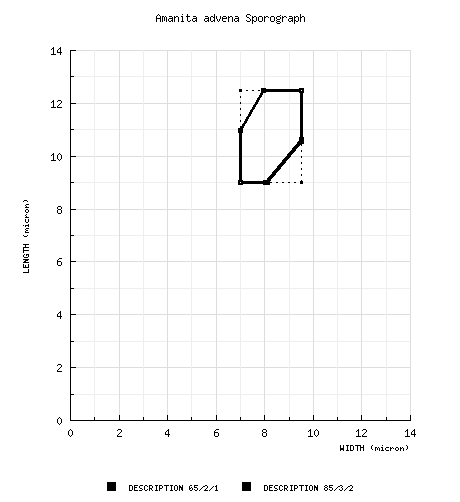
from isotype: [65/2/1] (8.5-) 9.0 - 12.5 (-14.0) ×: (6.5-) 7.0 - 9.5 (-10.2) μm, (L = 10.5 - 10.7 μm; L' = 10.6 μm; W = 8.2 - 8.3 μm; W' = 8.2 μm; Q = (1.10-) 1.11 - 1.57 (-1.62); Q = 1.24 - 1.31; Q' = 1.30), hyaline, colorless, smooth, thin-walled, amyloid, subglobose to broadly ellipsoid to ellipsoid, sometimes swollen at one end, more or less adaxially flattened; apiculus sublateral, cylindric or (occaionally) truncate-conic; contents granular to guttulate; color in deposit unknown.
Composite from all material examined: [85/3/2] (9.5-) 9.0 - 12.5 (-14.0) × (6.5-) 7.0 - 9.5 (-10.2) μm, (L = 10.5 - 10.8 μm; L' = 10.6 μm; W
= 8.2 - 8.3 μm; W' = 8.2 μm;
Q = (1.10-) 1.12 - 1.57 (-1.62); Q = 1.29 - 1.32; Q' = 1.30). |
| ecology |
Subgregarious to gregarious. Colombia: at 2500? - 3000 m elev. In Quercus humboldtii forest. Costa Rica: In forest including Q. seemannii and Q. copeyensis. |
| material examined |
COLOMBIA: ANTIOQUIA—Mpio. San José de la Montaña - along rd. from San José de la Montaña to Labores, 26.xi.1986 C. L. Ovrebo 2547 (holotype, HUA; isotype, NY).
COSTA RICA: SAN JOSÉ—Ctn. Dota - San Gerardo de Dota no. 1, 5± km SW of Cerro de la Muerte, Albergue de Montaña Savegre (Cabinas Chacón) [9°33’2” N/ 83°48’27” W,
2200 to ca. 2350 m], 28.vi.1998 R. E. Halling, R. H. Petersen, J. Cifuentes, J. L. Mata [Halling] 7773 (NY). |
| discussion |
t.b.d. |
| citations |
—R. E. Tulloss |
| editors |
RET |
|



 Spore data sets and their composite